

Lung disease
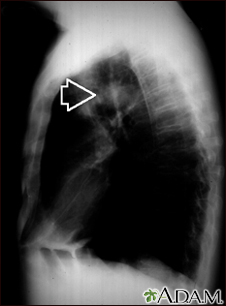
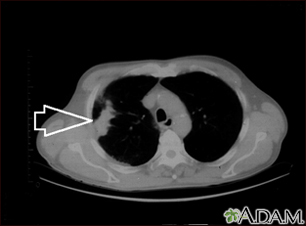
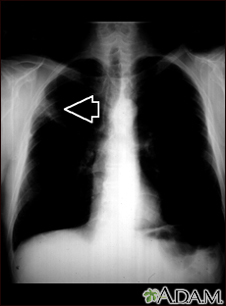
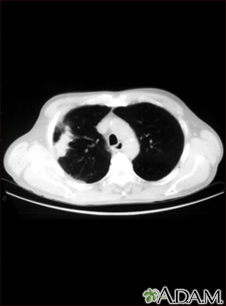
Lung disease is any problem in the lungs that prevents the lungs from working properly. There are three main types of lung disease:
- Airway diseases -- These diseases affect the tubes (airways) that carry oxygen and other gases into and out of the lungs. They usually cause a narrowing or blockage of the airways. Airway diseases include asthma, chronic obstructive pulmonary disease (COPD), bronchiolitis, and bronchiectasis (which also is the main disorder for persons with cystic fibrosis). People with airway diseases often say they feel as if they're "trying to breathe out through a straw."
- Lung tissue diseases -- These diseases affect the structure of the lung tissue. Scarring or inflammation of the tissue makes the lungs unable to expand fully (restrictive lung disease). This makes it hard for the lungs to take in oxygen and release carbon dioxide. People with this type of lung disorder often say they feel as if they are "wearing a too-tight sweater or vest." As a result, they can't breathe deeply. Pulmonary fibrosis and sarcoidosis are examples of lung tissue disease.
- Lung circulation diseases -- These diseases affect the blood vessels in the lungs. They are caused by clotting, scarring, or inflammation of the blood vessels. They affect the ability of the lungs to take up oxygen and release carbon dioxide. These diseases may also affect heart function. An example of a lung circulation disease is pulmonary hypertension. People with these conditions often feel very short of breath when they exert themselves.
Many lung diseases involve a combination of these three types.
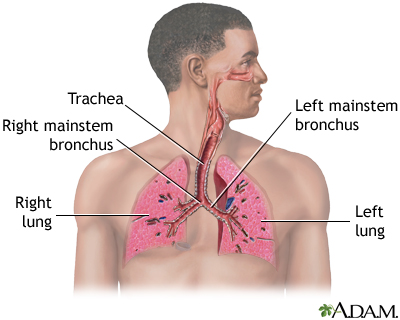
Respiratory system
Air is breathed in through the nasal passageways, travels through the trachea and bronchi to the lungs.
The most common lung diseases include:
- Asthma
- Collapse of part or all of the lung (pneumothorax or atelectasis)
- Swelling and inflammation in the main passages (bronchial tubes) that carry air to the lungs (bronchitis)
- COPD
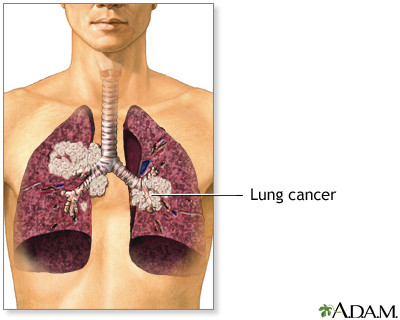
- Lung cancer
Lung cancer
Lung cancer is cancer that starts in the lungs. The lungs are located in the chest. When you breathe, air goes through your nose, down your windpipe...
 ImageRead Article Now Book Mark Article
 - Lung infection (pneumonia)
- Abnormal buildup of fluid in the lungs (pulmonary edema)
- Blocked lung artery (pulmonary embolus)
Reviewed By
Allen J. Blaivas, DO, Division of Pulmonary, Critical Care, and Sleep Medicine, VA New Jersey Health Care System, Clinical Assistant Professor, Rutgers New Jersey Medical School, East Orange, NJ. Review provided by VeriMed Healthcare Network. Also reviewed by David C. Dugdale, MD, Medical Director, Brenda Conaway, Editorial Director, and the A.D.A.M. Editorial team.
Clifton IJ, Ellames DAB. Respiratory medicine. In: Penman ID, Ralston SH, Strachan MWJ, Hobson RP, eds. Davidson's Principles and Practice of Medicine. 24th ed. Philadelphia, PA: Elsevier; 2023:chap 17.
Kraft M. Approach to the patient with respiratory disease. In: Goldman L, Cooney KA, eds. Goldman-Cecil Medicine. 27th ed. Philadelphia, PA: Elsevier; 2024:chap 71.
Disclaimer
© 1997- A.D.A.M., a business unit of Ebix, Inc. Any duplication or distribution of the information contained herein is strictly prohibited.