
Nasogastric feeding tube

Tube feeding
Schedule an Appointment
Definition
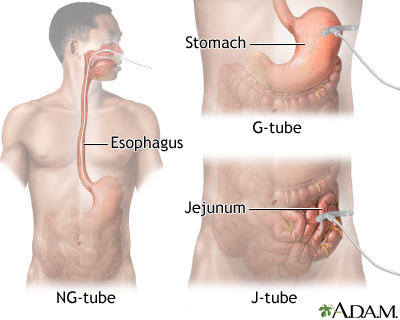
A nasogastric tube (NG tube) is a special tube that carries food and medicine to the stomach through the nose. It can be used for all feedings or for giving a person extra calories.
You'll learn to take good care of the tubing and the skin around the nostrils so that the skin (or nasal passages) don't get irritated.
Follow any specific instructions your health care provider gives you. Use the information below as a reminder of what to do.
What to Expect at Home
If your child has an NG tube, try to keep your child from touching or pulling on the tube.
After your nurse teaches you how to flush the tube and perform skin care around the nose, set up a daily routine for these tasks.
Flushing the Tube
Flushing the tube helps release any formula stuck to the inside of the tube. Flush the tube after each feeding, or as often as your nurse recommends.
- First, wash your hands well with soap and water.
- After the feeding is finished, add warm water to the feeding syringe and let it flow by gravity.
- If the water does not go through, try changing positions a bit or attach the plunger to the syringe, and gently push the plunger part-way. Do not press all the way down or press fast.
- Remove the syringe.
- Close the NG tube cap.
Taking Care of the Skin
Follow these general guidelines:
- Clean the skin around the tube with warm water and a clean washcloth after each feeding. Remove any crust or secretions in the nose.
- When removing a bandage or dressing from the nose, loosen it first with a bit of mineral oil or other lubricant. Then gently remove the bandage or dressing. Afterward, wash the mineral oil off the nose.
- If you notice redness or irritation, try putting the tube in the other nostril, if your nurse taught you how to do this.
When to Call the Doctor
Contact your provider if any of the following occur:
- There is redness, swelling, and irritation in both nostrils
- The tube keeps getting clogged and you are unable to unclog it with water
- The tube falls out
- Vomiting
- Your stomach is bloated
References
Cederholm TE, Bosaeus IG. Malnutrition: assessment and support. In: Goldman L, Cooney KA, eds. Goldman-Cecil Medicine. 27th ed. Philadelphia, PA: Elsevier; 2024:chap 198.

Review Date: 10/11/2024
Reviewed By: Frank D. Brodkey, MD, FCCM, Associate Professor, Section of Pulmonary and Critical Care Medicine, University of Wisconsin School of Medicine and Public Health, Madison, WI. Also reviewed by David C. Dugdale, MD, Medical Director, Brenda Conaway, Editorial Director, and the A.D.A.M. Editorial team.
The information provided herein should not be used during any medical emergency or for the diagnosis or treatment of any medical condition. A licensed medical professional should be consulted for diagnosis and treatment of any and all medical conditions. Links to other sites are provided for information only -- they do not constitute endorsements of those other sites. No warranty of any kind, either expressed or implied, is made as to the accuracy, reliability, timeliness, or correctness of any translations made by a third-party service of the information provided herein into any other language.
© 1997-
A.D.A.M., a business unit of Ebix, Inc. Any duplication or distribution of the information contained herein is strictly prohibited.
All content on this site including text, images, graphics, audio, video, data, metadata, and compilations is protected by copyright and other intellectual property laws. You may view the content for personal, noncommercial use. Any other use requires prior written consent from Ebix. You may not copy, reproduce, distribute, transmit, display, publish, reverse-engineer, adapt, modify, store beyond ordinary browser caching, index, mine, scrape, or create derivative works from this content. You may not use automated tools to access or extract content, including to create embeddings, vectors, datasets, or indexes for retrieval systems. Use of any content for training, fine-tuning, calibrating, testing, evaluating, or improving AI systems of any kind is prohibited without express written consent. This includes large language models, machine learning models, neural networks, generative systems, retrieval-augmented systems, and any software that ingests content to produce outputs. Any unauthorized use of the content including AI-related use is a violation of our rights and may result in legal action, damages, and statutory penalties to the fullest extent permitted by law. Ebix reserves the right to enforce its rights through legal, technological, and contractual measures.
 All rights reserved