
Small bowel bacterial overgrowth

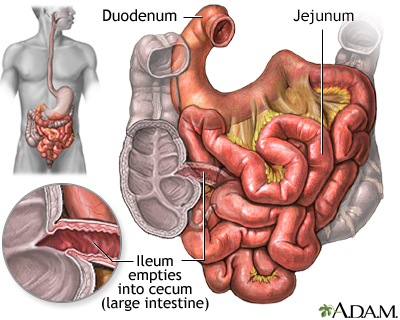
Small intestine
Schedule an Appointment
Definition
Small bowel bacterial overgrowth is a condition in which very large numbers of bacteria grow in the small intestine.
Causes
Most of the time, unlike the large intestine, the small intestine does not have a large number of bacteria. Excess bacteria in the small intestine may use up the nutrients needed by the body. As a result, a person may become malnourished.
The breakdown of nutrients by the excess bacteria can also damage the lining of the small intestine. This can make it even harder for the body to absorb nutrients.
Conditions that can lead to overgrowth of bacteria in the small intestine include:
- Complications of diseases or surgery that create pouches or blockages in the small intestine. Crohn disease is one of these conditions.
- Diseases that lead to decreased movement of the small bowel, such as diabetes and scleroderma.
- Immunodeficiency, such as AIDS or immunoglobulin deficiency.
- Short bowel syndrome caused by surgical removal of the small intestine.
- Small bowel diverticulosis, in which small, or, at times, large sacs occur in the wall of the intestine. These sacs allow too many bacteria to grow.
- Surgical procedures that create a loop of small intestine where excess bacteria can grow. An example is a Billroth II type of stomach removal (gastrectomy).
- Some cases of irritable bowel syndrome (IBS).
Symptoms
The most common symptoms are:
- Abdominal fullness
- Abdominal pain and cramps
- Bloating
- Diarrhea (most often watery)
- Gassiness
Other symptoms may include:
- Fatty stool
- Weight loss
Exams and Tests
Your health care provider will perform a physical exam and ask about your medical history. Tests may include:
- Blood chemistry tests (such as albumin level)
- Complete blood count (CBC)
- Fecal fat test
- Small intestine endoscopy
- Vitamin levels in the blood
- Small intestine biopsy or culture
- Special breath tests
Treatment
The goal is to treat the cause of the bacterial overgrowth. Treatment may include:
- Antibiotics
- Medicines that speed intestinal movement
- Intravenous (IV) fluids
- Nutrition given through a vein (total parenteral nutrition or TPN) in a malnourished person
A lactose-free diet can be helpful.
Possible Complications
Severe cases lead to malnutrition. Other possible complications include:
- Dehydration
- Excess bleeding or other problems due to vitamin deficiency
- Liver disease
- Osteomalacia or osteoporosis
- Inflammation of the intestine
References
Lacy BE, DiBaise JK. Small intestinal bacterial overgrowth. In: Feldman M, Friedman LS, Brandt LJ, eds. Sleisenger and Fordtran's Gastrointestinal and Liver Disease. 11th ed. Philadelphia, PA: Elsevier; 2021:chap 105.
Semrad CE. Approach to the patient with diarrhea and malabsorption. In: Goldman L, Cooney KA, eds. Goldman-Cecil Medicine. 27th ed. Philadelphia, PA: Elsevier; 2024:chap 126.

Review Date: 5/14/2024
Reviewed By: Jenifer K. Lehrer, MD, Department of Gastroenterology, Aria - Jefferson Health Torresdale, Jefferson Digestive Diseases Network, Philadelphia, PA. Review provided by VeriMed Healthcare Network. Also reviewed by David C. Dugdale, MD, Medical Director, Brenda Conaway, Editorial Director, and the A.D.A.M. Editorial team.
The information provided herein should not be used during any medical emergency or for the diagnosis or treatment of any medical condition. A licensed medical professional should be consulted for diagnosis and treatment of any and all medical conditions. Links to other sites are provided for information only -- they do not constitute endorsements of those other sites. No warranty of any kind, either expressed or implied, is made as to the accuracy, reliability, timeliness, or correctness of any translations made by a third-party service of the information provided herein into any other language.
© 1997-
A.D.A.M., a business unit of Ebix, Inc. Any duplication or distribution of the information contained herein is strictly prohibited.
All content on this site including text, images, graphics, audio, video, data, metadata, and compilations is protected by copyright and other intellectual property laws. You may view the content for personal, noncommercial use. Any other use requires prior written consent from Ebix. You may not copy, reproduce, distribute, transmit, display, publish, reverse-engineer, adapt, modify, store beyond ordinary browser caching, index, mine, scrape, or create derivative works from this content. You may not use automated tools to access or extract content, including to create embeddings, vectors, datasets, or indexes for retrieval systems. Use of any content for training, fine-tuning, calibrating, testing, evaluating, or improving AI systems of any kind is prohibited without express written consent. This includes large language models, machine learning models, neural networks, generative systems, retrieval-augmented systems, and any software that ingests content to produce outputs. Any unauthorized use of the content including AI-related use is a violation of our rights and may result in legal action, damages, and statutory penalties to the fullest extent permitted by law. Ebix reserves the right to enforce its rights through legal, technological, and contractual measures.
 All rights reserved