

Surgeries, Tests And Treatments
More <
bookmarks-menu

Urinary catheters - what to ask your doctor

Show Alternative Names
What to ask your doctor about urinary catheters

You have an indwelling catheter (tube) in your bladder. This means the tube is inside your body. This catheter drains urine from your bladder into a bag outside your body.

Below are some questions you may want to ask your health care provider to help you take care of your catheter.

Questions

How do I take care of the skin around the catheter? How often should I clean the area?

How much water or liquid should I be drinking?

Can I take a shower? How about a bath? Can I swim?

Can I walk around or exercise with the catheter in place?

What supplies do I need to keep in my home to care of my catheter? Where can I get them? How much do they cost?

How often do I need to empty the urine bag? How do I do that? Do I need to wear gloves?

How often do I need to clean the urine bag or catheter? How do I do that?

What do I do if there is blood in my urine? If my urine is cloudy? If my urine has an odor?

If I use a leg bag, how often do I need to change it? How do I empty it when I am in a public bathroom?

Should I switch to a larger bag for nighttime? How do I change this kind of bag?

What do I do if the catheter comes out or off?

What do I do if the catheter stops draining? What if it leaks?

What are the signs that I have an infection?

Review Date: 9/2/2024

Reviewed By

Kelly L. Stratton, MD, FACS, Associate Professor, Department of Urology, University of Oklahoma Health Sciences Center, Oklahoma City, OK. Also reviewed by David C. Dugdale, MD, Medical Director, Brenda Conaway, Editorial Director, and the A.D.A.M. Editorial team.

References

Boone TB, Stewart JN, Martinez LM. Additional therapies for storage and emptying failure. In: Partin AW, Dmochowski RR, Kavoussi LR, Peters CA, eds. Campbell-Walsh-Wein Urology. 12th ed. Philadelphia, PA: Elsevier; 2021:chap 127.

Vetrosky DT. Urinary bladder catheterization. In: Dehn R, Asprey D, eds. Essential Clinical Procedures. 4th ed. Philadelphia, PA: Elsevier; 2021:chap 30.

Disclaimer

The information provided herein should not be used during any medical emergency or for the diagnosis or treatment of any medical condition. A licensed medical professional should be consulted for diagnosis and treatment of any and all medical conditions. Links to other sites are provided for information only -- they do not constitute endorsements of those other sites. No warranty of any kind, either expressed or implied, is made as to the accuracy, reliability, timeliness, or correctness of any translations made by a third-party service of the information provided herein into any other language.

© 1997- A.D.A.M., a business unit of Ebix, Inc. Any duplication or distribution of the information contained herein is strictly prohibited.
All content on this site including text, images, graphics, audio, video, data, metadata, and compilations is protected by copyright and other intellectual property laws. You may view the content for personal, noncommercial use. Any other use requires prior written consent from Ebix. You may not copy, reproduce, distribute, transmit, display, publish, reverse-engineer, adapt, modify, store beyond ordinary browser caching, index, mine, scrape, or create derivative works from this content. You may not use automated tools to access or extract content, including to create embeddings, vectors, datasets, or indexes for retrieval systems. Use of any content for training, fine-tuning, calibrating, testing, evaluating, or improving AI systems of any kind is prohibited without express written consent. This includes large language models, machine learning models, neural networks, generative systems, retrieval-augmented systems, and any software that ingests content to produce outputs. Any unauthorized use of the content including AI-related use is a violation of our rights and may result in legal action, damages, and statutory penalties to the fullest extent permitted by law. Ebix reserves the right to enforce its rights through legal, technological, and contractual measures.

All
Videos
Images
Bladder catheterization - female - Illustration Thumbnail

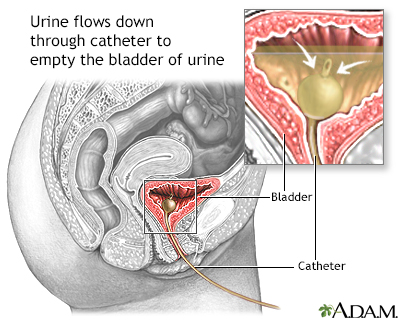
Bladder catheterization - female

A catheter (a hollow tube, often with an inflatable balloon tip) may be inserted into the urinary bladder when there is a urinary obstruction, following surgical procedures to the urethra, in unconscious patients (due to surgical anesthesia, coma, or other reasons), or for any other problem in which the bladder needs to be kept empty (decompressed) and urinary flow assured. The balloon holds the catheter in place for a duration of time.

Illustration

Bladder catheterization - male - Illustration Thumbnail

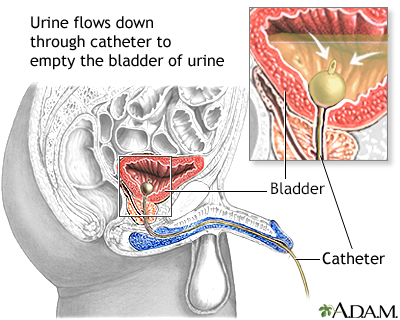
Bladder catheterization - male

Catheterization is accomplished by inserting a catheter (a hollow tube, often with and inflatable balloon tip) into the urinary bladder. This procedure is performed for urinary obstruction, following surgical procedures to the urethra, in unconscious patients (due to surgical anesthesia, coma, or other reasons), or for any other problem in which the bladder needs to be kept empty (decompressed) and urinary flow assured. The balloon holds the catheter in place for a duration of time. Catheterization in males is slightly more difficult and uncomfortable than in females because of the longer urethra.

Illustration

Bladder catheterization - female - Illustration Thumbnail

Bladder catheterization - female

A catheter (a hollow tube, often with an inflatable balloon tip) may be inserted into the urinary bladder when there is a urinary obstruction, following surgical procedures to the urethra, in unconscious patients (due to surgical anesthesia, coma, or other reasons), or for any other problem in which the bladder needs to be kept empty (decompressed) and urinary flow assured. The balloon holds the catheter in place for a duration of time.

Illustration

Bladder catheterization - male - Illustration Thumbnail

Bladder catheterization - male

Catheterization is accomplished by inserting a catheter (a hollow tube, often with and inflatable balloon tip) into the urinary bladder. This procedure is performed for urinary obstruction, following surgical procedures to the urethra, in unconscious patients (due to surgical anesthesia, coma, or other reasons), or for any other problem in which the bladder needs to be kept empty (decompressed) and urinary flow assured. The balloon holds the catheter in place for a duration of time. Catheterization in males is slightly more difficult and uncomfortable than in females because of the longer urethra.

Illustration


The information provided herein should not be used during any medical emergency or for the diagnosis or treatment of any medical condition. A licensed medical professional should be consulted for diagnosis and treatment of any and all medical conditions. Links to other sites are provided for information only -- they do not constitute endorsements of those other sites. No warranty of any kind, either expressed or implied, is made as to the accuracy, reliability, timeliness, or correctness of any translations made by a third-party service of the information provided herein into any other language.

© 1997- A.D.A.M., a business unit of Ebix, Inc. Any duplication or distribution of the information contained herein is strictly prohibited.

All content on this site including text, images, graphics, audio, video, data, metadata, and compilations is protected by copyright and other intellectual property laws. You may view the content for personal, noncommercial use. Any other use requires prior written consent from Ebix. You may not copy, reproduce, distribute, transmit, display, publish, reverse-engineer, adapt, modify, store beyond ordinary browser caching, index, mine, scrape, or create derivative works from this content. You may not use automated tools to access or extract content, including to create embeddings, vectors, datasets, or indexes for retrieval systems. Use of any content for training, fine-tuning, calibrating, testing, evaluating, or improving AI systems of any kind is prohibited without express written consent. This includes large language models, machine learning models, neural networks, generative systems, retrieval-augmented systems, and any software that ingests content to produce outputs. Any unauthorized use of the content including AI-related use is a violation of our rights and may result in legal action, damages, and statutory penalties to the fullest extent permitted by law. Ebix reserves the right to enforce its rights through legal, technological, and contractual measures.
© 1997- adam.com All rights reserved.