
Hepatic vein obstruction (Budd-Chiari)

Definition
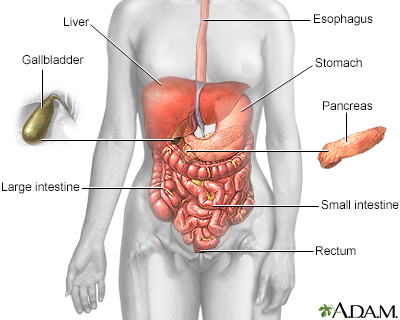
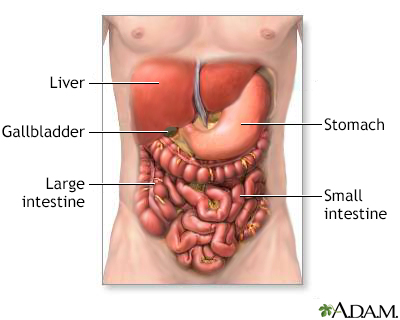
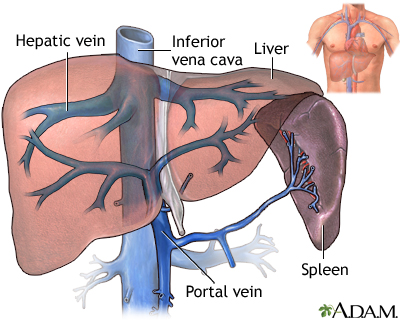
Hepatic vein obstruction is a blockage of the hepatic vein, which carries blood away from the liver.
Causes
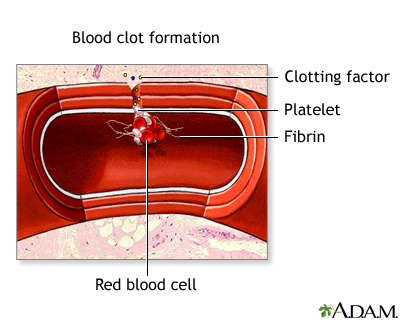
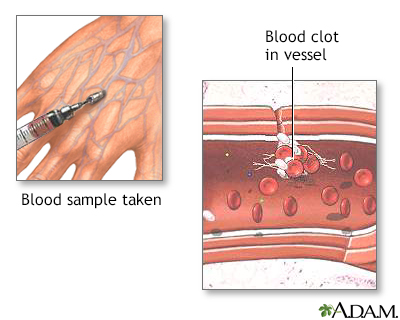
Hepatic vein obstruction prevents blood from flowing out of the liver and back to the heart. This blockage can cause liver damage. Obstruction of this vein can be caused by a tumor or growth pressing on the vessel, or by a clot in the vessel (hepatic vein thrombosis).
Most often, it is caused by conditions that make blood clots more likely to form, including:
- Abnormal growth of cells in the bone marrow (myeloproliferative disorders)
- Cancers
- Chronic inflammatory or autoimmune diseases
- Infections
- Inherited (hereditary) or acquired problems with excessive blood clotting
- Oral contraceptives
- Pregnancy
Hepatic vein blockage is the most common cause of Budd-Chiari syndrome.
Symptoms
Symptoms include:
- Abdominal swelling or stretching due to fluid in the abdomen
- Pain in the right upper abdomen
- Vomiting blood
- Yellowing of the skin (jaundice)
Exams and Tests
One of the signs is swelling of the abdomen from fluid buildup (ascites). The liver is often swollen and tender.
Tests include:
- CT scan or MRI of the abdomen
- Doppler ultrasound of the liver veins
- Liver biopsy
- Liver function tests
- Ultrasound of the liver
Treatment
Treatment varies, depending on the cause of the blockage.
Your health care provider may recommend the following medicines:
- Blood thinners (anticoagulants)
- Clot-busting medicines (thrombolytic treatment)
- Medicines to treat the liver disease, including ascites
Surgery may be recommended. This may involve:
- Angioplasty and stent placement
- Transjugular intrahepatic portosystemic shunt (TIPS)
- Venous shunt surgery
- Liver transplant
Possible Complications
Hepatic vein obstruction can get worse and lead to cirrhosis and liver failure. This can be life threatening.
When to Contact a Medical Professional
Contact your provider if:
- You have symptoms of hepatic vein obstruction
- You are being treated for this condition and you develop new symptoms
References
Kahi CJ. Vascular diseases of the gastrointestinal tract. In: Goldman L, Cooney KA, eds. Goldman-Cecil Medicine. 27th ed. Philadelphia, PA: Elsevier; 2024:chap 129.
Nery FG, Valla DC. Vascular diseases of the liver. In: Feldman M, Friedman LS, Brandt LJ, eds. Sleisenger and Fordtran's Gastrointestinal and Liver Disease. 11th ed. Philadelphia, PA: Elsevier; 2021:chap 85.

Review Date: 5/14/2024
Reviewed By: Jenifer K. Lehrer, MD, Department of Gastroenterology, Aria - Jefferson Health Torresdale, Jefferson Digestive Diseases Network, Philadelphia, PA. Review provided by VeriMed Healthcare Network. Also reviewed by David C. Dugdale, MD, Medical Director, Brenda Conaway, Editorial Director, and the A.D.A.M. Editorial team.
The information provided herein should not be used during any medical emergency or for the diagnosis or treatment of any medical condition. A licensed medical professional should be consulted for diagnosis and treatment of any and all medical conditions. Links to other sites are provided for information only -- they do not constitute endorsements of those other sites. No warranty of any kind, either expressed or implied, is made as to the accuracy, reliability, timeliness, or correctness of any translations made by a third-party service of the information provided herein into any other language.
© 1997-
A.D.A.M., a business unit of Ebix, Inc. Any duplication or distribution of the information contained herein is strictly prohibited.
All content on this site including text, images, graphics, audio, video, data, metadata, and compilations is protected by copyright and other intellectual property laws. You may view the content for personal, noncommercial use. Any other use requires prior written consent from Ebix. You may not copy, reproduce, distribute, transmit, display, publish, reverse-engineer, adapt, modify, store beyond ordinary browser caching, index, mine, scrape, or create derivative works from this content. You may not use automated tools to access or extract content, including to create embeddings, vectors, datasets, or indexes for retrieval systems. Use of any content for training, fine-tuning, calibrating, testing, evaluating, or improving AI systems of any kind is prohibited without express written consent. This includes large language models, machine learning models, neural networks, generative systems, retrieval-augmented systems, and any software that ingests content to produce outputs. Any unauthorized use of the content including AI-related use is a violation of our rights and may result in legal action, damages, and statutory penalties to the fullest extent permitted by law. Ebix reserves the right to enforce its rights through legal, technological, and contractual measures.
 All rights reserved