
Newborn jaundice - what to ask your doctor

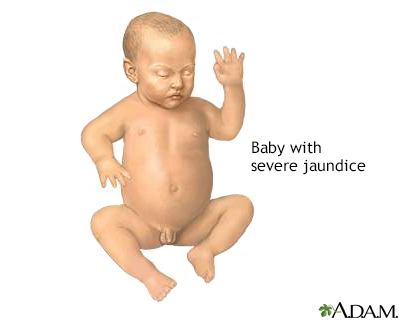
Infant jaundice
Schedule an Appointment
Definition
Newborn jaundice is a common condition. It is caused by high levels of bilirubin (a yellow coloring) in your child's blood. This can make your child's skin and sclera (the whites of their eyes) look yellow. Your child may go home with some jaundice or may develop jaundice after going home.
Below are some questions you may want to ask your health care provider about your child's jaundice.
Questions
- What causes jaundice in a newborn child?
- How common is newborn jaundice?
- Will the jaundice harm my child?
- What are the treatments for jaundice?
- How long does it take for the jaundice to go away?
- How can I tell if the jaundice is getting worse?
- How often should I feed my child?
- What should I do if I am having trouble breastfeeding?
- Does my child need blood transfusions for the jaundice?
- Does my child need light therapy for the jaundice? Can this be done at home?
- How do I arrange to have light therapy at home? Who do I call if I am having problems with the light therapy?
- Do I need to use light therapy all day and night? How about when I am holding or feeding my child?
- Can the light therapy harm my child?
- When do we need to have a follow-up visit with my child's provider?
References
Kaplan M, Wong RJ, Bensen R, Sibley E, Stevenson DK. Neonatal jaundice and liver disease. In: Martin RJ, Fanaroff AA, eds. Fanaroff and Martin's Neonatal-Perinatal Medicine. 12th ed. Philadelphia, PA: Elsevier; 2025:chap 95.
Kliegman RM. Digestive system disorders. In: Kliegman RM, St. Geme JW, Blum NJ, et al, eds. Nelson Textbook of Pediatrics. 22nd ed. Philadelphia, PA: Elsevier; 2025:chap 134.
Rozance PJ, Wright CJ. The neonate. In: Landon MB, Galan HL, Jauniaux ERM, et al, eds. Gabbe's Obstetrics: Normal and Problem Pregnancies. 9th ed. Philadelphia, PA: Elsevier; 2025:chap 25.

Review Date: 1/17/2025
Reviewed By: Charles I. Schwartz, MD, FAAP, Clinical Assistant Professor of Pediatrics, Perelman School of Medicine at the University of Pennsylvania, General Pediatrician at PennCare for Kids, Phoenixville, PA. Also reviewed by David C. Dugdale, MD, Medical Director, Brenda Conaway, Editorial Director, and the A.D.A.M. Editorial team.
The information provided herein should not be used during any medical emergency or for the diagnosis or treatment of any medical condition. A licensed medical professional should be consulted for diagnosis and treatment of any and all medical conditions. Links to other sites are provided for information only -- they do not constitute endorsements of those other sites. No warranty of any kind, either expressed or implied, is made as to the accuracy, reliability, timeliness, or correctness of any translations made by a third-party service of the information provided herein into any other language.
© 1997-
A.D.A.M., a business unit of Ebix, Inc. Any duplication or distribution of the information contained herein is strictly prohibited.
All content on this site including text, images, graphics, audio, video, data, metadata, and compilations is protected by copyright and other intellectual property laws. You may view the content for personal, noncommercial use. Any other use requires prior written consent from Ebix. You may not copy, reproduce, distribute, transmit, display, publish, reverse-engineer, adapt, modify, store beyond ordinary browser caching, index, mine, scrape, or create derivative works from this content. You may not use automated tools to access or extract content, including to create embeddings, vectors, datasets, or indexes for retrieval systems. Use of any content for training, fine-tuning, calibrating, testing, evaluating, or improving AI systems of any kind is prohibited without express written consent. This includes large language models, machine learning models, neural networks, generative systems, retrieval-augmented systems, and any software that ingests content to produce outputs. Any unauthorized use of the content including AI-related use is a violation of our rights and may result in legal action, damages, and statutory penalties to the fullest extent permitted by law. Ebix reserves the right to enforce its rights through legal, technological, and contractual measures.
