Health Topics, In-Depth Reports
More <
bookmarks-menu

Intestinal obstruction and Ileus

Show Alternative Names
Paralytic ileus
Intestinal volvulus
Bowel obstruction
Ileus
Pseudo-obstruction - intestinal
Colonic ileus
Small bowel obstruction

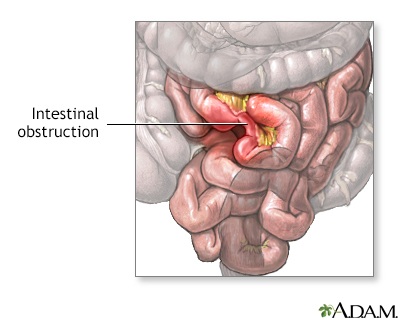
Intestinal obstruction is a partial or complete blockage of the bowel. The contents of the intestine cannot pass through it.

Causes

Obstruction of the bowel may be due to:

  • A mechanical cause, which means something is partially of fully blocking the bowel
  • Ileus, a condition in which the bowel does not work correctly, but there is no structural problem causing the obstruction

Paralytic ileus, also called pseudo-obstruction, is one of the major causes of intestinal obstruction in infants and children. Causes of paralytic ileus may include:

  • Bacteria or viruses that cause intestinal infections (gastroenteritis)
  • Chemical, electrolyte, or mineral imbalances (such as decreased blood potassium level)
  • Abdominal surgery
  • Decreased blood supply to the intestines
  • Infections inside the abdomen, such as appendicitis
  • Kidney or lung disease
  • Use of certain medicines, especially narcotics

Mechanical causes of intestinal obstruction may include:

  • Adhesions or scar tissue that form after surgery
  • Foreign bodies (objects that are swallowed and block the intestines)
  • Gallstones (rare)
  • Hernias
  • Impacted stool
  • Intussusception (telescoping of one segment of bowel into another)
  • Tumors blocking the intestines
  • Volvulus (twisted intestine)
  • Inflammatory diseases such as Crohn disease

Symptoms

Symptoms may include:

Exams and Tests

During a physical exam, the health care provider may find bloating, tenderness, or hernias in the abdomen.

Tests that show obstruction include:

  • Abdominal CT scan
  • Abdominal x-ray
  • Barium enema
  • Upper GI and small bowel series

Treatment

Treatment involves placing a tube through the nose into the stomach or intestine. This is to help relieve abdominal swelling (distention) and vomiting. Volvulus of the large bowel may be treated by passing a tube into the rectum.

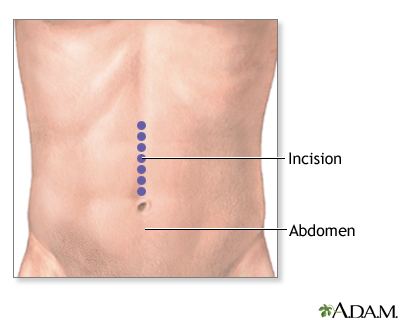
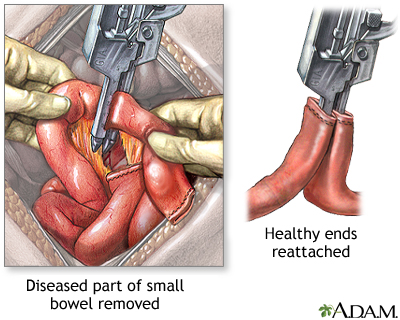
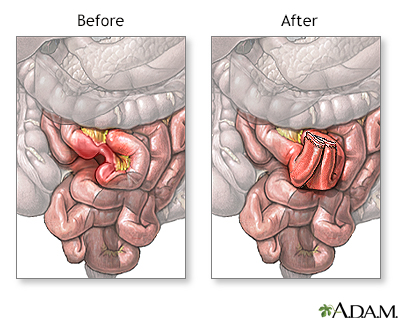
Surgery may be needed to relieve the obstruction if the tube does not relieve the symptoms. It may also be needed if there are signs of tissue death. If a tumor is causing a mechanical obstruction, surgery may be needed. Obstruction from inflammation such as Crohn disease may be treated with surgery, a procedure to dilate the narrow area, or medicine if inflammation is causing a blockage.

Outlook (Prognosis)

The outcome depends on the cause of the blockage. Most of the time, the cause is successfully treated.

Possible Complications

Complications may include or may lead to:

  • Electrolyte (blood chemical and mineral) imbalances
  • Dehydration
  • Hole (perforation) in the intestine
  • Infection
  • Jaundice (yellowing of the skin and eyes)

If the obstruction blocks the blood supply to the intestine, it may cause infection and tissue death (gangrene). Risks for tissue death are related to the cause of the blockage and how long it has been present. Hernias, volvulus, and intussusception carry a higher gangrene risk.

In a newborn, paralytic ileus that destroys the bowel wall (necrotizing enterocolitis) is a life-threatening condition. It may lead to blood and lung infections.

When to Contact a Medical Professional

Contact your provider if you:

  • Cannot pass stool or gas
  • Have a swollen abdomen (distention) that does not go away
  • Keep vomiting
  • Have unexplained abdominal pain that does not go away

Prevention

Prevention depends on the cause. Treating conditions, such as tumors and hernias that can lead to a blockage, may reduce your risk.

Some causes of obstruction cannot be prevented.

Review Date: 5/14/2024

Reviewed By

Jenifer K. Lehrer, MD, Department of Gastroenterology, Aria - Jefferson Health Torresdale, Jefferson Digestive Diseases Network, Philadelphia, PA. Review provided by VeriMed Healthcare Network. Also reviewed by David C. Dugdale, MD, Medical Director, Brenda Conaway, Editorial Director, and the A.D.A.M. Editorial team.

References

Galandiuk S, Netz U, Morpurgo S, et al. Colon and rectum. In: Townsend CM Jr, Beauchamp RD, Evers BM, Mattox KL, eds. Sabiston Textbook of Surgery. 21st ed. Philadelphia, PA: Elsevier; 2022:chap 52.

Gan T, Evers BM. Small intestine. In: Townsend CM Jr, Beauchamp RD, Evers BM, Mattox KL, eds. Sabiston Textbook of Surgery. 21st ed. Philadelphia, PA: Elsevier; 2022:chap 50.

Mustain WC, Turnage RH. Intestinal obstruction. In: Feldman M, Friedman LS, Brandt LJ, eds. Sleisenger and Fordtran's Gastrointestinal and Liver Disease. 11th ed. Philadelphia, PA: Elsevier; 2021:chap 123.

Disclaimer

The information provided herein should not be used during any medical emergency or for the diagnosis or treatment of any medical condition. A licensed medical professional should be consulted for diagnosis and treatment of any and all medical conditions. Links to other sites are provided for information only -- they do not constitute endorsements of those other sites. No warranty of any kind, either expressed or implied, is made as to the accuracy, reliability, timeliness, or correctness of any translations made by a third-party service of the information provided herein into any other language.

© 1997- A.D.A.M., a business unit of Ebix, Inc. Any duplication or distribution of the information contained herein is strictly prohibited.
All content on this site including text, images, graphics, audio, video, data, metadata, and compilations is protected by copyright and other intellectual property laws. You may view the content for personal, noncommercial use. Any other use requires prior written consent from Ebix. You may not copy, reproduce, distribute, transmit, display, publish, reverse-engineer, adapt, modify, store beyond ordinary browser caching, index, mine, scrape, or create derivative works from this content. You may not use automated tools to access or extract content, including to create embeddings, vectors, datasets, or indexes for retrieval systems. Use of any content for training, fine-tuning, calibrating, testing, evaluating, or improving AI systems of any kind is prohibited without express written consent. This includes large language models, machine learning models, neural networks, generative systems, retrieval-augmented systems, and any software that ingests content to produce outputs. Any unauthorized use of the content including AI-related use is a violation of our rights and may result in legal action, damages, and statutory penalties to the fullest extent permitted by law. Ebix reserves the right to enforce its rights through legal, technological, and contractual measures.

All
Videos
Images
Digestive system - Illustration Thumbnail

Digestive system

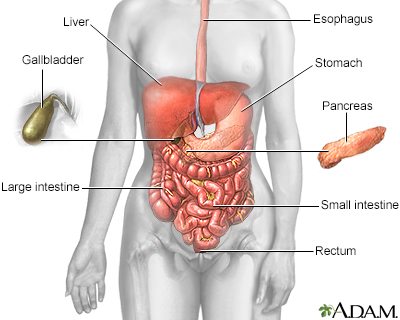
The esophagus, stomach, large and small intestine, aided by the liver, gallbladder and pancreas convert the nutritive components of food into energy and break down the non-nutritive components into waste to be excreted.

Illustration

Ileus - X-ray of distended bowel and stomach - Illustration Thumbnail

Ileus - X-ray of distended bowel and stomach

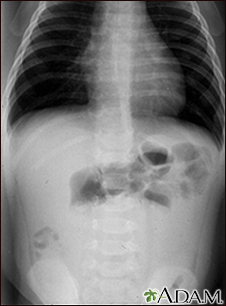
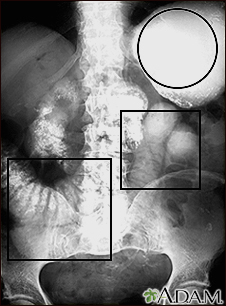
This abdominal X-ray shows a stomach filled with fluid and a swollen (distended) small bowel, caused by a blockage (pseudo-obstruction) in the intestines. A solution containing a dye (barium) that is visible on X-rays was swallowed by the patient (upper GI series).

Illustration

Ileus - X-ray of bowel distension - Illustration Thumbnail

Ileus - X-ray of bowel distension

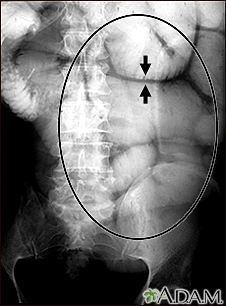
This abdominal x-ray shows thickening of the bowel wall and swelling (distention) caused by a blockage (pseudo-obstruction) in the intestines. A solution containing a dye (barium), which is visible on X-ray, was swallowed by the patient (the procedure is known as an upper GI series).

Illustration

Intussusception - X-ray - Illustration Thumbnail

Intussusception - X-ray

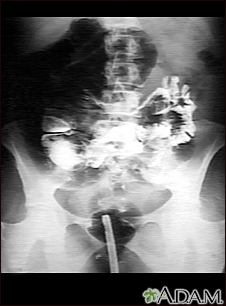
This abdominal x-ray shows an intestinal condition in which a loop of bowel has slipped into another section of bowel (intussusception), causing swelling, reduced blood flow, obstruction, and tissue damage. Intussusception requires emergency treatment (barium enema or surgery) to prevent intestinal tissue death (necrosis), intestinal perforation, peritonitis, and death.

Illustration

Volvulus - X-ray - Illustration Thumbnail

Volvulus - X-ray

A GI series in a patient with a twisted bowel (volvulus).

Illustration

Small bowel obstruction - X-ray - Illustration Thumbnail

Small bowel obstruction - X-ray

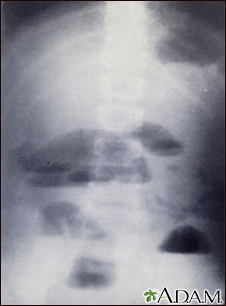
X-rays of the abdomen are important in diagnosing the presence of small bowel obstruction. When obstruction occurs, both fluid and gas collect in the intestine. They produce a characteristic pattern called "air-fluid levels". The air rises above the fluid and there is a flat surface at the "air-fluid" interface.

Illustration

Small bowel resection - series - Presentation Thumbnail

Small bowel resection - series

Presentation

 
Digestive system - Illustration Thumbnail

Digestive system

The esophagus, stomach, large and small intestine, aided by the liver, gallbladder and pancreas convert the nutritive components of food into energy and break down the non-nutritive components into waste to be excreted.

Illustration

Ileus - X-ray of distended bowel and stomach - Illustration Thumbnail

Ileus - X-ray of distended bowel and stomach

This abdominal X-ray shows a stomach filled with fluid and a swollen (distended) small bowel, caused by a blockage (pseudo-obstruction) in the intestines. A solution containing a dye (barium) that is visible on X-rays was swallowed by the patient (upper GI series).

Illustration

Ileus - X-ray of bowel distension - Illustration Thumbnail

Ileus - X-ray of bowel distension

This abdominal x-ray shows thickening of the bowel wall and swelling (distention) caused by a blockage (pseudo-obstruction) in the intestines. A solution containing a dye (barium), which is visible on X-ray, was swallowed by the patient (the procedure is known as an upper GI series).

Illustration

Intussusception - X-ray - Illustration Thumbnail

Intussusception - X-ray

This abdominal x-ray shows an intestinal condition in which a loop of bowel has slipped into another section of bowel (intussusception), causing swelling, reduced blood flow, obstruction, and tissue damage. Intussusception requires emergency treatment (barium enema or surgery) to prevent intestinal tissue death (necrosis), intestinal perforation, peritonitis, and death.

Illustration

Volvulus - X-ray - Illustration Thumbnail

Volvulus - X-ray

A GI series in a patient with a twisted bowel (volvulus).

Illustration

Small bowel obstruction - X-ray - Illustration Thumbnail

Small bowel obstruction - X-ray

X-rays of the abdomen are important in diagnosing the presence of small bowel obstruction. When obstruction occurs, both fluid and gas collect in the intestine. They produce a characteristic pattern called "air-fluid levels". The air rises above the fluid and there is a flat surface at the "air-fluid" interface.

Illustration

 - Presentation Thumbnail

Small bowel resection - series

Presentation


The information provided herein should not be used during any medical emergency or for the diagnosis or treatment of any medical condition. A licensed medical professional should be consulted for diagnosis and treatment of any and all medical conditions. Links to other sites are provided for information only -- they do not constitute endorsements of those other sites. No warranty of any kind, either expressed or implied, is made as to the accuracy, reliability, timeliness, or correctness of any translations made by a third-party service of the information provided herein into any other language.

© 1997- A.D.A.M., a business unit of Ebix, Inc. Any duplication or distribution of the information contained herein is strictly prohibited.
All content on this site including text, images, graphics, audio, video, data, metadata, and compilations is protected by copyright and other intellectual property laws. You may view the content for personal, noncommercial use. Any other use requires prior written consent from Ebix. You may not copy, reproduce, distribute, transmit, display, publish, reverse-engineer, adapt, modify, store beyond ordinary browser caching, index, mine, scrape, or create derivative works from this content. You may not use automated tools to access or extract content, including to create embeddings, vectors, datasets, or indexes for retrieval systems. Use of any content for training, fine-tuning, calibrating, testing, evaluating, or improving AI systems of any kind is prohibited without express written consent. This includes large language models, machine learning models, neural networks, generative systems, retrieval-augmented systems, and any software that ingests content to produce outputs. Any unauthorized use of the content including AI-related use is a violation of our rights and may result in legal action, damages, and statutory penalties to the fullest extent permitted by law. Ebix reserves the right to enforce its rights through legal, technological, and contractual measures.
© 1997- adam.com All rights reserved.