
Pancreatic pseudocyst

Definition
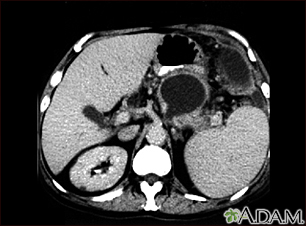
A pancreatic pseudocyst is a fluid-filled sac in the abdomen that arises from the pancreas. It may also contain tissue from the pancreas, enzymes, and blood.
Causes
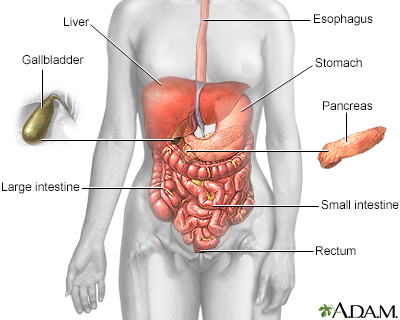
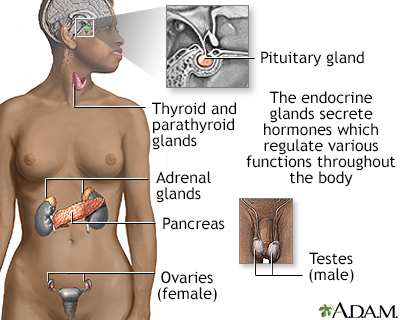
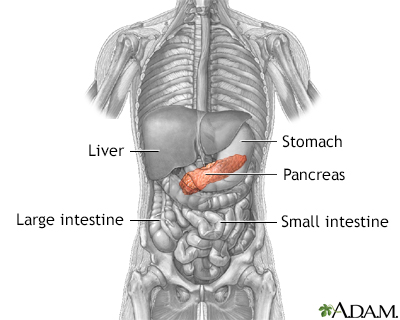
The pancreas is an organ located behind the stomach. It produces chemicals (called enzymes) needed to digest food. It also produces the hormones insulin and glucagon.
Pancreatic pseudocysts most often develop after an episode of severe pancreatitis. Pancreatitis happens when your pancreas gets inflamed. There are many causes of this problem.
This problem may sometimes occur:
- In someone with long-term (chronic) swelling of the pancreas (pancreatitis), most often due to alcohol abuse
- After trauma to the belly, more often in children
The pseudocyst happens when the ducts (tubes) in the pancreas are damaged and fluid with enzymes cannot drain.
Symptoms
Symptoms can occur within days to months after an attack of pancreatitis. They include:
- Bloating of the abdomen
- Constant pain or deep ache in the abdomen, which may also be felt in the back
- Nausea and vomiting
- Loss of appetite
- Difficulty eating and digesting food
Exams and Tests
The health care provider will feel your abdomen for a pseudocyst. It will feel like a lump in the middle or left upper abdomen.
Tests that may help detect pancreatic pseudocyst include:
- Abdominal CT scan
- Abdominal MRI
- Abdominal ultrasound
- Endoscopic ultrasound (EUS)
Treatment
Treatment depends on the size of the pseudocyst and whether it is causing symptoms. Many pseudocysts go away on their own. Those that remain for more than 6 weeks and are larger than 5 centimeters (about 2 inches) in diameter may need treatment. However, size and duration do not always mean treatment is needed, especially in a person without any symptoms and whose pseudocyst is not getting bigger.
Possible treatments include:
- Drainage through the skin using a needle, most often guided by a CT scan.
- Endoscopic-assisted drainage using an endoscope. In this, a tube containing a camera and a light is passed down into the stomach).
- Surgical drainage of the pseudocyst. A connection is made between the cyst and the stomach or small intestine. This may be done using a laparoscope.
Outlook (Prognosis)
The outcome is generally good with treatment. It is important to make sure that it is not a pancreatic cancer that starts in a cyst, which has a worse outcome.
Possible Complications
Complications may include:
- A pancreatic abscess can develop if the pseudocyst becomes infected.
- The pseudocyst can break open (rupture). This can be a serious complication because shock and excess bleeding (hemorrhage) may develop.
- The pseudocyst may press down on (compress) nearby organs.
When to Contact a Medical Professional
If you are known to have a pseudocyst, rupture of the pseudocyst is a medical emergency. Go to the emergency room or call 911 or the local emergency number if you develop symptoms of bleeding or shock, such as:
- Fainting
- Fever and chills
- Rapid heartbeat
- Severe abdominal pain
Prevention
The way to prevent pancreatic pseudocysts is by preventing pancreatitis. If pancreatitis is caused by gallstones, the provider will perform surgery to remove the gallbladder (cholecystectomy).
When pancreatitis occurs due to alcohol abuse, you must stop drinking alcohol to prevent future attacks.
When pancreatitis occurs due to high blood triglycerides, this condition should be treated.
References
Forsmark CE. Pancreatitis. In: Goldman L, Cooney KA, eds. Goldman-Cecil Medicine. 27th ed. Philadelphia, PA: Elsevier; 2024:chap 130.
Javed AA, Lafaro KJ. Pancreas: Management of pancreatic pseudocyst. In: Cameron J, ed. Current Surgical Therapy. 14th ed. Philadelphia, PA: Elsevier; 2023:539-650.
Van Buren G, Fisher WE. Acute and chronic pancreatitis. In: Kellerman RD, Rakel DP, Heidelbaugh JJ, Lee EM, eds. Conn's Current Therapy 2024. Philadelphia, PA: Elsevier; 2024:175-182.
Vege SS. Acute pancreatitis. In: Feldman M, Friedman LS, Brandt LJ, eds. Sleisenger and Fordtran's Gastrointestinal and Liver Disease: Pathophysiology/Diagnosis/Management. 11th ed. Philadelphia, PA: Elsevier; 2021:chap 58.

Review Date: 12/31/2023
Reviewed By: Jenifer K. Lehrer, MD, Department of Gastroenterology, Aria - Jefferson Health Torresdale, Jefferson Digestive Diseases Network, Philadelphia, PA. Review provided by VeriMed Healthcare Network. Also reviewed by David C. Dugdale, MD, Medical Director, Brenda Conaway, Editorial Director, and the A.D.A.M. Editorial team.
The information provided herein should not be used during any medical emergency or for the diagnosis or treatment of any medical condition. A licensed medical professional should be consulted for diagnosis and treatment of any and all medical conditions. Links to other sites are provided for information only -- they do not constitute endorsements of those other sites. No warranty of any kind, either expressed or implied, is made as to the accuracy, reliability, timeliness, or correctness of any translations made by a third-party service of the information provided herein into any other language.
© 1997-
A.D.A.M., a business unit of Ebix, Inc. Any duplication or distribution of the information contained herein is strictly prohibited.
All content on this site including text, images, graphics, audio, video, data, metadata, and compilations is protected by copyright and other intellectual property laws. You may view the content for personal, noncommercial use. Any other use requires prior written consent from Ebix. You may not copy, reproduce, distribute, transmit, display, publish, reverse-engineer, adapt, modify, store beyond ordinary browser caching, index, mine, scrape, or create derivative works from this content. You may not use automated tools to access or extract content, including to create embeddings, vectors, datasets, or indexes for retrieval systems. Use of any content for training, fine-tuning, calibrating, testing, evaluating, or improving AI systems of any kind is prohibited without express written consent. This includes large language models, machine learning models, neural networks, generative systems, retrieval-augmented systems, and any software that ingests content to produce outputs. Any unauthorized use of the content including AI-related use is a violation of our rights and may result in legal action, damages, and statutory penalties to the fullest extent permitted by law. Ebix reserves the right to enforce its rights through legal, technological, and contractual measures.
 All rights reserved