
Drug-induced diarrhea

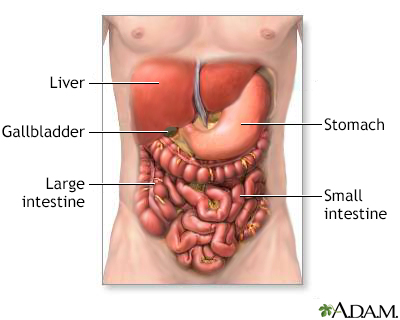
Digestive system organs
Schedule an Appointment
Definition
Drug-induced diarrhea is loose, watery stools that occur when you take certain medicines.
Causes
Nearly all medicines may cause diarrhea as a side effect. The medicines listed below, however, are more likely to cause diarrhea.
Laxatives are meant to cause diarrhea.
- They work either by drawing water into the gut or by causing the muscles of the intestines to contract.
- However, taking too much of a laxative can cause diarrhea that is a problem.
Antacids that have magnesium in them may also cause diarrhea or make it worse.
Antibiotics also can produce diarrhea.
- Normally, the intestines have many different bacteria. They keep each other in balance. Antibiotics destroy some of these bacteria, which allow other types to grow too much.
- In some cases, antibiotics can allow a type of bacteria called Clostridioides difficile to grow too much. This can lead to severe, watery, and often bloody diarrhea due to a condition called pseudomembranous colitis.
Many other drugs may cause diarrhea:
- Chemotherapy medicines used to treat cancer.
- Drugs used to treat heartburn and stomach ulcers, such as omeprazole (Prilosec), esomeprazole (Nexium), lansoprazole (Prevacid), dexlanxoprazole (Dexilant), rabeprazole (Aciphex), pantoprazole (Protonix), cimetidine (Tagamet), famotidine (Zantac 360 and Pepcid), and nizatidine (Axid). This is uncommon.
- Medicines that suppress the immune system (such as mycophenolate).
- Nonsteroidal anti-inflammatory drugs (NSAIDs) used to treat pain and arthritis, such as ibuprofen and naproxen.
- Metformin used to treat diabetes.
Some herbal teas contain senna or other "natural" laxatives that can cause diarrhea. Other vitamins, minerals, or supplements may also cause diarrhea.
Prevention
To prevent diarrhea due to antibiotic use, talk to your health care provider about taking supplements containing healthy bacteria (probiotics) and/or eating yogurt. Some of these products may reduce the risk for diarrhea. Keep taking these supplements for a few days after you finish your antibiotics.
References
Schiller LR, Sellin JH. Diarrhea. In: Feldman M, Friedman LS, Brandt LJ, eds. Sleisenger and Fordtran's Gastrointestinal and Liver Disease: Pathophysiology/Diagnosis/Management. 11th ed. Philadelphia, PA: Elsevier; 2021:chap 16.
Siddiqi HA, Rabinowitz S, Axiotis CA. Laboratory diagnosis of gastrointestinal and pancreatic disorders. In: McPherson RA, Pincus MR, eds. Henry's Clinical Diagnosis and Management by Laboratory Methods. 24th ed. Philadelphia, PA: Elsevier; 2022:chap 23.

Review Date: 12/31/2023
Reviewed By: Jenifer K. Lehrer, MD, Department of Gastroenterology, Aria - Jefferson Health Torresdale, Jefferson Digestive Diseases Network, Philadelphia, PA. Review provided by VeriMed Healthcare Network. Also reviewed by David C. Dugdale, MD, Medical Director, Brenda Conaway, Editorial Director, and the A.D.A.M. Editorial team.
The information provided herein should not be used during any medical emergency or for the diagnosis or treatment of any medical condition. A licensed medical professional should be consulted for diagnosis and treatment of any and all medical conditions. Links to other sites are provided for information only -- they do not constitute endorsements of those other sites. No warranty of any kind, either expressed or implied, is made as to the accuracy, reliability, timeliness, or correctness of any translations made by a third-party service of the information provided herein into any other language.
© 1997-
A.D.A.M., a business unit of Ebix, Inc. Any duplication or distribution of the information contained herein is strictly prohibited.
All content on this site including text, images, graphics, audio, video, data, metadata, and compilations is protected by copyright and other intellectual property laws. You may view the content for personal, noncommercial use. Any other use requires prior written consent from Ebix. You may not copy, reproduce, distribute, transmit, display, publish, reverse-engineer, adapt, modify, store beyond ordinary browser caching, index, mine, scrape, or create derivative works from this content. You may not use automated tools to access or extract content, including to create embeddings, vectors, datasets, or indexes for retrieval systems. Use of any content for training, fine-tuning, calibrating, testing, evaluating, or improving AI systems of any kind is prohibited without express written consent. This includes large language models, machine learning models, neural networks, generative systems, retrieval-augmented systems, and any software that ingests content to produce outputs. Any unauthorized use of the content including AI-related use is a violation of our rights and may result in legal action, damages, and statutory penalties to the fullest extent permitted by law. Ebix reserves the right to enforce its rights through legal, technological, and contractual measures.
 All rights reserved