
Gilbert syndrome

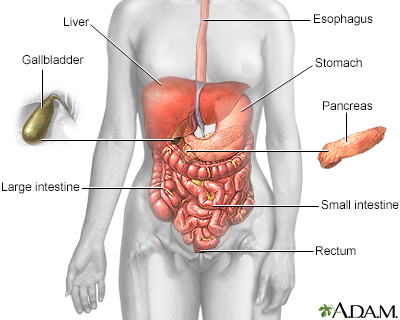
Digestive system
Schedule an Appointment
Definition
Gilbert syndrome is a common disorder passed down through families. It affects the way bilirubin is processed by the liver, and may cause the skin to take on a yellow color (jaundice) at times.
Causes
Gilbert syndrome affects 1 in 10 people in some white groups. This condition occurs due to an variant gene, which is passed from parents to their children.
Symptoms
Symptoms may include:
- Yellowing of the skin and whites of the eyes (mild jaundice)
In people with Gilbert syndrome, jaundice most often appears during times of exertion, stress, dehydration, menstruation, and infection, or when they do not eat.
Exams and Tests
A blood test for bilirubin shows changes that occur with Gilbert syndrome. The total bilirubin level is mildly elevated, with most being unconjugated bilirubin. Most often the total level is less than 2 mg/dL, and the conjugated bilirubin level is normal.
Gilbert syndrome is due to a genetic change, but genetic testing is not needed.
Treatment
No treatment is necessary for Gilbert syndrome.
Outlook (Prognosis)
Jaundice may come and go throughout life. It is more likely to appear during illnesses such as colds. It does not cause health problems. However, it can confuse the results of tests for jaundice.
Possible Complications
There are no known complications.
When to Contact a Medical Professional
Contact your health care provider if you have jaundice or pain in the abdomen that does not go away.
Prevention
There is no proven prevention.
References
Korenblat KM, Berk PD. Approach to the patient with jaundice or abnormal liver tests. In: Goldman L, Cooney KA, eds. Goldman-Cecil Medicine. 27th ed. Philadelphia, PA: Elsevier; 2024:chap 133.
Lidofsky SD. Jaundice. In: Feldman M, Friedman LS, Brandt LJ, eds. Sleisenger and Fordtran's Gastrointestinal and Liver Disease. 11th ed. Philadelphia, PA: Elsevier; 2021:chap 21.
Squires JE, Balistreri WF. Manifestations of liver disease. In: Kliegman RM, St. Geme JW, Blum NJ, et al, eds. Nelson Textbook of Pediatrics. 22nd ed. Philadelphia, PA: Elsevier; 2025:chap 403.

Review Date: 4/21/2025
Reviewed By: Todd Eisner, MD, Private practice specializing in Gastroenterology in Boca Raton and Delray Beach, Florida at Gastroenterology Consultants of Boca Raton. Affiliate Assistant Professor, Florida Atlantic University School of Medicine. Review provided by VeriMed Healthcare Network. Also reviewed by David C. Dugdale, MD, Medical Director, Brenda Conaway, Editorial Director, and the A.D.A.M. Editorial team.
The information provided herein should not be used during any medical emergency or for the diagnosis or treatment of any medical condition. A licensed medical professional should be consulted for diagnosis and treatment of any and all medical conditions. Links to other sites are provided for information only -- they do not constitute endorsements of those other sites. No warranty of any kind, either expressed or implied, is made as to the accuracy, reliability, timeliness, or correctness of any translations made by a third-party service of the information provided herein into any other language.
© 1997-
A.D.A.M., a business unit of Ebix, Inc. Any duplication or distribution of the information contained herein is strictly prohibited.
All content on this site including text, images, graphics, audio, video, data, metadata, and compilations is protected by copyright and other intellectual property laws. You may view the content for personal, noncommercial use. Any other use requires prior written consent from Ebix. You may not copy, reproduce, distribute, transmit, display, publish, reverse-engineer, adapt, modify, store beyond ordinary browser caching, index, mine, scrape, or create derivative works from this content. You may not use automated tools to access or extract content, including to create embeddings, vectors, datasets, or indexes for retrieval systems. Use of any content for training, fine-tuning, calibrating, testing, evaluating, or improving AI systems of any kind is prohibited without express written consent. This includes large language models, machine learning models, neural networks, generative systems, retrieval-augmented systems, and any software that ingests content to produce outputs. Any unauthorized use of the content including AI-related use is a violation of our rights and may result in legal action, damages, and statutory penalties to the fullest extent permitted by law. Ebix reserves the right to enforce its rights through legal, technological, and contractual measures.
 All rights reserved