
Hypophosphatemia

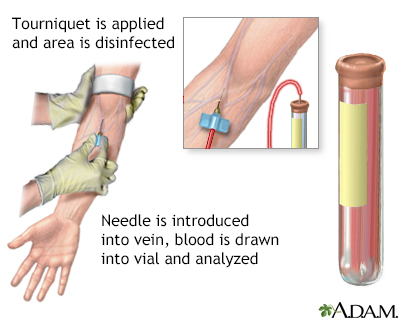
Blood test
Schedule an Appointment
Definition
Hypophosphatemia is a low level of phosphorus (phosphate) in the blood.
Causes
The following may cause hypophosphatemia:
- Alcoholism
- Antacids
- Certain medicines, including insulin, acetazolamide, foscarnet, imatinib, intravenous iron, niacin, pentamidine, sorafenib, and tenofovir
- Fanconi syndrome
- Fat malabsorption in the gastrointestinal tract
- Hyperparathyroidism (overactive parathyroid gland)
- Starvation
- Too little vitamin D
Symptoms
Symptoms may include:
- Bone pain
- Confusion
- Muscle weakness
- Seizures
Exams and Tests
Your health care provider will examine you.
The following tests may be done:
- Kidney function tests
- Parathyroid hormone level
- Vitamin D blood test
Exam and testing may show:
- Anemia due to too many red blood cells being destroyed (hemolytic anemia)
- Heart muscle damage (cardiomyopathy)
Treatment
Treatment depends on the cause. Phosphate can be given by mouth or through a vein (IV).
Outlook (Prognosis)
How well you do depends on what has caused the condition.
When to Contact a Medical Professional
Contact your provider if you have muscle weakness or confusion.
References
Chonchol M, Smogorzewski MJ, Stubbs, JR, Yu ASL. Disorders of calcium, magnesium, and phosphate balance. In: Yu ASL, Chertow GM, Luyckx VA, Marsden PA, Skorecki K, Taal MW, eds. Brenner and Rector's The Kidney. 11th ed. Philadelphia, PA: Elsevier; 2020:chap 18.
Klemm KM, Klein MJ, Zhang Y. Biochemical markers of bone metabolism. In: McPherson RA, Pincus MR, eds. Henry's Clinical Diagnosis and Management by Laboratory Methods. 24th ed. Philadelphia, PA: Elsevier; 2022:chap 16.
Yu ASL. Diseases of magnesium and phosphorus. In: Goldman L, Cooney KA, eds. Goldman-Cecil Medicine. 27th ed. Philadelphia, PA: Elsevier; 2024:chap 105.

Review Date: 12/31/2023
Reviewed By: Walead Latif, MD, Nephrologist and Clinical Associate Professor, Rutgers Medical School, Newark, NJ. Review provided by VeriMed Healthcare Network. Also reviewed by David C. Dugdale, MD, Medical Director, Brenda Conaway, Editorial Director, and the A.D.A.M. Editorial team.
The information provided herein should not be used during any medical emergency or for the diagnosis or treatment of any medical condition. A licensed medical professional should be consulted for diagnosis and treatment of any and all medical conditions. Links to other sites are provided for information only -- they do not constitute endorsements of those other sites. No warranty of any kind, either expressed or implied, is made as to the accuracy, reliability, timeliness, or correctness of any translations made by a third-party service of the information provided herein into any other language.
© 1997-
A.D.A.M., a business unit of Ebix, Inc. Any duplication or distribution of the information contained herein is strictly prohibited.
All content on this site including text, images, graphics, audio, video, data, metadata, and compilations is protected by copyright and other intellectual property laws. You may view the content for personal, noncommercial use. Any other use requires prior written consent from Ebix. You may not copy, reproduce, distribute, transmit, display, publish, reverse-engineer, adapt, modify, store beyond ordinary browser caching, index, mine, scrape, or create derivative works from this content. You may not use automated tools to access or extract content, including to create embeddings, vectors, datasets, or indexes for retrieval systems. Use of any content for training, fine-tuning, calibrating, testing, evaluating, or improving AI systems of any kind is prohibited without express written consent. This includes large language models, machine learning models, neural networks, generative systems, retrieval-augmented systems, and any software that ingests content to produce outputs. Any unauthorized use of the content including AI-related use is a violation of our rights and may result in legal action, damages, and statutory penalties to the fullest extent permitted by law. Ebix reserves the right to enforce its rights through legal, technological, and contractual measures.
 All rights reserved