
Bartter syndrome

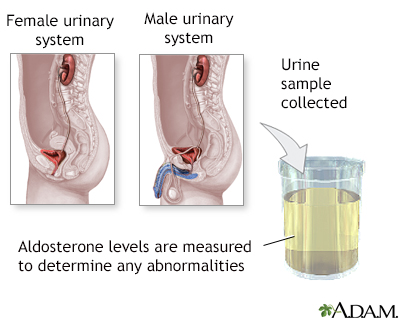
Aldosterone level test
Schedule an Appointment
Definition
Bartter syndrome is a group of rare conditions that affect the kidneys.
Causes
There are five gene defects known to be associated with Bartter syndrome. The condition is present at birth (congenital).
The condition is caused by a defect in the kidneys' ability to reabsorb sodium. People affected by Bartter syndrome lose too much sodium through the urine. This causes a rise in the level of the hormone aldosterone, and makes the kidneys remove too much potassium from the body. This is known as potassium wasting.
The condition also results in an abnormal acid balance in the blood called hypokalemic alkalosis, which causes too much calcium in the urine.
Symptoms
This disease usually occurs in childhood. Symptoms include:
- Constipation
- Less weight gain than other children of similar age and sex (growth failure)
- Frequent urination (urinary frequency)
- Low blood pressure
- Kidney stones
- Muscle cramping and weakness
Exams and Tests
Bartter syndrome is usually suspected when a blood test finds a low level of potassium in the blood. Unlike other forms of kidney disease, this condition does not cause high blood pressure. There is a tendency toward low blood pressure. Laboratory tests may show:
- High urine potassium, calcium, and chloride levels
- High blood levels of the hormones, renin and aldosterone
- Low blood chloride level
- Metabolic alkalosis
These same signs and symptoms can also occur in people who take too many diuretics (water pills) or laxatives. Urine tests can be done to rule out other causes.
An ultrasound of the kidneys may be done.
Treatment
Bartter syndrome is treated by eating foods rich in potassium or taking potassium supplements.
Many people also need salt and magnesium supplements. Medicine may be needed that blocks the kidney's ability to get rid of potassium. High doses of nonsteroidal anti-inflammatory drugs (NSAIDs) may also be used.
Outlook (Prognosis)
Infants who have severe growth failure may grow normally with treatment. Over time, some people with the condition will develop kidney failure.
When to Contact a Medical Professional
Contact your health care provider if your child is:
- Having muscle cramps
- Not growing well
- Urinating frequently
References
Guay-Woodford LM. Hereditary nephropathies and developmental renal/urinary abnormalities. In: Goldman L, Cooney KA, eds. Goldman-Cecil Medicine. 27th ed. Philadelphia, PA: Elsevier; 2024:chap 113.
Kliegman RM, St. Geme JW, Blum NJ, et al. Inherited tubular transport abnormalities: Bartter syndrome. In: Kliegman RM, St. Geme JW, Blum NJ, et al, eds. Nelson Textbook of Pediatrics. 22nd ed. Philadelphia, PA: Elsevier; 2025:chap 571.
Mount DB. Disorders of potassium balance. In: Yu ASL, Chertow GM, Luyckx VA, Marsden PA, Skorecki K, Taal MW, eds. Brenner and Rector's The Kidney. 11th ed. Philadelphia, PA: Elsevier; 2020:chap 17.

Review Date: 12/31/2023
Reviewed By: Walead Latif, MD, Nephrologist and Clinical Associate Professor, Rutgers Medical School, Newark, NJ. Review provided by VeriMed Healthcare Network. Also reviewed by David C. Dugdale, MD, Medical Director, Brenda Conaway, Editorial Director, and the A.D.A.M. Editorial team.
The information provided herein should not be used during any medical emergency or for the diagnosis or treatment of any medical condition. A licensed medical professional should be consulted for diagnosis and treatment of any and all medical conditions. Links to other sites are provided for information only -- they do not constitute endorsements of those other sites. No warranty of any kind, either expressed or implied, is made as to the accuracy, reliability, timeliness, or correctness of any translations made by a third-party service of the information provided herein into any other language.
© 1997-
A.D.A.M., a business unit of Ebix, Inc. Any duplication or distribution of the information contained herein is strictly prohibited.
All content on this site including text, images, graphics, audio, video, data, metadata, and compilations is protected by copyright and other intellectual property laws. You may view the content for personal, noncommercial use. Any other use requires prior written consent from Ebix. You may not copy, reproduce, distribute, transmit, display, publish, reverse-engineer, adapt, modify, store beyond ordinary browser caching, index, mine, scrape, or create derivative works from this content. You may not use automated tools to access or extract content, including to create embeddings, vectors, datasets, or indexes for retrieval systems. Use of any content for training, fine-tuning, calibrating, testing, evaluating, or improving AI systems of any kind is prohibited without express written consent. This includes large language models, machine learning models, neural networks, generative systems, retrieval-augmented systems, and any software that ingests content to produce outputs. Any unauthorized use of the content including AI-related use is a violation of our rights and may result in legal action, damages, and statutory penalties to the fullest extent permitted by law. Ebix reserves the right to enforce its rights through legal, technological, and contractual measures.
 All rights reserved