
Pseudohypoparathyroidism

Definition
Pseudohypoparathyroidism (PHP) is a genetic disorder in which the body fails to respond to parathyroid hormone.
A related condition is hypoparathyroidism, in which the body does not make enough parathyroid hormone.
Causes
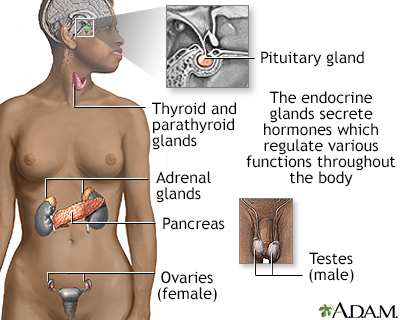
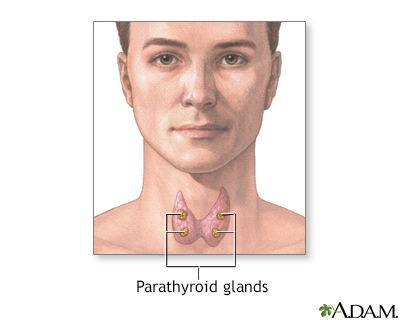
The parathyroid glands produce parathyroid hormone (PTH). PTH helps regulate calcium, phosphorus, and vitamin D levels in the blood and is important for bone health.
If you have PHP, your body produces the right amount of PTH, but is resistant to its effect. This causes low blood calcium levels and high blood phosphate levels.
PHP is caused by abnormal genes. There are different types of PHP. All forms are rare and are usually diagnosed in childhood.
- Type 1a is inherited in an autosomal dominant manner. That means only one parent needs to pass you the variant gene for you to have the condition. It is also called Albright hereditary osteodystrophy. The condition causes short stature, round face, obesity, developmental delay, and short hand bones. Symptoms depend on whether you inherit the gene from your mother or father.
- Type 1b involves resistance to PTH only in the kidneys. Less is known about type 1b than type 1a. Calcium in the blood is low, but there are none of the other characteristic features of Albright hereditary osteodystrophy.
- Type 2 also involves low blood calcium and high blood phosphate levels. People with this form do not have the physical traits common to people with Type 1a. The genetic abnormality that causes it is not known. It is different from Type 1b in how the kidney responds to high PTH levels.
Symptoms
Symptoms are related to a low level of calcium and include:
- Cataracts
- Dental problems
- Numbness
- Seizures
- Tetany (a collection of symptoms including muscle twitches and hand and foot cramps and muscle spasms)
People with Albright hereditary osteodystrophy may have the following symptoms:
- Calcium deposits under the skin
- Dimples that can replace knuckles on affected fingers
- Round face and short neck
- Short hand bones, especially the bone below the 4th finger
- Short height
Exams and Tests
Blood tests will be done to check calcium, phosphorus, and PTH levels. You may also need urine tests.
Other tests may include:
- Genetic testing
- Head MRI or CT scan of the brain
Treatment
Your health care provider will recommend calcium and vitamin D supplements to maintain a proper blood calcium level. If the blood phosphate level is high, you may need to follow a low-phosphorus diet or take medicines called phosphate binders (such as calcium carbonate or calcium acetate). Treatment is usually life-long.
Outlook (Prognosis)
Low blood calcium in PHP is usually milder than in other forms of hypoparathyroidism, but the severity of symptoms can be different between different people.
Possible Complications
People with type 1a PHP are more likely to have other endocrine system problems (such as hypothyroidism and hypogonadism).
PHP may be connected to other hormone problems, resulting in:
- Low sex drive
- Slow sexual development
- Low energy levels
- Weight gain
When to Contact a Medical Professional
Contact your provider if you or your child have any symptoms of a low calcium level or pseudohypoparathyroidism.
References
Bastepe M, Juppner H. Pseudohypoparathyroidism, Albright's hereditary osteodystrophy, and progressive osseous heteroplasia: disorders caused by inactivating GNAS mutations that reduce Gsa activity. In: Robertson RP, ed. DeGroot's Endocrinology. 8th ed. Philadelphia, PA: Elsevier; 2023:chap 57.
Hanley PC, Doyle DA. Pseudohypoparathyroidism. In: Kliegman RM, St. Geme JW, Blum NJ, et al, eds. Nelson Textbook of Pediatrics. 22nd ed. Philadelphia, PA: Elsevier; 2025:chap 612.
Thakker RV. The parathyroid glands, hypercalcemia, and hypocalcemia. In: Goldman L, Cooney KA, eds. Goldman-Cecil Medicine. 27th ed. Philadelphia, PA: Elsevier; 2024:chap 227.

Review Date: 5/20/2024
Reviewed By: Sandeep K. Dhaliwal, MD, board-certified in Diabetes, Endocrinology, and Metabolism, Springfield, VA. Also reviewed by David C. Dugdale, MD, Medical Director, Brenda Conaway, Editorial Director, and the A.D.A.M. Editorial team.
The information provided herein should not be used during any medical emergency or for the diagnosis or treatment of any medical condition. A licensed medical professional should be consulted for diagnosis and treatment of any and all medical conditions. Links to other sites are provided for information only -- they do not constitute endorsements of those other sites. No warranty of any kind, either expressed or implied, is made as to the accuracy, reliability, timeliness, or correctness of any translations made by a third-party service of the information provided herein into any other language.
© 1997-
A.D.A.M., a business unit of Ebix, Inc. Any duplication or distribution of the information contained herein is strictly prohibited.
All content on this site including text, images, graphics, audio, video, data, metadata, and compilations is protected by copyright and other intellectual property laws. You may view the content for personal, noncommercial use. Any other use requires prior written consent from Ebix. You may not copy, reproduce, distribute, transmit, display, publish, reverse-engineer, adapt, modify, store beyond ordinary browser caching, index, mine, scrape, or create derivative works from this content. You may not use automated tools to access or extract content, including to create embeddings, vectors, datasets, or indexes for retrieval systems. Use of any content for training, fine-tuning, calibrating, testing, evaluating, or improving AI systems of any kind is prohibited without express written consent. This includes large language models, machine learning models, neural networks, generative systems, retrieval-augmented systems, and any software that ingests content to produce outputs. Any unauthorized use of the content including AI-related use is a violation of our rights and may result in legal action, damages, and statutory penalties to the fullest extent permitted by law. Ebix reserves the right to enforce its rights through legal, technological, and contractual measures.
 All rights reserved