
Leydig cell testicular tumor

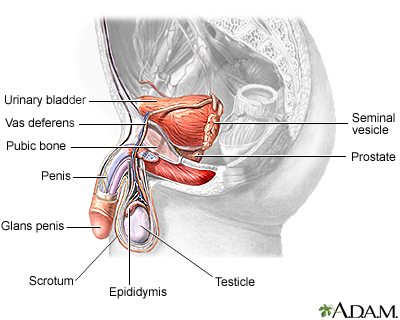
Male reproductive anatomy
Schedule an Appointment
Definition
A Leydig cell tumor is a tumor of the testicle. It develops from Leydig cells. These are the cells in the testicles that release the male hormone, testosterone.
Causes
The cause of this tumor is unknown. There are no known risk factors for this tumor. Unlike germ cell tumors of the testicles, this tumor does not seem to be linked to undescended testes.
Leydig cell tumors make up a very small number of all testicular tumors. They are most often found in men between 30 and 60 years of age. This tumor is not common in children before puberty, but it may cause early puberty.
Symptoms
There may be no symptoms.
When symptoms do occur, they can include:
- Discomfort or pain in the testicle
- Enlargement of a testicle or change in the way it feels
- Excess growth of breast tissue (gynecomastia) -- however, this can occur normally in adolescent boys who do not have testicular cancer
- Heaviness in the scrotum
- Lump or swelling in either testicle
- Pain in the lower abdomen or back
- Not able to father children (infertility)
Symptoms in other parts of the body, such as the lungs, abdomen, pelvis, back, or brain may also occur if the cancer has spread.
Exams and Tests
A physical examination typically reveals a firm lump in one of the testicles. When your health care provider holds a flashlight up to your scrotum, the light does not pass through the lump. This test is called transillumination.
Other tests include:
- Blood tests for tumor markers: alpha fetoprotein (AFP), human chorionic gonadotropin (beta HCG), and lactate dehydrogenase (LDH)
- CT scan of the chest, abdomen and pelvis to check if the cancer has spread
- Ultrasound of the scrotum
An examination of the tissue is usually done after the entire testicle is surgically removed (orchiectomy).
Treatment
Treatment of a Leydig cell tumor depends on its stage.
- Stage I cancer has not spread beyond the testicle.
- Stage II cancer has spread to lymph nodes in the abdomen.
- Stage III cancer has spread beyond the lymph nodes (possibly as far as the liver, lungs, or brain).
Surgery is done to remove the testicle (orchiectomy). Nearby lymph nodes may also be removed (lymphadenectomy).
Chemotherapy may be used to treat this tumor. As Leydig cell tumors are rare, these treatments have not been studied as much as treatments for other, more common testicular cancers.
Support Groups
Joining a support group where members share common experiences and problems can often help ease the stress of illness.
Outlook (Prognosis)
Testicular cancer is one of the most treatable and curable cancers. The outlook is worse if the tumor is not found early.
Possible Complications
The cancer may spread to other parts of the body. The most common sites include the:
- Abdomen
- Lungs
- Retroperitoneal area (the area near the kidneys behind the other organs in the belly area)
- Spine
Complications of surgery can include:
- Bleeding and infection
- Infertility (if both testicles are removed)
If you are of childbearing age, ask your provider about methods to save your sperm for use at a later date.
When to Contact a Medical Professional
Contact your provider if you have symptoms of testicular cancer.
Prevention
Performing testicular self-examination (TSE) each month may help detect testicular cancer at an early stage, before it spreads. Finding testicular cancer early is important for successful treatment and survival.
References
Friedlander TW, Small E. Testicular cancer. In: Niederhuber JE, Armitage JO, Kastan MB, Doroshow JH, Tepper JE, eds. Abeloff's Clinical Oncology. 6th ed. Philadelphia, PA: Elsevier; 2020:chap 83.
National Cancer Institute website. Testicular cancer treatment (PDQ) – health professional version. www.cancer.gov/types/testicular/hp/testicular-treatment-pdq. Updated March 15, 2024. Accessed July 9, 2024.
Stephenson AJ, Gilligan TD. Neoplasms of the testis. In: Partin AW, Dmochowski RR, Kavoussi LR, Peters CA, eds. Campbell-Walsh-Wein Urology. 12th ed. Philadelphia, PA: Elsevier; 2021:chap 76.

Review Date: 6/17/2024
Reviewed By: Todd Gersten, MD, Hematology/Oncology, Florida Cancer Specialists & Research Institute, Wellington, FL. Review provided by VeriMed Healthcare Network. Also reviewed by David C. Dugdale, MD, Medical Director, Brenda Conaway, Editorial Director, and the A.D.A.M. Editorial team.
The information provided herein should not be used during any medical emergency or for the diagnosis or treatment of any medical condition. A licensed medical professional should be consulted for diagnosis and treatment of any and all medical conditions. Links to other sites are provided for information only -- they do not constitute endorsements of those other sites. No warranty of any kind, either expressed or implied, is made as to the accuracy, reliability, timeliness, or correctness of any translations made by a third-party service of the information provided herein into any other language.
© 1997-
A.D.A.M., a business unit of Ebix, Inc. Any duplication or distribution of the information contained herein is strictly prohibited.
All content on this site including text, images, graphics, audio, video, data, metadata, and compilations is protected by copyright and other intellectual property laws. You may view the content for personal, noncommercial use. Any other use requires prior written consent from Ebix. You may not copy, reproduce, distribute, transmit, display, publish, reverse-engineer, adapt, modify, store beyond ordinary browser caching, index, mine, scrape, or create derivative works from this content. You may not use automated tools to access or extract content, including to create embeddings, vectors, datasets, or indexes for retrieval systems. Use of any content for training, fine-tuning, calibrating, testing, evaluating, or improving AI systems of any kind is prohibited without express written consent. This includes large language models, machine learning models, neural networks, generative systems, retrieval-augmented systems, and any software that ingests content to produce outputs. Any unauthorized use of the content including AI-related use is a violation of our rights and may result in legal action, damages, and statutory penalties to the fullest extent permitted by law. Ebix reserves the right to enforce its rights through legal, technological, and contractual measures.
 All rights reserved