
Personal protective equipment

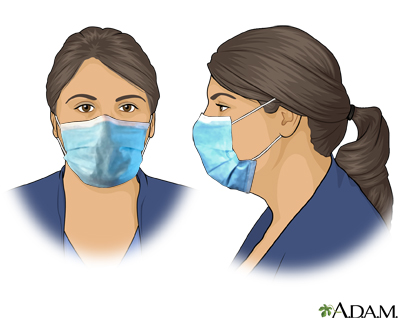
Face masks prevent the spread of respiratory viruses
Schedule an Appointment
Definition
Personal protective equipment (PPE) is special equipment you wear to create a barrier between you and germs. This barrier reduces the chance of touching, being exposed to, and spreading germs.
Information
PPE helps prevent the spread of germs in the hospital. This can protect all people including health care workers from infections.
All hospital staff, patients, and visitors should use PPE when there will be contact with blood or other bodily fluids as well as when exposed to air-borne diseases such as COVID-19.
Types of PPE
Gloves protect your hands from germs and help reduce the spread of germs.
Masks cover your mouth and nose.
- Some masks have a see-through plastic part that covers your eyes.
- A surgical mask helps stop germs in your nose and mouth from spreading. It can also keep you from breathing in some germs.
- A special respiratory mask (respirator) forms a tight seal around your nose and mouth. An N95 respirator is an example of this type of equipment. It may be needed so that you do not breathe in small germs like tuberculosis bacteria or measles or chickenpox viruses.
Eye protection includes face shields and goggles. These protect the mucous membranes in your eyes from blood and other bodily fluids. If these fluids make contact with the eyes, germs in the fluid can enter the body through the mucous membranes. These also may protect from infectious droplets carried through the air.
Clothing includes gowns, aprons, head covering, and shoe covers.
- These are often used during surgery to protect you and your patient.
- They are also used during surgery to protect you when you work with bodily fluids.
- Visitors wear gowns if they are visiting a person who is in isolation due to an illness that can be easily spread.
You may need special PPE when handling some cancer medicines. This equipment is called cytotoxic PPE.
- You may need to wear a gown with long sleeves and elastic cuffs. This gown should keep liquids from touching your skin.
- You may also need to wear shoe covers, goggles, and special gloves.
Choose the Right PPE
You may need to use different types of PPE for different people. Your workplace has written instructions about when to wear PPE and what type to use. You need PPE when you care for people who are in isolation as well as other patients.
Ask your supervisor how you can learn more about PPE.
After You Use PPE
Remove and dispose of PPE safely to protect others from being exposed to germs. Before leaving your work area, remove all PPE and put it in the right place. This may include:
- Special laundry containers that can be reused after cleaning
- Special waste containers that are different from other waste containers
- Specially marked bags for cytotoxic PPE
References
Calfee DP. Prevention and control of health care-associated infections. In: Goldman L, Cooney KA, eds. Goldman-Cecil Medicine. 27th ed. Philadelphia, PA: Elsevier; 2024:chap 261.
Centers for Disease Control and Prevention website. Personal protective equipment. www.cdc.gov/niosh/ppe. Accessed December 8, 2025.
Palmore TN. Infection prevention and control in the health care setting. In: Blaser MJ, Cohen JI, Holland SM, et al, eds. Mandell, Douglas, and Bennett's Principles and Practice of Infectious Diseases. 10th ed. Philadelphia, PA: Elsevier; 2026:chap 304.

Review Date: 10/19/2025
Reviewed By: Laura J. Martin, MD, MPH, ABIM Board Certified in Internal Medicine and Hospice and Palliative Medicine, Atlanta, GA. Also reviewed by David C. Dugdale, MD, Medical Director, Brenda Conaway, Editorial Director, and the A.D.A.M. Editorial team.
The information provided herein should not be used during any medical emergency or for the diagnosis or treatment of any medical condition. A licensed medical professional should be consulted for diagnosis and treatment of any and all medical conditions. Links to other sites are provided for information only -- they do not constitute endorsements of those other sites. No warranty of any kind, either expressed or implied, is made as to the accuracy, reliability, timeliness, or correctness of any translations made by a third-party service of the information provided herein into any other language.
© 1997-
A.D.A.M., a business unit of Ebix, Inc. Any duplication or distribution of the information contained herein is strictly prohibited.
All content on this site including text, images, graphics, audio, video, data, metadata, and compilations is protected by copyright and other intellectual property laws. You may view the content for personal, noncommercial use. Any other use requires prior written consent from Ebix. You may not copy, reproduce, distribute, transmit, display, publish, reverse-engineer, adapt, modify, store beyond ordinary browser caching, index, mine, scrape, or create derivative works from this content. You may not use automated tools to access or extract content, including to create embeddings, vectors, datasets, or indexes for retrieval systems. Use of any content for training, fine-tuning, calibrating, testing, evaluating, or improving AI systems of any kind is prohibited without express written consent. This includes large language models, machine learning models, neural networks, generative systems, retrieval-augmented systems, and any software that ingests content to produce outputs. Any unauthorized use of the content including AI-related use is a violation of our rights and may result in legal action, damages, and statutory penalties to the fullest extent permitted by law. Ebix reserves the right to enforce its rights through legal, technological, and contractual measures.
 All rights reserved