
Allergies, asthma, and dust

Description
In people who have sensitive airways, allergy and asthma symptoms can be triggered by breathing in substances called allergens, or triggers. It is important to know your triggers because avoiding them is your first step toward feeling better. Dust is a common trigger.
Dust and Dust Mites
When your asthma or allergies become worse due to dust, you are said to have a dust allergy.
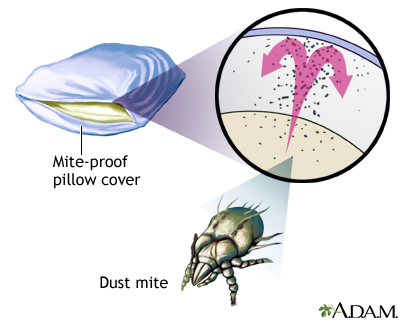
- Very tiny insects called dust mites are the main cause of dust allergies. Dust mites can only be seen under a microscope. Most dust mites in your home are found in bedding, mattresses, and box springs.
- House dust may also contain tiny particles of pollen, mold, fibers from clothing and fabrics, and detergents. All of these can also trigger allergies and asthma.
Choose the Right Home Furnishings
You can do many things to limit your or your child's exposure to dust and dust mites.
Replace blinds that have slats and cloth draperies with pull-down shades. They will not collect as much dust.
Dust particles collect in fabrics and carpets.
- If you can, get rid of fabric or upholstered furniture. Wood, leather, and vinyl are better.
- Avoid sleeping or lying on cushions and furniture that are covered in cloth.
- Replace wall-to-wall carpet with wood or other hard flooring.
Since mattresses, box springs, and pillows are hard to avoid:
- Wrap them with mite-proof covers.
- Wash bedding and pillows once a week in hot water (130°F [54.4°C] to 140°F [60°C]).
Other Tips
Keep indoor air dry. Dust mites thrive in moist air.
In the basement:
- Check your basement for moisture and mold.
- Use a dehumidifier to keep the air drier. Keeping indoor moisture levels (humidity) between 30% to 50% will keep mold spores down.
- Empty dehumidifiers daily and clean them often with a vinegar solution.
Central heating and air-conditioning systems may help control dust.
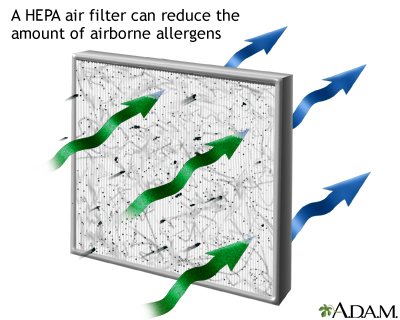
- The system should include special filters to capture dust and animal dander.
- Change furnace filters frequently.
- Use high efficiency particulate air (HEPA) filters.
When cleaning:
- Wipe away dust with a damp cloth and vacuum once a week. Use a vacuum cleaner with a HEPA filter to help control the dust that vacuuming stirs up.
- Use furniture polish to help reduce dust and other allergens.
- Wear a mask when you clean the house.
- You and your child should leave the house when others are cleaning, if possible.
Keep stuffed toys off beds, and wash them weekly.
Keep closets clean and closet doors closed.
References
American Academy of Allergy Asthma & Immunology website. Home allergy management. acaai.org/resource/home-allergy-management/. Updated June 28, 2023. Accessed April 12, 2024.
Matsui E, Platts-Mills TAE. Indoor allergens. In: Burks AW, Holgate ST, O'Hehir RE, et al, eds. Middleton's Allergy: Principles and Practice. 9th ed. Philadelphia, PA: Elsevier; 2020:chap 28.

Review Date: 4/1/2024
Reviewed By: Charles I. Schwartz, MD, FAAP, Clinical Assistant Professor of Pediatrics, Perelman School of Medicine at the University of Pennsylvania, General Pediatrician at PennCare for Kids, Phoenixville, PA. Also reviewed by David C. Dugdale, MD, Medical Director, Brenda Conaway, Editorial Director, and the A.D.A.M. Editorial team.
The information provided herein should not be used during any medical emergency or for the diagnosis or treatment of any medical condition. A licensed medical professional should be consulted for diagnosis and treatment of any and all medical conditions. Links to other sites are provided for information only -- they do not constitute endorsements of those other sites. No warranty of any kind, either expressed or implied, is made as to the accuracy, reliability, timeliness, or correctness of any translations made by a third-party service of the information provided herein into any other language.
© 1997-
A.D.A.M., a business unit of Ebix, Inc. Any duplication or distribution of the information contained herein is strictly prohibited.
All content on this site including text, images, graphics, audio, video, data, metadata, and compilations is protected by copyright and other intellectual property laws. You may view the content for personal, noncommercial use. Any other use requires prior written consent from Ebix. You may not copy, reproduce, distribute, transmit, display, publish, reverse-engineer, adapt, modify, store beyond ordinary browser caching, index, mine, scrape, or create derivative works from this content. You may not use automated tools to access or extract content, including to create embeddings, vectors, datasets, or indexes for retrieval systems. Use of any content for training, fine-tuning, calibrating, testing, evaluating, or improving AI systems of any kind is prohibited without express written consent. This includes large language models, machine learning models, neural networks, generative systems, retrieval-augmented systems, and any software that ingests content to produce outputs. Any unauthorized use of the content including AI-related use is a violation of our rights and may result in legal action, damages, and statutory penalties to the fullest extent permitted by law. Ebix reserves the right to enforce its rights through legal, technological, and contractual measures.
 All rights reserved