
Immune thrombocytopenic purpura (ITP)

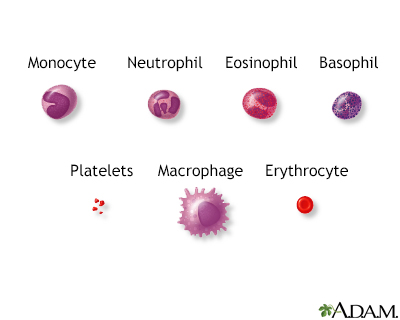
Blood cells
Schedule an Appointment
Definition
Immune thrombocytopenic purpura (ITP) is a bleeding disorder in which the immune system destroys platelets, which are necessary for normal blood clotting. People with the disease have too few platelets in the blood.
Causes
ITP occurs when certain immune system cells produce antibodies against platelets. Platelets help your blood clot by clumping together to plug small holes in damaged blood vessels.
The antibodies attach to the platelets. The body destroys the platelets that carry the antibodies.
In children, the disease sometimes follows a viral infection. In adults, it is more often a long-term (chronic) disease and can occur after a viral infection, with use of certain medicines, during pregnancy, or as part of an immune disorder.
ITP affects women more often than men. It is more common in children than adults. In children, the disease affects boys and girls equally.
Symptoms
ITP symptoms can include any of the following:
- Abnormally heavy periods in women
- Bleeding into the skin, often around the shins, causing a skin rash that looks like pinpoint red spots (petechial rash)
- Easy bruising
- Nosebleed or bleeding in the mouth
Exams and Tests
Blood tests will be done to check your platelet count.
A bone marrow aspiration or biopsy may also be done.
Treatment
In children, the disease usually goes away without treatment. Some children may need treatment.
Adults are usually started on a steroid medicine called prednisone or dexamethasone. In some cases, surgery to remove the spleen (splenectomy) is recommended. This increases the platelet count in about half of people. However, other medicine treatments are usually recommended instead.
If the disease does not get better with prednisone, other treatments may include:
- Infusions of high-dose gamma globulin (an immune factor)
- Medicines that suppress the immune system
- Anti-RhD therapy for people with certain blood types
- Medicines that stimulate the bone marrow to make more platelets
People with ITP should not take aspirin, ibuprofen, or warfarin, because these medicines interfere with platelet function or blood clotting, and bleeding may occur.
Support Groups
More information and support for people with ITP and their families can be found at:
- Platelet Disorder Support Association -- pdsa.org/patients-caregivers/support-resources.html
Outlook (Prognosis)
With treatment, the chance of remission (a symptom-free period) is good. In rare cases, ITP may become a long-term condition in adults and reappear, even after a symptom-free period.
Possible Complications
Sudden and severe loss of blood from the digestive tract may occur. Bleeding into the brain may also occur.
When to Contact a Medical Professional
Go to the emergency room or call 911 or the local emergency number if severe bleeding occurs, or if other new symptoms develop.
References
Abrams CS. Thrombocytopenia. In: Goldman L, Cooney KA, eds. Goldman-Cecil Medicine. 27th ed. Philadelphia, PA: Elsevier; 2024:chap 158.
Zeller MP, Ning S, Arnold DM, Gabe C. Diseases of platelet number: Immune thrombocytopenia, neonatal alloimmune thrombocytopenia, and posttransfusion purpura. In: Hoffman R, Benz EJ, Silberstein LE, et al, eds. Hematology: Basic Principles and Practice. 8th ed. Philadelphia, PA: Elsevier; 2023:chap 129.

Review Date: 3/31/2024
Reviewed By: Todd Gersten, MD, Hematology/Oncology, Florida Cancer Specialists & Research Institute, Wellington, FL. Review provided by VeriMed Healthcare Network. Also reviewed by David C. Dugdale, MD, Medical Director, Brenda Conaway, Editorial Director, and the A.D.A.M. Editorial team.
The information provided herein should not be used during any medical emergency or for the diagnosis or treatment of any medical condition. A licensed medical professional should be consulted for diagnosis and treatment of any and all medical conditions. Links to other sites are provided for information only -- they do not constitute endorsements of those other sites. No warranty of any kind, either expressed or implied, is made as to the accuracy, reliability, timeliness, or correctness of any translations made by a third-party service of the information provided herein into any other language.
© 1997-
A.D.A.M., a business unit of Ebix, Inc. Any duplication or distribution of the information contained herein is strictly prohibited.
All content on this site including text, images, graphics, audio, video, data, metadata, and compilations is protected by copyright and other intellectual property laws. You may view the content for personal, noncommercial use. Any other use requires prior written consent from Ebix. You may not copy, reproduce, distribute, transmit, display, publish, reverse-engineer, adapt, modify, store beyond ordinary browser caching, index, mine, scrape, or create derivative works from this content. You may not use automated tools to access or extract content, including to create embeddings, vectors, datasets, or indexes for retrieval systems. Use of any content for training, fine-tuning, calibrating, testing, evaluating, or improving AI systems of any kind is prohibited without express written consent. This includes large language models, machine learning models, neural networks, generative systems, retrieval-augmented systems, and any software that ingests content to produce outputs. Any unauthorized use of the content including AI-related use is a violation of our rights and may result in legal action, damages, and statutory penalties to the fullest extent permitted by law. Ebix reserves the right to enforce its rights through legal, technological, and contractual measures.
 All rights reserved