
Drug-induced thrombocytopenia

Definition
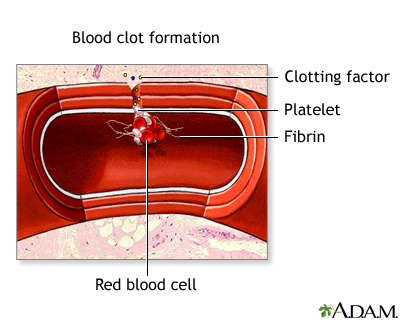
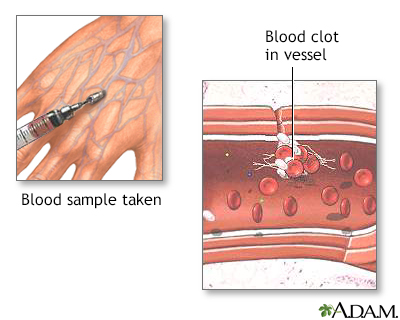
Thrombocytopenia means that there are not enough platelets. Platelets are elements in the blood that help the blood clot. A low platelet count makes bleeding more likely.
Many conditions can cause a low platelet count. When medicines or drugs do this, it is called drug-induced thrombocytopenia.
Causes
Drug-induced thrombocytopenia occurs when certain medicines destroy platelets or interfere with the body's ability to make enough of them.
There are two types of drug-induced thrombocytopenia: immune and nonimmune.
If a medicine causes your immune system to produce antibodies which seek and destroy your platelets, the condition is called drug-induced immune thrombocytopenia. Heparin, a blood thinner, is the most common cause of drug-induced immune thrombocytopenia. This is a unique form of drug-induced immune thrombocytopenia that increases the risk of blood clots.
If a medicine prevents your bone marrow from making enough platelets, the condition is called drug-induced nonimmune thrombocytopenia. Chemotherapy medicines and a seizure medicine called valproic acid may lead to this problem.
Other medicines that may cause drug-induced thrombocytopenia include:
- Furosemide
- Gold, used to treat arthritis
- Nonsteroidal anti-inflammatory drugs (NSAIDs)
- Penicillin
- Quinidine
- Quinine
- Ranitidine
- Sulfonamides
- Linezolid
- Statins
Symptoms
Decreased platelets may cause:
- Abnormal bleeding
- Bleeding when you brush your teeth
- Easy bruising
- Pinpoint red spots on the skin (petechiae)
Treatment
The first step is to stop using the medicine that is causing the problem.
For people who have life-threatening bleeding, treatments may include:
- Immunoglobulin therapy (IVIG) given through a vein
- Plasma exchange (plasmapheresis)
- Platelet transfusions
- Corticosteroid medicine
Possible Complications
Bleeding can be life threatening if it occurs in the brain or certain other organs.
A pregnant woman who has antibodies to platelets may pass the antibodies to the baby in the womb.
When to Contact a Medical Professional
Contact your health care provider if you have unexplained bleeding or bruising and are taking medicines, such as the ones mentioned above under Causes.
References
Abrams CS. Thrombocytopenia. In: Goldman L, Cooney KA, eds. Goldman-Cecil Medicine. 27th ed. Philadelphia, PA: Elsevier; 2024:chap 158.
Warkentin TE. Thrombocytopenia caused by hypersplenism, platelet destruction, or surgery/hemodilution. In: Hoffman R, Benz EJ, Silberstein LE, et al, eds. Hematology: Basic Principles and Practice. 8th ed. Philadelphia, PA: Elsevier; 2023:chap 130.

Review Date: 4/1/2025
Reviewed By: Warren Brenner, MD, Oncologist, Lynn Cancer Institute, Boca Raton, FL. Review provided by VeriMed Healthcare Network. Also reviewed by David C. Dugdale, MD, Medical Director, Brenda Conaway, Editorial Director, and the A.D.A.M. Editorial team.
The information provided herein should not be used during any medical emergency or for the diagnosis or treatment of any medical condition. A licensed medical professional should be consulted for diagnosis and treatment of any and all medical conditions. Links to other sites are provided for information only -- they do not constitute endorsements of those other sites. No warranty of any kind, either expressed or implied, is made as to the accuracy, reliability, timeliness, or correctness of any translations made by a third-party service of the information provided herein into any other language.
© 1997-
A.D.A.M., a business unit of Ebix, Inc. Any duplication or distribution of the information contained herein is strictly prohibited.
All content on this site including text, images, graphics, audio, video, data, metadata, and compilations is protected by copyright and other intellectual property laws. You may view the content for personal, noncommercial use. Any other use requires prior written consent from Ebix. You may not copy, reproduce, distribute, transmit, display, publish, reverse-engineer, adapt, modify, store beyond ordinary browser caching, index, mine, scrape, or create derivative works from this content. You may not use automated tools to access or extract content, including to create embeddings, vectors, datasets, or indexes for retrieval systems. Use of any content for training, fine-tuning, calibrating, testing, evaluating, or improving AI systems of any kind is prohibited without express written consent. This includes large language models, machine learning models, neural networks, generative systems, retrieval-augmented systems, and any software that ingests content to produce outputs. Any unauthorized use of the content including AI-related use is a violation of our rights and may result in legal action, damages, and statutory penalties to the fullest extent permitted by law. Ebix reserves the right to enforce its rights through legal, technological, and contractual measures.
 All rights reserved