
Paroxysmal cold hemoglobinuria (PCH)

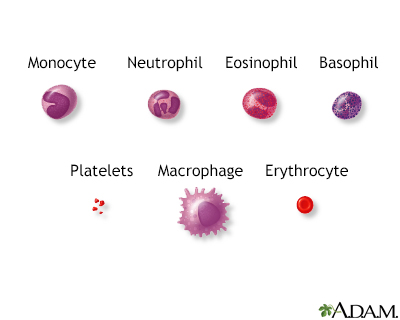
Blood cells
Schedule an Appointment
Definition
Paroxysmal cold hemoglobinuria (PCH) is a rare blood disorder in which the body's immune system produces antibodies that destroy red blood cells. It occurs when the person is exposed to cold temperatures.
Causes
PCH only occurs in the cold, and affects mainly the hands and feet. Antibodies attach (bind) to red blood cells. This allows other proteins in the blood (called complement) to also latch on. The antibodies destroy the red blood cells as they move through the body. As the cells are destroyed, hemoglobin, the part of red blood cells that carries oxygen, is released into the blood and passed in the urine.
PCH has been linked to secondary syphilis, tertiary syphilis, and other viral or bacterial infections. Sometimes the cause is unknown.
The disorder is rare.
Symptoms
Symptoms may include:
- Chills
- Fever
- Back pain
- Leg pain
- Abdominal pain
- Headache
- General discomfort, uneasiness, or ill feeling (malaise)
- Blood in the urine (red urine)
Exams and Tests
Laboratory tests can help diagnose this condition.
- Bilirubin levels are high in blood and urine.
- Complete blood count (CBC) shows anemia.
- Coombs test is negative.
- Donath-Landsteiner test is positive.
- Lactate dehydrogenase level is high.
Treatment
Treating the underlying condition can help. For example, if PCH is caused by syphilis, symptoms may get better when the syphilis is treated.
In some cases, medicines that suppress the immune system are used.
Outlook (Prognosis)
People with this disease often get better quickly and do not have symptoms between episodes. In most cases, the attacks end as soon as the damaged cells stop moving through the body.
Possible Complications
Complications may include:
- Continued attacks
- Kidney failure
- Severe anemia
When to Contact a Medical Professional
Contact your health care provider if you have symptoms of this disorder. Your provider can check for other causes of the symptoms and decide whether you need treatment.
Prevention
People who have been diagnosed with this disease can prevent future attacks by staying out of the cold.
References
Michel M. Autoimmune and intravascular hemolytic anemias. In: Goldman L, Cooney KA, eds. Goldman-Cecil Medicine. 27th ed. Philadelphia, PA: Elsevier; 2024:chap 146.
Michel M, Jäger U. Autoimmune hemolytic anemia. In: Hoffman R, Benz EJ, Silberstein LE, et al, eds. Hematology: Basic Principles and Practice. 8th ed. Philadelphia, PA: Elsevier; 2023:chap 47.

Review Date: 3/31/2024
Reviewed By: Todd Gersten, MD, Hematology/Oncology, Florida Cancer Specialists & Research Institute, Wellington, FL. Review provided by VeriMed Healthcare Network. Also reviewed by David C. Dugdale, MD, Medical Director, Brenda Conaway, Editorial Director, and the A.D.A.M. Editorial team.
The information provided herein should not be used during any medical emergency or for the diagnosis or treatment of any medical condition. A licensed medical professional should be consulted for diagnosis and treatment of any and all medical conditions. Links to other sites are provided for information only -- they do not constitute endorsements of those other sites. No warranty of any kind, either expressed or implied, is made as to the accuracy, reliability, timeliness, or correctness of any translations made by a third-party service of the information provided herein into any other language.
© 1997-
A.D.A.M., a business unit of Ebix, Inc. Any duplication or distribution of the information contained herein is strictly prohibited.
All content on this site including text, images, graphics, audio, video, data, metadata, and compilations is protected by copyright and other intellectual property laws. You may view the content for personal, noncommercial use. Any other use requires prior written consent from Ebix. You may not copy, reproduce, distribute, transmit, display, publish, reverse-engineer, adapt, modify, store beyond ordinary browser caching, index, mine, scrape, or create derivative works from this content. You may not use automated tools to access or extract content, including to create embeddings, vectors, datasets, or indexes for retrieval systems. Use of any content for training, fine-tuning, calibrating, testing, evaluating, or improving AI systems of any kind is prohibited without express written consent. This includes large language models, machine learning models, neural networks, generative systems, retrieval-augmented systems, and any software that ingests content to produce outputs. Any unauthorized use of the content including AI-related use is a violation of our rights and may result in legal action, damages, and statutory penalties to the fullest extent permitted by law. Ebix reserves the right to enforce its rights through legal, technological, and contractual measures.
 All rights reserved