
Hemoglobin C disease

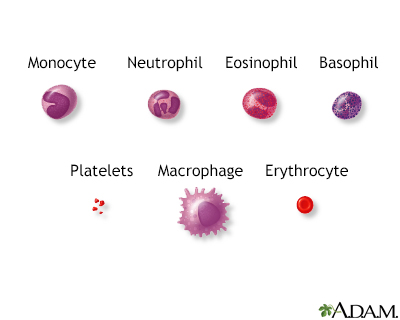
Blood cells
Schedule an Appointment
Definition
Hemoglobin C disease is a blood disorder passed down through families. It leads to a type of anemia, which occurs when red blood cells break down earlier than normal.
Causes
Hemoglobin C is an abnormal type of hemoglobin, the protein in red blood cells that carries oxygen. It is a type of hemoglobinopathy. The disease is caused by a problem with a gene called beta globin.
The disease most often occurs in African Americans. You are more likely to have hemoglobin C disease if someone in your family has had it.
Symptoms
Most people do not have symptoms. In some cases, jaundice may occur. Some people may develop gallstones that need to be treated.
Exams and Tests
A physical exam may show an enlarged spleen.
Tests that may be done include:
Treatment
In most cases, no treatment is needed. Folic acid supplements may help your body produce normal red blood cells and improve the symptoms of the anemia.
Outlook (Prognosis)
People with hemoglobin C disease can expect to lead a normal life.
Possible Complications
Complications may include:
- Anemia
- Gallbladder disease
- Enlargement of the spleen
When to Contact a Medical Professional
Contact your health care provider if you have symptoms of hemoglobin C disease.
Prevention
You may want to seek genetic counseling if you are at high risk for the condition and are considering having a baby.
References
Howard J. Sickle cell disease and other hemoglobinopathies. In: Goldman L, Cooney KA, eds. Goldman-Cecil Medicine. 27th ed. Philadelphia, PA: Elsevier; 2024:chap 149.
Smith-Whitley K, Kwiatkowski JL. Hemoglobinopathies. In: Kliegman RM, St. Geme JW, Blum NJ, et al, eds. Nelson Textbook of Pediatrics. 22nd ed. Philadelphia, PA: Elsevier; 2025:chap 511.
So JCC, Ma ESK. Hemoglobin and hemoglobinopathies. In: Rifai N, Chiu RWK, Young I, Burnham CAD, Wittwer CT, eds. Tietz Textbook of Laboratory Medicine. 7th ed. St Louis, MO: Elsevier; 2023:chap 77.
Wilson CS, Vergara-Lluri ME, Brynes RK. Evaluation of anemia, leukopenia, and thrombocytopenia. In: Jaffe ES, Arber DA, Campo E, Harris NL, Quintanilla-Martinez L, eds. Hematopathology. 2nd ed. Philadelphia, PA: Elsevier; 2017:chap 11.

Review Date: 3/31/2024
Reviewed By: Todd Gersten, MD, Hematology/Oncology, Florida Cancer Specialists & Research Institute, Wellington, FL. Review provided by VeriMed Healthcare Network. Also reviewed by David C. Dugdale, MD, Medical Director, Brenda Conaway, Editorial Director, and the A.D.A.M. Editorial team.
The information provided herein should not be used during any medical emergency or for the diagnosis or treatment of any medical condition. A licensed medical professional should be consulted for diagnosis and treatment of any and all medical conditions. Links to other sites are provided for information only -- they do not constitute endorsements of those other sites. No warranty of any kind, either expressed or implied, is made as to the accuracy, reliability, timeliness, or correctness of any translations made by a third-party service of the information provided herein into any other language.
© 1997-
A.D.A.M., a business unit of Ebix, Inc. Any duplication or distribution of the information contained herein is strictly prohibited.
All content on this site including text, images, graphics, audio, video, data, metadata, and compilations is protected by copyright and other intellectual property laws. You may view the content for personal, noncommercial use. Any other use requires prior written consent from Ebix. You may not copy, reproduce, distribute, transmit, display, publish, reverse-engineer, adapt, modify, store beyond ordinary browser caching, index, mine, scrape, or create derivative works from this content. You may not use automated tools to access or extract content, including to create embeddings, vectors, datasets, or indexes for retrieval systems. Use of any content for training, fine-tuning, calibrating, testing, evaluating, or improving AI systems of any kind is prohibited without express written consent. This includes large language models, machine learning models, neural networks, generative systems, retrieval-augmented systems, and any software that ingests content to produce outputs. Any unauthorized use of the content including AI-related use is a violation of our rights and may result in legal action, damages, and statutory penalties to the fullest extent permitted by law. Ebix reserves the right to enforce its rights through legal, technological, and contractual measures.
 All rights reserved