
Secondary systemic amyloidosis


Definition
Secondary systemic amyloidosis is a disorder in which abnormal proteins build up in tissues and organs. Clumps of the abnormal proteins are called amyloid deposits.
Secondary means it occurs because of another disease or situation. For example, this condition usually occurs due to long-term (chronic) infection or inflammation. In contrast, primary amyloidosis is a primary hematological disorder that results in deposition of abnormal amyloid proteins in different organs such as the heart and kidney.
Systemic means that the disease affects the entire body.
Causes
The exact cause of secondary systemic amyloidosis is unknown. You are more likely to develop secondary systemic amyloidosis if you have a long-term infection or inflammation.
This condition may occur with:
- Ankylosing spondylitis -- a form of arthritis that mostly affects the bones and joints in the spine
- Bronchiectasis -- a disease in which the large airways in the lungs are damaged by chronic infection
- Chronic osteomyelitis -- a long-standing bone infection
- Cystic fibrosis -- a genetic disease that causes thick, sticky mucus to build up in the lungs, digestive tract, and other areas of the body, leading to chronic infection of the lungs
- Familial Mediterranean fever -- an inherited disorder of repeated fevers and inflammation that often affects the lining of the abdomen, chest, or joints
- Gout
- Hairy cell leukemia -- a type of blood cancer
- Hodgkin disease -- cancer of the lymph tissue
- Inflammatory bowel disease
- Juvenile idiopathic arthritis -- arthritis that affects children
- Multiple myeloma -- a type of blood cancer
- Psoriatic arthritis
- Reactive arthritis -- a group of conditions that causes swelling and inflammation of the joints, eyes, and urinary and genital systems
- Rheumatoid arthritis
- Systemic lupus erythematosus -- an autoimmune disorder
- Tuberculosis
- Vasculitis (inflammation of the blood vessels)
Symptoms
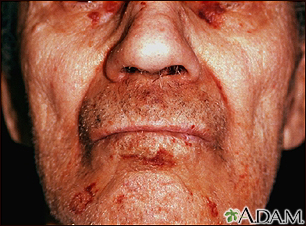
Symptoms of secondary systemic amyloidosis depend on which body tissue is affected by the protein deposits. These deposits damage normal tissues. This may lead to the symptoms or signs of this illness, including:
- Bleeding in the skin
- Fatigue
- Irregular heartbeat
- Numbness of hands and feet
- Rash
- Shortness of breath
- Swallowing difficulties
- Swollen arms or legs
- Swollen tongue
- Weak hand grip
- Weight loss
Exams and Tests
The health care provider will perform a physical examination and ask about your symptoms.
Tests that may be done include:
- Abdominal ultrasound (may show a swollen liver or spleen)
- Biopsy (removing a small piece) or aspiration using a needle to remove a small piece of fat just beneath the skin
- Biopsy of rectum
- Biopsy of skin
- Biopsy of bone marrow
- Blood tests, including creatinine and BUN (blood urea nitrogen)
- Echocardiogram
- Electrocardiogram (ECG)
- Nerve conduction velocity
- Urinalysis
- A special test known as mass spectrometry can determine the subtype of amyloid
Treatment
The condition that is causing the amyloidosis should be treated. In some cases, the drug colchicine or an immunosuppressive medicine (medicine that suppresses the immune system) is prescribed.
Outlook (Prognosis)
How well a person does depends on which organs are affected. It also depends on, whether the disease that is causing it can be controlled. If the disease involves the heart and kidneys, it may lead to organ failure and death.
Possible Complications
Health problems that may result from secondary systemic amyloidosis include:
- Endocrine failure
- Heart failure
- Kidney failure
- Nerve damage
- Respiratory failure
When to Contact a Medical Professional
Contact your provider if you have symptoms of this condition. The following are serious symptoms that need prompt medical attention:
- Bleeding
- Irregular heartbeat
- Numbness
- Shortness of breath
- Swelling
- Weak grip
Prevention
If you have a disease that is known to increase your risk for this condition, make sure you get it treated. This may help prevent amyloidosis.
References
Gertz MA, Dispenzieri A. Amyloidosis. In: Goldman L, Cooney KA, eds. Goldman-Cecil Medicine. 27th ed. Philadelphia, PA: Elsevier; 2024:chap 174.
Papa R, Lachmann HJ. Secondary, AA, amyloidosis. Rheum Dis Clin North Am. 2018;44(4):585-603. PMID: 30274625 pubmed.ncbi.nlm.nih.gov/30274625/.

Review Date: 4/1/2025
Reviewed By: Warren Brenner, MD, Oncologist, Lynn Cancer Institute, Boca Raton, FL. Review provided by VeriMed Healthcare Network. Also reviewed by David C. Dugdale, MD, Medical Director, Brenda Conaway, Editorial Director, and the A.D.A.M. Editorial team.
The information provided herein should not be used during any medical emergency or for the diagnosis or treatment of any medical condition. A licensed medical professional should be consulted for diagnosis and treatment of any and all medical conditions. Links to other sites are provided for information only -- they do not constitute endorsements of those other sites. No warranty of any kind, either expressed or implied, is made as to the accuracy, reliability, timeliness, or correctness of any translations made by a third-party service of the information provided herein into any other language.
© 1997-
A.D.A.M., a business unit of Ebix, Inc. Any duplication or distribution of the information contained herein is strictly prohibited.
All content on this site including text, images, graphics, audio, video, data, metadata, and compilations is protected by copyright and other intellectual property laws. You may view the content for personal, noncommercial use. Any other use requires prior written consent from Ebix. You may not copy, reproduce, distribute, transmit, display, publish, reverse-engineer, adapt, modify, store beyond ordinary browser caching, index, mine, scrape, or create derivative works from this content. You may not use automated tools to access or extract content, including to create embeddings, vectors, datasets, or indexes for retrieval systems. Use of any content for training, fine-tuning, calibrating, testing, evaluating, or improving AI systems of any kind is prohibited without express written consent. This includes large language models, machine learning models, neural networks, generative systems, retrieval-augmented systems, and any software that ingests content to produce outputs. Any unauthorized use of the content including AI-related use is a violation of our rights and may result in legal action, damages, and statutory penalties to the fullest extent permitted by law. Ebix reserves the right to enforce its rights through legal, technological, and contractual measures.
 All rights reserved