
Waterhouse-Friderichsen syndrome


Definition
Waterhouse-Friderichsen syndrome (WFS) is a group of symptoms that occur when the adrenal glands fail to function normally. This is caused by bleeding into the glands.
Causes
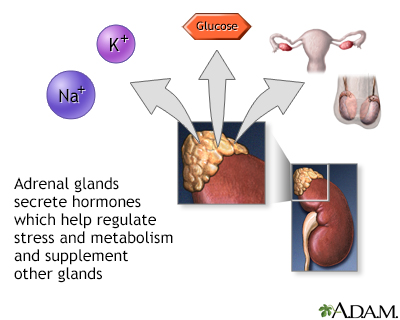
The adrenal glands are two triangle-shaped glands. One gland is located on top of each kidney. The adrenal glands produce and release different hormones that the body needs to function normally. The adrenal glands can be affected by many diseases, such as infections like WFS.
WFS is caused by severe infection with meningococcus bacteria or other bacteria such as:
- Group B streptococcus
- Pseudomonas aeruginosa
- Streptococcus pneumoniae
- Staphylococcus aureus
Symptoms
Symptoms occur suddenly. They are due to the bacteria growing in large numbers inside the body. Symptoms include:
- Fever and chills
- Joint and muscle pain
- Headache
- Vomiting
The infection with bacteria causes bleeding throughout the body, which causes:
- A rash throughout the body
- Disseminated intravascular coagulation, in which small blood clots cut off the blood supply to the organs
- Septic shock
Bleeding into the adrenal glands makes the glands unable to produce enough adrenal hormones. This is called an adrenal crisis, and it leads to symptoms such as:
Exams and Tests
Your health care provider will perform a physical exam and ask about your symptoms.
Blood tests will be done to confirm a bacterial infection. Tests may include:
If your provider suspects the infection is caused by meningococcus bacteria, other tests that may be done include:
- Lumbar puncture to get a sample of spinal fluid for culture
- Skin biopsy and Gram stain
- Urine analysis
Tests that may be ordered to help diagnose acute adrenal crisis include:
- ACTH (cosyntropin) stimulation test
- Cortisol blood test
- Blood sugar
- Potassium blood test
- Sodium blood test
- Blood pH test
Treatment
Antibiotics are started right away to treat the bacterial infection. Glucocorticoid medicines will also be given to treat adrenal gland insufficiency. Supportive treatments will be needed for other symptoms.
Outlook (Prognosis)
WFS is fatal unless treatment for the bacterial infection is started right away and glucocorticoid medicines are given.
Prevention
To reduce the risk of WFS caused by meningococcal bacteria, a vaccine against the bacteria is available.
References
Auchus RJ, Flück Pandey CE. The adrenal cortex. In: Melmed S, Auchus RJ, Goldfine AB, Rosen CJ, Kopp PA, eds. Williams Textbook of Endocrinology. 15th ed. Philadelphia, PA: Elsevier; 2025:chap 13.
Stephens DS. Neisseria meningitidis. In: Blaser MJ, Cohen JI, Holland SM, et al, eds. Mandell, Douglas, and Bennett's Principles and Practice of Infectious Diseases. 10th ed. Philadelphia, PA: Elsevier; 2026:chap 216.

Review Date: 8/5/2025
Reviewed By: Jatin M. Vyas, MD, PhD, Roy and Diana Vagelos Professor in Medicine, Columbia University Vagelos College of Physicians and Surgeons, Division of Infectious Diseases, Department of Medicine, New York, NY. Also reviewed by David C. Dugdale, MD, Medical Director, Brenda Conaway, Editorial Director, and the A.D.A.M. Editorial team.
The information provided herein should not be used during any medical emergency or for the diagnosis or treatment of any medical condition. A licensed medical professional should be consulted for diagnosis and treatment of any and all medical conditions. Links to other sites are provided for information only -- they do not constitute endorsements of those other sites. No warranty of any kind, either expressed or implied, is made as to the accuracy, reliability, timeliness, or correctness of any translations made by a third-party service of the information provided herein into any other language.
© 1997-
A.D.A.M., a business unit of Ebix, Inc. Any duplication or distribution of the information contained herein is strictly prohibited.
All content on this site including text, images, graphics, audio, video, data, metadata, and compilations is protected by copyright and other intellectual property laws. You may view the content for personal, noncommercial use. Any other use requires prior written consent from Ebix. You may not copy, reproduce, distribute, transmit, display, publish, reverse-engineer, adapt, modify, store beyond ordinary browser caching, index, mine, scrape, or create derivative works from this content. You may not use automated tools to access or extract content, including to create embeddings, vectors, datasets, or indexes for retrieval systems. Use of any content for training, fine-tuning, calibrating, testing, evaluating, or improving AI systems of any kind is prohibited without express written consent. This includes large language models, machine learning models, neural networks, generative systems, retrieval-augmented systems, and any software that ingests content to produce outputs. Any unauthorized use of the content including AI-related use is a violation of our rights and may result in legal action, damages, and statutory penalties to the fullest extent permitted by law. Ebix reserves the right to enforce its rights through legal, technological, and contractual measures.
 All rights reserved