
Legionnaires disease

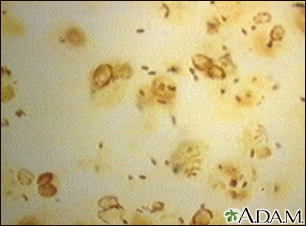
Legionnaire disease - organism legionella
Schedule an Appointment
Definition
Legionnaires disease is an infection of the lungs and airways. It is caused by Legionella bacteria.
Causes
The bacteria that cause Legionnaires disease have been found in water delivery systems. They can survive in the warm, moist air conditioning systems of large buildings, including hospitals.
Most cases are caused by the bacteria Legionella pneumophila. The rest of the cases are caused by other Legionella species.
Spread of the bacteria from person to person has not been demonstrated.
Most infections occur in middle-aged or older people. In rare cases, children can get the infection. When they do, the disease is less severe.
Risk factors include:
- Alcohol use
- Cigarette smoking
- Chronic illnesses, such as kidney failure or diabetes
- Long-term (chronic) lung disease, such as COPD
- Long-term use of a breathing machine (ventilator)
- Medicines that suppress the immune system, including chemotherapy and steroid medicines
- Older age
Symptoms
Symptoms tend to get worse during the first 4 to 6 days. They most often improve in another 4 to 5 days.
Symptoms may include:
- General discomfort, loss of energy, or ill feeling (malaise)
- Headache
- Fever, shaking chills
- Joint pain, muscle aches and stiffness
- Chest pain
- Cough that does not produce much sputum or mucus (dry cough)
- Coughing up blood (rare)
- Diarrhea, nausea, vomiting, and abdominal pain
- Shortness of breath
Exams and Tests
Your health care provider will perform a physical exam. Abnormal sounds, called crackles, may be heard when listening to the chest with a stethoscope.
Tests that may be done include:
- Arterial blood gases
- Blood cultures or other tests to identify the bacteria
- Bronchoscopy to view the airways and diagnose lung disease
- Chest x-ray or CT scan
- Complete blood count (CBC), including white blood cell count
- Liver blood tests
- Tests and cultures on sputum to identify Legionella bacteria
- Urine tests to check for Legionella pneumophila bacteria
- Molecular tests with polymerase chain reaction (PCR)
Treatment
Antibiotics are used to fight the infection. Treatment is started as soon as Legionnaire disease is suspected, without waiting for results of any lab test.
Other treatments may include receiving:
- Fluids through a vein (IV)
- Oxygen, which is given through a mask or breathing machine
- Medicines that are breathed in to ease breathing
Outlook (Prognosis)
Legionnaires disease can be life threatening. The risk of dying is higher in people who:
- Have long-term (chronic) diseases or compromised immune systems
- Become infected while in the hospital
- Are older adults
When to Contact a Medical Professional
Contact your provider right away if you have any type of breathing problem and think you have symptoms of Legionnaires disease.
References
Edelstein PH, Roy CR. Legionnaires' disease and Pontiac fever. In: Bennett JE, Dolin R, Blaser MJ, eds. Mandell, Douglas, and Bennett's Principles and Practice of Infectious Diseases. 9th ed. Philadelphia, PA: Elsevier; 2020:chap 232.
Marschall J, Fraser VJ. Legionella infections. In: Goldman L, Cooney KA, eds. Goldman-Cecil Medicine. 27th ed. Philadelphia, PA: Elsevier; 2024:chap 290.

Review Date: 2/5/2025
Reviewed By: Jatin M. Vyas, MD, PhD, Roy and Diana Vagelos Professor in Medicine, Columbia University Vagelos College of Physicians and Surgeons, Division of Infectious Diseases, Department of Medicine, New York, NY. Also reviewed by David C. Dugdale, MD, Medical Director, Brenda Conaway, Editorial Director, and the A.D.A.M. Editorial team.
The information provided herein should not be used during any medical emergency or for the diagnosis or treatment of any medical condition. A licensed medical professional should be consulted for diagnosis and treatment of any and all medical conditions. Links to other sites are provided for information only -- they do not constitute endorsements of those other sites. No warranty of any kind, either expressed or implied, is made as to the accuracy, reliability, timeliness, or correctness of any translations made by a third-party service of the information provided herein into any other language.
© 1997-
A.D.A.M., a business unit of Ebix, Inc. Any duplication or distribution of the information contained herein is strictly prohibited.
All content on this site including text, images, graphics, audio, video, data, metadata, and compilations is protected by copyright and other intellectual property laws. You may view the content for personal, noncommercial use. Any other use requires prior written consent from Ebix. You may not copy, reproduce, distribute, transmit, display, publish, reverse-engineer, adapt, modify, store beyond ordinary browser caching, index, mine, scrape, or create derivative works from this content. You may not use automated tools to access or extract content, including to create embeddings, vectors, datasets, or indexes for retrieval systems. Use of any content for training, fine-tuning, calibrating, testing, evaluating, or improving AI systems of any kind is prohibited without express written consent. This includes large language models, machine learning models, neural networks, generative systems, retrieval-augmented systems, and any software that ingests content to produce outputs. Any unauthorized use of the content including AI-related use is a violation of our rights and may result in legal action, damages, and statutory penalties to the fullest extent permitted by law. Ebix reserves the right to enforce its rights through legal, technological, and contractual measures.
 All rights reserved