
Peritonitis - secondary

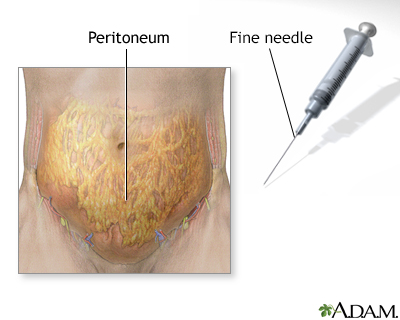
Peritoneal sample
Schedule an Appointment
Definition
The peritoneum is the thin tissue that lines the inner wall of the abdomen and covers most of the organs in the abdomen. Peritonitis is present when this tissue becomes inflamed or infected. Secondary peritonitis is when another condition is the cause.
Causes
Secondary peritonitis has several major causes.
- Bacteria may enter the peritoneum through a hole (perforation) in an organ of the digestive tract. The hole may be caused by a ruptured appendix, stomach ulcer, or perforated colon. It may also come from an injury, such as a gunshot or knife wound or following the ingestion of a sharp foreign body.
- Bile or chemicals released by the pancreas may leak into the abdominal cavity. This may be caused by swelling and inflammation of the pancreas called pancreatitis.
- Tubes or catheters placed into the abdomen may cause this problem. These include catheters for peritoneal dialysis, feeding tubes, and others.
An infection of the bloodstream (sepsis) may lead to an infection in the abdomen also. This is a severe illness.
This tissue may become infected when there is no clear cause.
Necrotizing enterocolitis occurs when the lining of the intestinal wall dies and can lead to peritonitis. This problem nearly always develops in an infant who is ill or born early.
Symptoms
Symptoms include:
- Swollen abdomen when your belly area is bigger than usual
- Abdominal pain
- Decreased appetite
- Fever
- Low urine output
- Nausea
- Thirst
- Vomiting
Note: There may be signs of shock.
Exams and Tests
During a physical exam, the health care provider may find abnormal vital signs with fever, rapid heart rate and breathing, low blood pressure, and a tender distended abdomen.
Tests may include:
- Blood culture
- Blood chemistry, including pancreatic enzymes
- Complete blood count
- Liver and kidney function tests
- X-rays or CT scan
- Peritoneal fluid culture, Gram stain and chemistry tests
- Urinalysis
Treatment
Often, surgery is needed to remove or treat sources of infection. These may be an infected bowel, an inflamed appendix, or an abscess or perforated diverticulum, usually due to diverticulitis.
General treatment includes:
- Antibiotics
- Fluids through a vein (IV)
- Pain medicines
- Tube through the nose into the stomach or intestine (nasogastric or NG tube)
Outlook (Prognosis)
The outcome can range from complete recovery to overwhelming infection and death. Factors that determine the outcome include:
- How long the symptoms were present before treatment began
- The person's general health
Possible Complications
Complications may include:
- Abscess
- Gangrene (dead) bowel requiring surgery
- Intraperitoneal adhesions (a potential cause of future bowel blockage)
- Septic shock
When to Contact a Medical Professional
Contact your provider if you have symptoms of peritonitis. This is a serious condition. It needs emergency treatment in most cases.
References
Mathews JB, Turaga K. Surgical peritonitis and other diseases of the peritoneum, mesentery, omentum, and diaphragm. In: Feldman M, Friedman LS, Brandt LJ, eds. Sleisenger and Fordtran's Gastrointestinal and Liver Disease. 11th ed. Philadelphia, PA: Elsevier; 2021:chap 39.
Privratsky AM, Barreto JC, Turnage RH, Mizell J, Badgwell B. Abdominal wall, umbilicus, peritoneum, mesenteries, omentum, and retroperitoneum. In: Townsend CM Jr, Beauchamp RD, Evers BM, Mattox KL, eds. Sabiston Textbook of Surgery. 21st ed. St Louis, MO: Elsevier; 2022:chap 44.

Review Date: 6/11/2024
Reviewed By: Jenifer K. Lehrer, MD, Department of Gastroenterology, Aria - Jefferson Health Torresdale, Jefferson Digestive Diseases Network, Philadelphia, PA. Review provided by VeriMed Healthcare Network. Also reviewed by David C. Dugdale, MD, Medical Director, Brenda Conaway, Editorial Director, and the A.D.A.M. Editorial team.
The information provided herein should not be used during any medical emergency or for the diagnosis or treatment of any medical condition. A licensed medical professional should be consulted for diagnosis and treatment of any and all medical conditions. Links to other sites are provided for information only -- they do not constitute endorsements of those other sites. No warranty of any kind, either expressed or implied, is made as to the accuracy, reliability, timeliness, or correctness of any translations made by a third-party service of the information provided herein into any other language.
© 1997-
A.D.A.M., a business unit of Ebix, Inc. Any duplication or distribution of the information contained herein is strictly prohibited.
All content on this site including text, images, graphics, audio, video, data, metadata, and compilations is protected by copyright and other intellectual property laws. You may view the content for personal, noncommercial use. Any other use requires prior written consent from Ebix. You may not copy, reproduce, distribute, transmit, display, publish, reverse-engineer, adapt, modify, store beyond ordinary browser caching, index, mine, scrape, or create derivative works from this content. You may not use automated tools to access or extract content, including to create embeddings, vectors, datasets, or indexes for retrieval systems. Use of any content for training, fine-tuning, calibrating, testing, evaluating, or improving AI systems of any kind is prohibited without express written consent. This includes large language models, machine learning models, neural networks, generative systems, retrieval-augmented systems, and any software that ingests content to produce outputs. Any unauthorized use of the content including AI-related use is a violation of our rights and may result in legal action, damages, and statutory penalties to the fullest extent permitted by law. Ebix reserves the right to enforce its rights through legal, technological, and contractual measures.
 All rights reserved