
Low white blood cell count and cancer

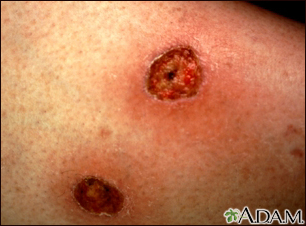
Ecthyma gangrenosum
Schedule an Appointment
Description
White blood cells (WBCs) fight infections from bacteria, viruses, fungi, and other germs. One important type of WBC is the neutrophil. These cells are made in the bone marrow and travel in the blood throughout the body. They sense infections, gather at sites of infection, and destroy the germs.
When the body has too few neutrophils, the condition is called neutropenia. This makes it harder for the body to fight off infection, and a person is more likely to get sick. In general, an adult who has fewer than 1,000 neutrophils in a microliter of blood has neutropenia.
If the neutrophil count is very low, fewer than 500 neutrophils in a microliter of blood, it is called severe neutropenia. When the neutrophil count gets this low, even the bacteria normally living in a person's mouth, skin, and gut can cause serious infections.
Why It Occurs
A person with cancer can develop a low WBC count from the cancer or from treatment for the cancer. Cancer may be in the bone marrow, causing fewer neutrophils to be made. The WBC count can also go down when cancer is treated with chemotherapy medicines, which slow bone marrow production of healthy WBCs.
How Low Is Too Low?
When your blood is tested, ask for your WBC count and specifically, your neutrophil count. If your counts are low, do what you can to prevent infections. Know the signs of infection and what to do if you have them.
What You Can Do to Prevent Infections
Prevent infections by taking the following measures:
- Be careful with pets and other animals to avoid catching infections from them.
- Practice safe eating and drinking habits.
- Wash your hands often with soap and water.
- Stay away from people who have symptoms of an infection.
- Avoid traveling and crowded public places.
When to Call the Doctor
If you have any of the following symptoms, contact your health care provider:
- Fevers, chills, or sweats.
- Diarrhea that does not go away or is bloody.
- Severe nausea and vomiting.
- Being unable to eat or drink.
- Extreme weakness.
- Redness, swelling, or drainage from any place where you have an IV (intravenous) line inserted into your body.
- A new skin rash or blisters.
- Pain in your stomach area.
- A very bad headache or one that does not go away.
- A cough that is getting worse.
- Trouble breathing when you are at rest or when you are doing simple tasks.
- Burning when you urinate.
References
American Cancer Society website. Why are people with cancer more likely to get infections. www.cancer.org/cancer/managing-cancer/side-effects/low-blood-counts/infections/why-people-with-cancer-are-at-risk.html. Updated February 13, 2024. Accessed April 8, 2025.
Berliner N. Leukocytosis and leukopenia. In: Goldman L, Cooney KA, eds. Goldman-Cecil Medicine. 27th ed. Philadelphia, PA: Elsevier; 2024:chap 153.
Centers for Disease Control and Prevention website. Preventing infections in cancer patients. www.cdc.gov/cancer-preventing-infections/. Accessed April 8, 2025.
Freifeld AG, Kaul DR. Infection in the patient with cancer. In: Niederhuber JE, Armitage JO, Kastan MB, Doroshow JH, Tepper JE, eds. Abeloff's Clinical Oncology. 6th ed. Philadelphia, PA: Elsevier; 2020:chap 34.

Review Date: 4/1/2025
Reviewed By: Warren Brenner, MD, Oncologist, Lynn Cancer Institute, Boca Raton, FL. Review provided by VeriMed Healthcare Network. Also reviewed by David C. Dugdale, MD, Medical Director, Brenda Conaway, Editorial Director, and the A.D.A.M. Editorial team.
The information provided herein should not be used during any medical emergency or for the diagnosis or treatment of any medical condition. A licensed medical professional should be consulted for diagnosis and treatment of any and all medical conditions. Links to other sites are provided for information only -- they do not constitute endorsements of those other sites. No warranty of any kind, either expressed or implied, is made as to the accuracy, reliability, timeliness, or correctness of any translations made by a third-party service of the information provided herein into any other language.
© 1997-
A.D.A.M., a business unit of Ebix, Inc. Any duplication or distribution of the information contained herein is strictly prohibited.
All content on this site including text, images, graphics, audio, video, data, metadata, and compilations is protected by copyright and other intellectual property laws. You may view the content for personal, noncommercial use. Any other use requires prior written consent from Ebix. You may not copy, reproduce, distribute, transmit, display, publish, reverse-engineer, adapt, modify, store beyond ordinary browser caching, index, mine, scrape, or create derivative works from this content. You may not use automated tools to access or extract content, including to create embeddings, vectors, datasets, or indexes for retrieval systems. Use of any content for training, fine-tuning, calibrating, testing, evaluating, or improving AI systems of any kind is prohibited without express written consent. This includes large language models, machine learning models, neural networks, generative systems, retrieval-augmented systems, and any software that ingests content to produce outputs. Any unauthorized use of the content including AI-related use is a violation of our rights and may result in legal action, damages, and statutory penalties to the fullest extent permitted by law. Ebix reserves the right to enforce its rights through legal, technological, and contractual measures.
 All rights reserved