
Pyloric stenosis in infants

Definition
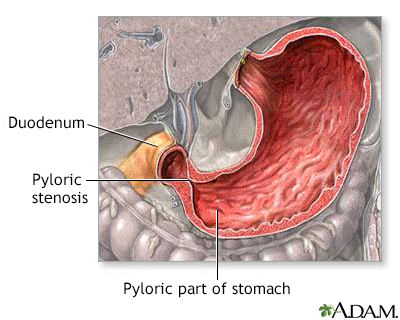
Pyloric stenosis is a narrowing of the opening from the stomach into the small intestine. This is called the pylorus. This article describes the condition in infants.
Causes
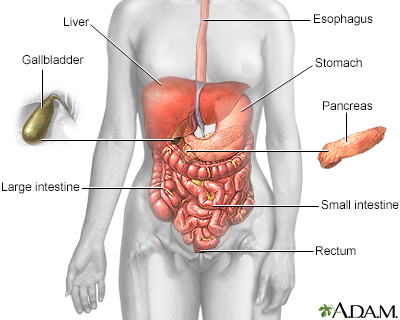
Normally, food passes easily from the stomach into the first part of the small intestine through a valve called the pylorus. With pyloric stenosis, the muscles of the pylorus are thickened. This prevents the stomach from emptying into the small intestine.
The exact cause of the thickening is unknown. Genes may play a role, since children of parents who had pyloric stenosis are more likely to have this condition. Other risk factors include:
- Certain antibiotics
- Too much acid in the first part of the small intestine (duodenum)
- Certain diseases a baby is born with, such as diabetes
Pyloric stenosis occurs most often in infants younger than 6 months. It is more common in boys than in girls.
Symptoms
Vomiting is the first symptom in most children:
- Vomiting may occur after every feeding or only after some feedings.
- Vomiting usually starts around 3 weeks of age, but may start any time between 1 week and 5 months of age.
- Vomiting is forceful (projectile vomiting).
- The infant is hungry after vomiting and wants to feed again.
Other symptoms appear several weeks after birth and may include:
- Abdominal pain
- Burping
- Constant hunger
- Dehydration (gets worse as vomiting gets worse)
- Failure to gain weight or weight loss
- Wave-like motion of the abdomen shortly after feeding and just before vomiting occurs
Exams and Tests
The condition is often diagnosed before the baby is 6 months old.
A physical exam may reveal:
- Signs of dehydration, such as dry skin and mouth, less tearing when crying, and dry diapers
- Swollen belly
- Olive-shaped mass when feeling the upper belly, which is the abnormal pylorus
Ultrasound of the abdomen may be the first imaging test. Other tests may include:
- Barium x-ray -- reveals a swollen stomach and narrowed pylorus
- Blood tests -- often reveal an electrolyte imbalance
Treatment
Treatment for pyloric stenosis involves surgery to widen the pylorus. The surgery is called pyloromyotomy.
In infants who cannot have surgery, tube feeding or medicine to relax the pylorus is tried.
Outlook (Prognosis)
Surgery usually relieves all symptoms. As soon as several hours after surgery, the infant can start small, frequent feedings.
Possible Complications
If pyloric stenosis isn't treated, a baby won't get enough nutrition and fluid. The child can become underweight and dehydrated.
When to Contact a Medical Professional
Contact your health care provider if your baby has symptoms of this condition.
References
Kliegman RM, St. Geme JW, Blum NJ, Shah SS, Tasker RC, Wilson KM. Pyloric stenosis and other congenital anomalies of the stomach. In: Kliegman RM, St. Geme JW, Blum NJ, Shah SS, Tasker RC, Wilson KM, eds. Nelson Textbook of Pediatrics. 21st ed. Philadelphia, PA: Elsevier; 2020:chap 355.
Seifarth FG, Soldes OS. Congenital anomalies and surgical disorders of the stomach. In: Wyllie R, Hyams JS, Kay M, eds. Pediatric Gastrointestinal and Liver Disease. 6th ed. Philadelphia, PA: Elsevier; 2021:chap 25.

Review Date: 8/5/2023
Reviewed By: Neil K. Kaneshiro, MD, MHA, Clinical Professor of Pediatrics, University of Washington School of Medicine, Seattle, WA. Also reviewed by David C. Dugdale, MD, Medical Director, Brenda Conaway, Editorial Director, and the A.D.A.M. Editorial team. Editorial update 09/03/2025.
The information provided herein should not be used during any medical emergency or for the diagnosis or treatment of any medical condition. A licensed medical professional should be consulted for diagnosis and treatment of any and all medical conditions. Links to other sites are provided for information only -- they do not constitute endorsements of those other sites. No warranty of any kind, either expressed or implied, is made as to the accuracy, reliability, timeliness, or correctness of any translations made by a third-party service of the information provided herein into any other language.
© 1997-
A.D.A.M., a business unit of Ebix, Inc. Any duplication or distribution of the information contained herein is strictly prohibited.
All content on this site including text, images, graphics, audio, video, data, metadata, and compilations is protected by copyright and other intellectual property laws. You may view the content for personal, noncommercial use. Any other use requires prior written consent from Ebix. You may not copy, reproduce, distribute, transmit, display, publish, reverse-engineer, adapt, modify, store beyond ordinary browser caching, index, mine, scrape, or create derivative works from this content. You may not use automated tools to access or extract content, including to create embeddings, vectors, datasets, or indexes for retrieval systems. Use of any content for training, fine-tuning, calibrating, testing, evaluating, or improving AI systems of any kind is prohibited without express written consent. This includes large language models, machine learning models, neural networks, generative systems, retrieval-augmented systems, and any software that ingests content to produce outputs. Any unauthorized use of the content including AI-related use is a violation of our rights and may result in legal action, damages, and statutory penalties to the fullest extent permitted by law. Ebix reserves the right to enforce its rights through legal, technological, and contractual measures.
 All rights reserved