
Health Topics, In-Depth Reports
More <
bookmarks-menu

Blood clots

Show Alternative Names
Clot
Emboli
Thrombi
Thromboembolus
Hypercoagulable state

Blood clots are clumps that occur when blood hardens from a liquid to a solid.

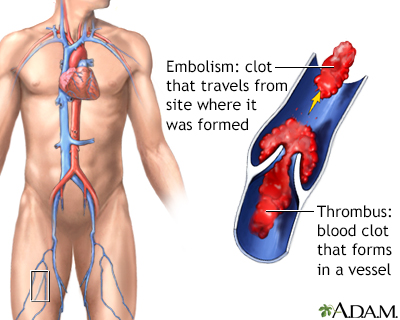
  • A blood clot that forms inside one of your veins or arteries is called a thrombus. A thrombus may also form in your heart.
  • A thrombus that breaks loose and travels from one location in the body to another is called an embolus.

A thrombus or embolus can partly or completely block the flow of blood in a blood vessel.

  • A blockage in an artery may prevent oxygen from reaching the tissues in that area. This is called ischemia. If ischemia is not treated promptly, it can lead to tissue damage or death.
  • A blockage in the vein will often cause fluid buildup and swelling in the area where blood is drained by that vein.

Causes

Situations in which a blood clot is more likely to form in veins include:

  • Being on long-term bed rest
  • Sitting for long periods, such as in a plane or car
  • During and after pregnancy
  • Taking birth control pills or estrogen hormones (especially in women who smoke)
  • Long-term use of an intravenous catheter
  • After surgery

Blood clots are also more likely to form after an injury. People with cancer, obesity, and liver or kidney disease are also prone to blood clots.

Smoking also increases the risk of forming blood clots.

Conditions that are passed down through families (inherited) may make you more likely to form abnormal blood clots. Inherited conditions that affect clotting are:

  • Factor V Leiden mutation
  • Prothrombin G20210A mutation

Other rare conditions, such as protein C, protein S, and antithrombin III deficiencies.

A blood clot may block an artery or vein in an organ, affecting the:

  • Heart (angina or a heart attack)
  • Intestines (mesenteric ischemia or mesenteric venous thrombosis)
  • Kidneys (renal vein thrombosis)
  • Leg or arm arteries
  • Legs (deep vein thrombosis)
  • Lungs (pulmonary embolism)
  • Neck or brain (stroke)
Review Date: 6/17/2024

Reviewed By

Todd Gersten, MD, Hematology/Oncology, Florida Cancer Specialists & Research Institute, Wellington, FL. Review provided by VeriMed Healthcare Network. Also reviewed by David C. Dugdale, MD, Medical Director, Brenda Conaway, Editorial Director, and the A.D.A.M. Editorial team.

References

Anderson JA, Weitz JI. Hypercoagulable states. In: Hoffman R, Benz EJ, Silberstein LE, et al, eds. Hematology: Basic Principles and Practice. 8th ed. Philadelphia, PA: Elsevier; 2023:chap 138.

Cross SS. Ischaemia, infarction and shock . In: Cross SS, ed. Underwood's Pathology. 7th ed. Philadelphia, PA: Elsevier; 2019:chap 7.

Schafer AI. Approach to the patient with bleeding or thrombosis: hypercoagulable states. In: Goldman L, Cooney KA, eds. Goldman-Cecil Medicine. 27th ed. Philadelphia, PA: Elsevier; 2024:chap 157.

Disclaimer

The information provided herein should not be used during any medical emergency or for the diagnosis or treatment of any medical condition. A licensed medical professional should be consulted for diagnosis and treatment of any and all medical conditions. Links to other sites are provided for information only -- they do not constitute endorsements of those other sites. No warranty of any kind, either expressed or implied, is made as to the accuracy, reliability, timeliness, or correctness of any translations made by a third-party service of the information provided herein into any other language.

© 1997- A.D.A.M., a business unit of Ebix, Inc. Any duplication or distribution of the information contained herein is strictly prohibited.
All content on this site including text, images, graphics, audio, video, data, metadata, and compilations is protected by copyright and other intellectual property laws. You may view the content for personal, noncommercial use. Any other use requires prior written consent from Ebix. You may not copy, reproduce, distribute, transmit, display, publish, reverse-engineer, adapt, modify, store beyond ordinary browser caching, index, mine, scrape, or create derivative works from this content. You may not use automated tools to access or extract content, including to create embeddings, vectors, datasets, or indexes for retrieval systems. Use of any content for training, fine-tuning, calibrating, testing, evaluating, or improving AI systems of any kind is prohibited without express written consent. This includes large language models, machine learning models, neural networks, generative systems, retrieval-augmented systems, and any software that ingests content to produce outputs. Any unauthorized use of the content including AI-related use is a violation of our rights and may result in legal action, damages, and statutory penalties to the fullest extent permitted by law. Ebix reserves the right to enforce its rights through legal, technological, and contractual measures.

All
Videos
Images
Thrombus - Illustration Thumbnail

Thrombus

A thrombus is a blood clot that forms in a vessel and remains there. An embolism is a clot that travels from the site where it formed to another location in the body. Thrombi or emboli can lodge in a blood vessel and block the flow of blood in that location depriving tissues of normal blood flow and oxygen. This can result in damage, destruction (infarction), or even death of the tissues (necrosis) in that area.

Illustration

Deep venous thrombosis - iliofemoral - Illustration Thumbnail

Deep venous thrombosis - iliofemoral

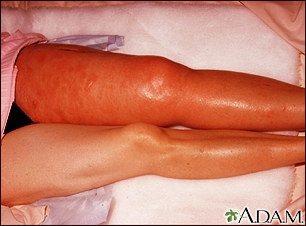
This picture shows a red and swollen thigh and leg caused by a blood clot (thrombus) in the deep veins in the groin (iliofemoral veins) which prevents normal return of blood from the leg to the heart.

Illustration

Thrombus - Illustration Thumbnail

Thrombus

A thrombus is a blood clot that forms in a vessel and remains there. An embolism is a clot that travels from the site where it formed to another location in the body. Thrombi or emboli can lodge in a blood vessel and block the flow of blood in that location depriving tissues of normal blood flow and oxygen. This can result in damage, destruction (infarction), or even death of the tissues (necrosis) in that area.

Illustration

Deep venous thrombosis - iliofemoral - Illustration Thumbnail

Deep venous thrombosis - iliofemoral

This picture shows a red and swollen thigh and leg caused by a blood clot (thrombus) in the deep veins in the groin (iliofemoral veins) which prevents normal return of blood from the leg to the heart.

Illustration


The information provided herein should not be used during any medical emergency or for the diagnosis or treatment of any medical condition. A licensed medical professional should be consulted for diagnosis and treatment of any and all medical conditions. Links to other sites are provided for information only -- they do not constitute endorsements of those other sites. No warranty of any kind, either expressed or implied, is made as to the accuracy, reliability, timeliness, or correctness of any translations made by a third-party service of the information provided herein into any other language.

© 1997- A.D.A.M., a business unit of Ebix, Inc. Any duplication or distribution of the information contained herein is strictly prohibited.

All content on this site including text, images, graphics, audio, video, data, metadata, and compilations is protected by copyright and other intellectual property laws. You may view the content for personal, noncommercial use. Any other use requires prior written consent from Ebix. You may not copy, reproduce, distribute, transmit, display, publish, reverse-engineer, adapt, modify, store beyond ordinary browser caching, index, mine, scrape, or create derivative works from this content. You may not use automated tools to access or extract content, including to create embeddings, vectors, datasets, or indexes for retrieval systems. Use of any content for training, fine-tuning, calibrating, testing, evaluating, or improving AI systems of any kind is prohibited without express written consent. This includes large language models, machine learning models, neural networks, generative systems, retrieval-augmented systems, and any software that ingests content to produce outputs. Any unauthorized use of the content including AI-related use is a violation of our rights and may result in legal action, damages, and statutory penalties to the fullest extent permitted by law. Ebix reserves the right to enforce its rights through legal, technological, and contractual measures.
© 1997- adam.com All rights reserved.