
Fibrous dysplasia

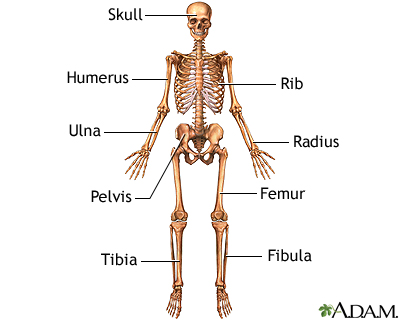
Anterior skeletal anatomy
Schedule an Appointment
Definition
Fibrous dysplasia is a bone disease that destroys and replaces normal bone with fibrous bone tissue. One or more bones can be affected.
Causes
Fibrous dysplasia usually occurs in childhood. Most people have symptoms by the time they are 30 years old. The disease occurs more often in females.
Fibrous dysplasia is linked to a problem with a specific gene that control bone-producing cells. The problem occurs when a baby is developing in the womb. The condition is not passed from parent to child.
Symptoms
Symptoms may include any of the following:
- Bone pain
- Bone sores (lesions)
- Hormone (endocrine gland) problems
- Fractures or bone deformities
- Unusual skin color (pigmentation), which occurs with McCune-Albright syndrome
The bone lesions may stop when the child reaches puberty.
Exams and Tests
Your child's health care provider will perform a physical examination. X-rays of bones are taken. An MRI may be recommended.
Treatment
There is no cure for fibrous dysplasia. Bone fractures or deformities are treated as needed. Hormone problems will need to be treated.
Outlook (Prognosis)
The outlook depends on the severity of the condition and the symptoms that occur.
Possible Complications
Depending on the bones that are affected, health problems that may result include:
- If a skull bone is affected, there can be vision or hearing loss
- If a leg bone is affected, there can be difficulty walking and joint problems such as arthritis
When to Contact a Medical Professional
Contact your provider if your child has symptoms of this condition, such as repeated bone fractures and unexplained bone deformity.
Specialists in orthopedics, endocrinology, and genetics may be involved in your child's diagnosis and care.
Prevention
There is no known way to prevent fibrous dysplasia. Treatment aims to prevent complications, such as recurrent bone fractures, to help make the condition less severe.
References
Gun ZH, Arif A, Boyce AM. Fibrous dysplasia in children and its management. Curr Opin Endocrinol Diabetes Obes. 2024;31(1):60-66. PMID: 38010041 pubmed.ncbi.nlm.nih.gov/38010041/.
Nadol JB, Quesnel AM. Otologic manifestations of systemic disease. In: Flint PW, Francis HW, Haughey BH, et al, eds. Cummings Otolaryngology: Head and Neck Surgery. 7th ed. Philadelphia, PA: Elsevier; 2021:chap 151.
Nicolai P, Mattavelli D, Castelnuovo P. Benign tumors of the sinonasal tract. In: Flint PW, Francis HW, Haughey BH, et al, eds. Cummings Otolaryngology: Head and Neck Surgery. 7th ed. Philadelphia, PA: Elsevier; 2021:chap 50.
Shiflett JM, Carroll BW. Skull lesions in children. In: Winn HR, ed. Youmans and Winn Neurological Surgery. 8th ed. Philadelphia, PA: Elsevier; 2023:chap 245.
Toy PC, Heck RK. Benign bone tumors and nonneoplastic conditions simulating bone tumors. In: Azar FM, Beaty JH, eds. Campbell's Operative Orthopaedics. 14th ed. Philadelphia, PA: Elsevier; 2021:chap 25.

Review Date: 10/1/2025
Reviewed By: Charles I. Schwartz, MD, FAAP, Clinical Assistant Professor of Pediatrics, Regional Medical Director of Penn Medicine Primary and Specialty Care, Perelman School of Medicine at the University of Pennsylvania, General Pediatrician at PennCare for Kids, Phoenixville, PA. Also reviewed by David C. Dugdale, MD, Medical Director, Brenda Conaway, Editorial Director, and the A.D.A.M. Editorial team.
The information provided herein should not be used during any medical emergency or for the diagnosis or treatment of any medical condition. A licensed medical professional should be consulted for diagnosis and treatment of any and all medical conditions. Links to other sites are provided for information only -- they do not constitute endorsements of those other sites. No warranty of any kind, either expressed or implied, is made as to the accuracy, reliability, timeliness, or correctness of any translations made by a third-party service of the information provided herein into any other language.
© 1997-
A.D.A.M., a business unit of Ebix, Inc. Any duplication or distribution of the information contained herein is strictly prohibited.
All content on this site including text, images, graphics, audio, video, data, metadata, and compilations is protected by copyright and other intellectual property laws. You may view the content for personal, noncommercial use. Any other use requires prior written consent from Ebix. You may not copy, reproduce, distribute, transmit, display, publish, reverse-engineer, adapt, modify, store beyond ordinary browser caching, index, mine, scrape, or create derivative works from this content. You may not use automated tools to access or extract content, including to create embeddings, vectors, datasets, or indexes for retrieval systems. Use of any content for training, fine-tuning, calibrating, testing, evaluating, or improving AI systems of any kind is prohibited without express written consent. This includes large language models, machine learning models, neural networks, generative systems, retrieval-augmented systems, and any software that ingests content to produce outputs. Any unauthorized use of the content including AI-related use is a violation of our rights and may result in legal action, damages, and statutory penalties to the fullest extent permitted by law. Ebix reserves the right to enforce its rights through legal, technological, and contractual measures.
 All rights reserved