
Kuru

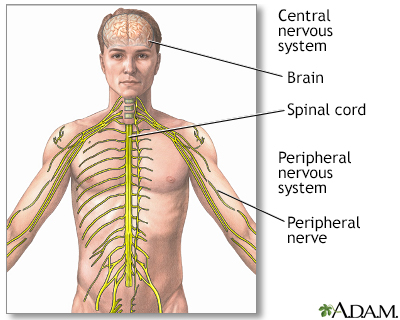
Central nervous system and peripheral nervous system
Schedule an Appointment
Definition
Kuru is a disease of the nervous system.
Causes
Kuru is a very rare disease. It is caused by an infectious protein (prion) found in contaminated human brain tissue.
Kuru is found among people from New Guinea who practiced a form of cannibalism in which they ate the brains of dead people as part of a funeral ritual. This practice stopped in 1960, but cases of kuru were reported for many years afterward because the disease has a long incubation period. The incubation period is the time it takes for symptoms to appear after being exposed to the agent that causes disease.
Kuru causes brain and nervous system changes similar to Creutzfeldt-Jakob disease. Similar diseases appear in cows as bovine spongiform encephalopathy (BSE), also called mad cow disease.
The main risk factor for kuru is eating human brain tissue, which can contain the infectious particles.
Symptoms
Symptoms of kuru include:
- Arm and leg pain
- Coordination problems that become severe
- Difficulty walking
- Headache
- Swallowing difficulty
- Tremors and muscle jerks
Difficulty swallowing and being unable to feed oneself can lead to malnutrition or starvation.
The average incubation period is 10 to 13 years, but an incubation period of 50 years or longer has also been reported.
Exams and Tests
A neurologic exam may show changes in coordination and walking ability.
Treatment
There is no known treatment for kuru.
Outlook (Prognosis)
Death usually occurs within 1 year after the first sign of symptoms.
When to Contact a Medical Professional
See your health care provider if you have any walking, swallowing, or coordination problems. Kuru is extremely rare. Your provider will check for other nervous system diseases.
References
Bosque PJ, Tyler KL. Prions and prion disease of the central nervous system (transmissible neurodegenerative diseases). In: Bennett JE, Dolin R, Blaser MJ, eds. Mandell, Douglas, and Bennett's Principles and Practice of Infectious Diseases. 9th ed. Philadelphia, PA: Elsevier; 2020:chap 179.
Tee BL, Geschwind MD. Prion diseases. In: Jankovic J, Mazziotta JC, Pomeroy SL, Newman NJ, eds. Bradley and Daroff's Neurology in Clinical Practice. 8th ed. Philadelphia, PA: Elsevier; 2022:chap 94.

Review Date: 11/10/2024
Reviewed By: Jatin M. Vyas, MD, PhD, Roy and Diana Vagelos Professor in Medicine, Columbia University Vagelos College of Physicians and Surgeons, Division of Infectious Diseases, Department of Medicine, New York, NY. Also reviewed by David C. Dugdale, MD, Medical Director, Brenda Conaway, Editorial Director, and the A.D.A.M. Editorial team.
The information provided herein should not be used during any medical emergency or for the diagnosis or treatment of any medical condition. A licensed medical professional should be consulted for diagnosis and treatment of any and all medical conditions. Links to other sites are provided for information only -- they do not constitute endorsements of those other sites. No warranty of any kind, either expressed or implied, is made as to the accuracy, reliability, timeliness, or correctness of any translations made by a third-party service of the information provided herein into any other language.
© 1997-
A.D.A.M., a business unit of Ebix, Inc. Any duplication or distribution of the information contained herein is strictly prohibited.
All content on this site including text, images, graphics, audio, video, data, metadata, and compilations is protected by copyright and other intellectual property laws. You may view the content for personal, noncommercial use. Any other use requires prior written consent from Ebix. You may not copy, reproduce, distribute, transmit, display, publish, reverse-engineer, adapt, modify, store beyond ordinary browser caching, index, mine, scrape, or create derivative works from this content. You may not use automated tools to access or extract content, including to create embeddings, vectors, datasets, or indexes for retrieval systems. Use of any content for training, fine-tuning, calibrating, testing, evaluating, or improving AI systems of any kind is prohibited without express written consent. This includes large language models, machine learning models, neural networks, generative systems, retrieval-augmented systems, and any software that ingests content to produce outputs. Any unauthorized use of the content including AI-related use is a violation of our rights and may result in legal action, damages, and statutory penalties to the fullest extent permitted by law. Ebix reserves the right to enforce its rights through legal, technological, and contractual measures.
 All rights reserved