
Tapeworm infection - beef or pork

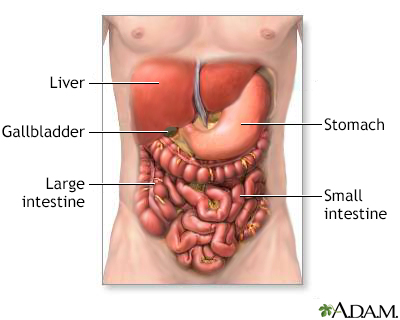
Digestive system organs
Schedule an Appointment
Definition
Beef or pork tapeworm infection is an infection with the tapeworm parasite found in beef or pork.
Causes
A tapeworm infection is caused by eating the raw or undercooked meat of infected animals. Cattle usually carry Taenia saginata (T saginata). Pigs carry Taenia solium (T solium).
In the human intestine, the young form of the tapeworm from the infected meat (larva) develops into the adult tapeworm. A tapeworm can grow to longer than 12 feet (3.6 meters) and can live for years.
Tapeworms have many segments. Each segment is able to produce eggs. The eggs are spread alone or in groups and can be passed out with the stool or through the anus.
Adults and children with pork tapeworm can infect themselves if they have poor hygiene. They can ingest tapeworm eggs they pick up on their hands while wiping or scratching their anus or the skin around it.
Those who are infected can expose other people to T solium eggs, usually through food handling.
Symptoms
Tapeworm infection usually does not cause any symptoms. Some people may have abdominal discomfort.
People often realize they are infected when they pass segments of the worm in their stool, especially if the segments are moving.
Exams and Tests
Tests that may be done to confirm the diagnosis of an infection include:
- CBC, including white blood cell differential count
- Stool exam for eggs of T solium or T saginata, or the worm itself
Treatment
Tapeworms are treated with medicines taken by mouth, usually in a single dose. The medicine of choice for tapeworm infections is praziquantel.
Outlook (Prognosis)
With treatment, the tapeworm infection goes away.
Possible Complications
In rare cases, worms can cause a blockage in the intestine.
If pork tapeworm larvae move out of the intestine, they can cause local growths and damage tissues such as the brain, eye, or heart. This condition is called cysticercosis. Infection of the brain (neurocysticercosis) can cause seizures and other nervous system problems.
When to Contact a Medical Professional
Contact your health care provider if you pass something in your stool that looks like a white worm.
Prevention
In the United States, laws on feeding practices and the inspection of domestic food animals have largely eliminated tapeworms.
Measures you can take to prevent tapeworm infection include:
- Do not eat raw meat.
- Cook whole cut meat to 145°F (63°C) and ground meat to 160°F (71°C). Use a food thermometer to measure the thickest part of the meat.
- Freezing meat is not reliable because it may not kill all eggs.
- Wash hands well after using the toilet, especially after a bowel movement.
References
Fairley JK, O'Connell EM. Tapeworms (cestodes). In: Blaser MJ, Cohen JI, Holland SM, et al, eds. Mandell, Douglas, and Bennett's Principles and Practice of Infectious Diseases. 10th ed. Philadelphia, PA: Elsevier; 2026:chap 295.
Fischer PR, White AC. Adult tapeworm infections. In: Kliegman RM, St. Geme JW, Blum NJ, et al, eds. Nelson Textbook of Pediatrics. 22nd ed. Philadelphia, PA: Elsevier; 2025:chap 348.
White AC, Brunetti E. Cestodes. In: Goldman L, Cooney KA, eds. Goldman-Cecil Medicine. 27th ed. Philadelphia, PA: Elsevier; 2024:chap 325.

Review Date: 8/5/2025
Reviewed By: Jatin M. Vyas, MD, PhD, Roy and Diana Vagelos Professor in Medicine, Columbia University Vagelos College of Physicians and Surgeons, Division of Infectious Diseases, Department of Medicine, New York, NY. Also reviewed by David C. Dugdale, MD, Medical Director, Brenda Conaway, Editorial Director, and the A.D.A.M. Editorial team.
The information provided herein should not be used during any medical emergency or for the diagnosis or treatment of any medical condition. A licensed medical professional should be consulted for diagnosis and treatment of any and all medical conditions. Links to other sites are provided for information only -- they do not constitute endorsements of those other sites. No warranty of any kind, either expressed or implied, is made as to the accuracy, reliability, timeliness, or correctness of any translations made by a third-party service of the information provided herein into any other language.
© 1997-
A.D.A.M., a business unit of Ebix, Inc. Any duplication or distribution of the information contained herein is strictly prohibited.
All content on this site including text, images, graphics, audio, video, data, metadata, and compilations is protected by copyright and other intellectual property laws. You may view the content for personal, noncommercial use. Any other use requires prior written consent from Ebix. You may not copy, reproduce, distribute, transmit, display, publish, reverse-engineer, adapt, modify, store beyond ordinary browser caching, index, mine, scrape, or create derivative works from this content. You may not use automated tools to access or extract content, including to create embeddings, vectors, datasets, or indexes for retrieval systems. Use of any content for training, fine-tuning, calibrating, testing, evaluating, or improving AI systems of any kind is prohibited without express written consent. This includes large language models, machine learning models, neural networks, generative systems, retrieval-augmented systems, and any software that ingests content to produce outputs. Any unauthorized use of the content including AI-related use is a violation of our rights and may result in legal action, damages, and statutory penalties to the fullest extent permitted by law. Ebix reserves the right to enforce its rights through legal, technological, and contractual measures.
 All rights reserved