
Alopecia areata

Definition
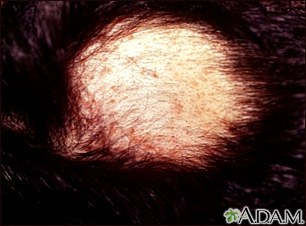
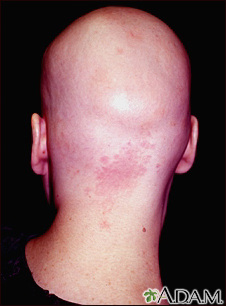
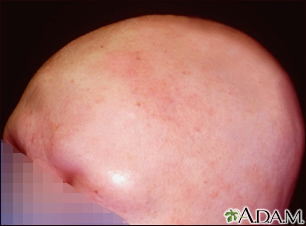
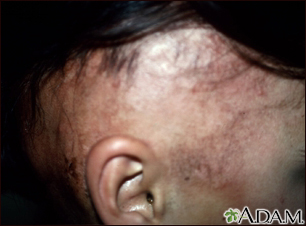
Alopecia areata is a condition that causes round patches of hair loss. It can lead to total hair loss.
Causes
Alopecia areata is thought to be an autoimmune condition. This occurs when the immune system mistakenly attacks and destroys healthy hair follicles.
Some people with this condition have a family history of alopecia. Alopecia areata is seen in men, women, and children. In a few people, hair loss may occur after a major life event such as an illness, pregnancy, or trauma.
Symptoms
Hair loss is usually the only symptom. A few people may also feel a burning sensation or itching.
Alopecia areata usually begins as one to several patches of hair loss about 0.4 inches (1 centimeter) to 1.6 in (4 cm). Hair loss is most often seen on the scalp. It may also occur in the beard, eyebrows, pubic hair, and arms or legs in some people. Nail pitting may also occur.
Patches where hair has fallen out are smooth and round in shape. They may be peach-colored. Hairs that look like exclamation points are sometimes seen at the edges of a bald patch with a magnifying tool.
If alopecia areata leads to total hair loss, it often occurs within 6 months after symptoms first start. This is called alopecia totalis when the entire scalp is involved, and alopecia universalis when the entire body is affected.
Exams and Tests
Your health care provider will examine you and ask about your symptoms, focusing on areas where you have hair loss.
A scalp biopsy may be done. Blood tests may also be done to check for autoimmune conditions and thyroid problems.
Treatment
If hair loss is not widespread, the hair may regrow in a few months without treatment.
For more severe hair loss, it is not clear how much treatment can help change the course of the condition.
Common treatments may include:
- Steroid injection under the skin surface
- Medicines applied to the skin
- Ultraviolet light therapy
JAK inhibitors are a newer treatment that can target the immune response. These are medicines taken in pill form for severe cases of alopecia areata.
A wig may be used to hide areas of hair loss.
Support Groups
More information and support for people with alopecia areata and their families can be found at:
- National Alopecia Areata Foundation -- www.naaf.org
Outlook (Prognosis)
Full recovery of hair loss is common.
However, some people may have a poorer outcome, including those with:
- Alopecia areata that starts at a young age
- Eczema
- Long-term alopecia
- Widespread or complete loss of scalp or body hair
When to Contact a Medical Professional
Contact your provider if you are concerned about hair loss.
References
Dinulos JGH. Hair diseases. In: Dinulos JGH, ed. Habif's Clinical Dermatology. 7th ed. Philadelphia, PA: Elsevier; 2021:chap 24.
Gawkrodger DJ, Ardern-Jones MR. Disorders of hair. In: Gawkrodger DJ, Ardern-Jones MR, eds. Dermatology: An Illustrated Colour Text. 7th ed. Philadelphia, PA: Elsevier; 2021:chap 38.

Review Date: 10/14/2024
Reviewed By: Elika Hoss, MD, Assistant Professor of Dermatology, Mayo Clinic, Scottsdale, AZ. Also reviewed by David C. Dugdale, MD, Medical Director, Brenda Conaway, Editorial Director, and the A.D.A.M. Editorial team.
The information provided herein should not be used during any medical emergency or for the diagnosis or treatment of any medical condition. A licensed medical professional should be consulted for diagnosis and treatment of any and all medical conditions. Links to other sites are provided for information only -- they do not constitute endorsements of those other sites. No warranty of any kind, either expressed or implied, is made as to the accuracy, reliability, timeliness, or correctness of any translations made by a third-party service of the information provided herein into any other language.
© 1997-
A.D.A.M., a business unit of Ebix, Inc. Any duplication or distribution of the information contained herein is strictly prohibited.
All content on this site including text, images, graphics, audio, video, data, metadata, and compilations is protected by copyright and other intellectual property laws. You may view the content for personal, noncommercial use. Any other use requires prior written consent from Ebix. You may not copy, reproduce, distribute, transmit, display, publish, reverse-engineer, adapt, modify, store beyond ordinary browser caching, index, mine, scrape, or create derivative works from this content. You may not use automated tools to access or extract content, including to create embeddings, vectors, datasets, or indexes for retrieval systems. Use of any content for training, fine-tuning, calibrating, testing, evaluating, or improving AI systems of any kind is prohibited without express written consent. This includes large language models, machine learning models, neural networks, generative systems, retrieval-augmented systems, and any software that ingests content to produce outputs. Any unauthorized use of the content including AI-related use is a violation of our rights and may result in legal action, damages, and statutory penalties to the fullest extent permitted by law. Ebix reserves the right to enforce its rights through legal, technological, and contractual measures.
 All rights reserved