
Ectodermal dysplasias

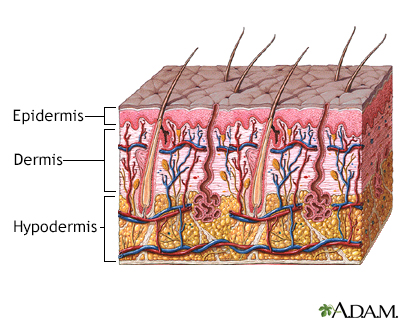
Skin layers
Schedule an Appointment
Definition
Ectodermal dysplasias is a group of conditions in which there is abnormal development of the skin, hair, nails, teeth, or sweat glands.
Causes
There are many different types of ectodermal dysplasias. Each type of dysplasia is caused by specific variants in certain genes. Dysplasia means abnormal development of cells or tissues. The most common form of ectodermal dysplasia usually affects men. Other forms of the condition affect men and women equally.
Symptoms
People with ectodermal dysplasia have a lack of sweat glands. This means they may not sweat or sweat less than normal.
In children with ectodermal dysplasia, their bodies may have a problem controlling fevers. When the skin cannot sweat, it is hard for the body to control temperature properly. So even a mild illness can cause a very high fever.
Adults with ectodermal dysplasia can't tolerate a warm environment. Air conditioning and other measures are needed to keep a normal body temperature.
Depending on which genes are affected, other symptoms may include:
- Abnormal nails
- Abnormal or missing teeth, or fewer than normal number of teeth
- Cleft lip
- Decreased skin color (pigment)
- Large forehead
- Low nasal bridge
- Thin, sparse hair
- Learning disabilities
- Poor hearing
- Poor vision with decreased tear production
- Weakened immune system
Exams and Tests
Tests that may be done include:
- Biopsy of the mucous membranes
- Biopsy of the skin
- Genetic testing (available for some types of this disorder)
- X-rays of the teeth or bones may be done
Treatment
There is no specific treatment for these conditions. Instead, symptoms are treated as needed.
Things you can do may include:
- Wear a wig and dentures to feel more comfortable about appearance.
- Use artificial tears to prevent dry eyes.
- Use saline nose spray to remove debris and prevent infection.
- Take cooling water baths or use water sprays to keep a normal body temperature. Water evaporating from the skin replaces the cooling function of sweat evaporating from the skin.
Support Groups
These resources can provide more information on ectodermal dysplasias:
- National Foundation for Ectodermal Dysplasias -- www.nfed.org
- NIH Genetic and Rare Diseases Information Center -- rarediseases.info.nih.gov/diseases/6317/ectodermal-dysplasia
Outlook (Prognosis)
If you have a common variant of ectodermal dysplasia, this will not shorten your lifespan. However, you may need to pay attention to temperature changes and other problems associated with this condition.
Possible Complications
If untreated, health problems from this condition may include:
- Brain damage caused by increased body temperature
- Seizures caused by high fever (febrile seizures)
When to Contact a Medical Professional
Contact your health care provider if your child shows symptoms of ectodermal dysplasia.
Prevention
If you have a family history of ectodermal dysplasia, and you are planning to have children, genetic counseling is recommended. Often, it is possible to diagnose ectodermal dysplasia while the baby is still in the womb.
References
Bayliss SJ, Kumar MG, Hernandez-Martin A, et al. Other genodermatoses. In: Bolognia JL, Schaffer JV, Cerroni L, eds. Dermatology. 5th ed. Philadelphia, PA: Elsevier; 2025:chap 63.
Martin KL. Ectodermal dysplasias. In: Kliegman RM, St. Geme JW, Blum NJ, et al, eds. Nelson Textbook of Pediatrics. 22nd ed. Philadelphia, PA: Elsevier; 2025:chap 690.
Narendran V. The skin of the neonate. In: Martin RJ, Fanaroff AA, eds. Fanaroff and Martin's Neonatal-Perinatal Medicine. 12th ed. Philadelphia, PA: Elsevier; 2025:chap 98.

Review Date: 8/2/2025
Reviewed By: Ramin Fathi, MD, FAAD, Director, Phoenix Surgical Dermatology Group, Phoenix, AZ. Also reviewed by David C. Dugdale, MD, Medical Director, Brenda Conaway, Editorial Director, and the A.D.A.M. Editorial team.
The information provided herein should not be used during any medical emergency or for the diagnosis or treatment of any medical condition. A licensed medical professional should be consulted for diagnosis and treatment of any and all medical conditions. Links to other sites are provided for information only -- they do not constitute endorsements of those other sites. No warranty of any kind, either expressed or implied, is made as to the accuracy, reliability, timeliness, or correctness of any translations made by a third-party service of the information provided herein into any other language.
© 1997-
A.D.A.M., a business unit of Ebix, Inc. Any duplication or distribution of the information contained herein is strictly prohibited.
All content on this site including text, images, graphics, audio, video, data, metadata, and compilations is protected by copyright and other intellectual property laws. You may view the content for personal, noncommercial use. Any other use requires prior written consent from Ebix. You may not copy, reproduce, distribute, transmit, display, publish, reverse-engineer, adapt, modify, store beyond ordinary browser caching, index, mine, scrape, or create derivative works from this content. You may not use automated tools to access or extract content, including to create embeddings, vectors, datasets, or indexes for retrieval systems. Use of any content for training, fine-tuning, calibrating, testing, evaluating, or improving AI systems of any kind is prohibited without express written consent. This includes large language models, machine learning models, neural networks, generative systems, retrieval-augmented systems, and any software that ingests content to produce outputs. Any unauthorized use of the content including AI-related use is a violation of our rights and may result in legal action, damages, and statutory penalties to the fullest extent permitted by law. Ebix reserves the right to enforce its rights through legal, technological, and contractual measures.
 All rights reserved