
Dermal melanocytosis

Definition
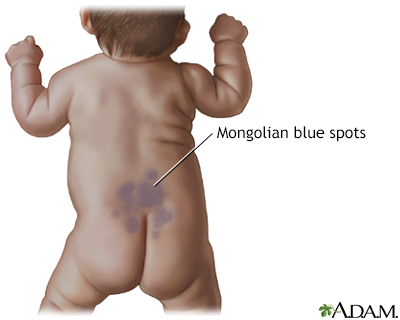
Dermal melanocytosis is the name of a kind of birthmark that is flat and blue, or blue-gray in color. They appear at birth or in the first few weeks of life. Dermal melanocytosis was formerly called Mongolian blue spots.
Causes
Dermal melanocytosis is common among people of Asian, Native American, Hispanic, East Indian, and African descent.
The color of the birth mark is from a collection of melanocytes in the deeper layers of the skin. Melanocytes are cells that make the pigment (color) in the skin.
Symptoms
Dermal melanocytosis is not cancerous and is not associated with disease. The markings may cover a large area of the back.
The markings are usually:
- Blue or blue-gray spots on the back, buttocks, base of spine, shoulders, or other body areas
- Flat with irregular shape and unclear edges
- Normal in skin texture
- 0.79 to 3.15 inches (in) or 2 to 8 centimeters (cm) wide or larger
Dermal melanocytosis is sometimes mistaken for bruises. This can raise a question about possible child abuse. It is important to recognize that dermal melanocytosis is a birthmark, not bruises.
Exams and Tests
No tests are needed. Your health care provider can diagnose this condition by looking at the skin.
If your provider suspects an underlying disorder, further tests will be done.
Treatment
No treatment is needed when dermal melanocytosis is a normal birthmark. If treatment is needed, lasers may be used.
Spots may be a sign of an underlying disorder. If so, treatment for that problem will likely be recommended. Your provider can tell you more.
Outlook (Prognosis)
Spots that are normal birthmarks often fade in a few years. They are almost always gone by the teen years.
When to Contact a Medical Professional
All birthmarks should be examined by a provider during the routine newborn examination.
References
James WD. Melanocytic nevi and neoplasms. In: James WD, ed. Andrews' Diseases of the Skin: Clinical Dermatology. 14th ed. Philadelphia, PA: Elsevier; 2026:chap 25.
Martin KL. Cutaneous nevi. In: Kliegman RM, St. Geme JW, Blum NJ, et al, eds. Nelson Textbook of Pediatrics. 22nd ed. Philadelphia, PA: Elsevier; 2025:chap 692.

Review Date: 6/3/2025
Reviewed By: Ramin Fathi, MD, FAAD, Director, Phoenix Surgical Dermatology Group, Phoenix, AZ. Also reviewed by David C. Dugdale, MD, Medical Director, Brenda Conaway, Editorial Director, and the A.D.A.M. Editorial team.
The information provided herein should not be used during any medical emergency or for the diagnosis or treatment of any medical condition. A licensed medical professional should be consulted for diagnosis and treatment of any and all medical conditions. Links to other sites are provided for information only -- they do not constitute endorsements of those other sites. No warranty of any kind, either expressed or implied, is made as to the accuracy, reliability, timeliness, or correctness of any translations made by a third-party service of the information provided herein into any other language.
© 1997-
A.D.A.M., a business unit of Ebix, Inc. Any duplication or distribution of the information contained herein is strictly prohibited.
All content on this site including text, images, graphics, audio, video, data, metadata, and compilations is protected by copyright and other intellectual property laws. You may view the content for personal, noncommercial use. Any other use requires prior written consent from Ebix. You may not copy, reproduce, distribute, transmit, display, publish, reverse-engineer, adapt, modify, store beyond ordinary browser caching, index, mine, scrape, or create derivative works from this content. You may not use automated tools to access or extract content, including to create embeddings, vectors, datasets, or indexes for retrieval systems. Use of any content for training, fine-tuning, calibrating, testing, evaluating, or improving AI systems of any kind is prohibited without express written consent. This includes large language models, machine learning models, neural networks, generative systems, retrieval-augmented systems, and any software that ingests content to produce outputs. Any unauthorized use of the content including AI-related use is a violation of our rights and may result in legal action, damages, and statutory penalties to the fullest extent permitted by law. Ebix reserves the right to enforce its rights through legal, technological, and contractual measures.
 All rights reserved