
Trichotillomania

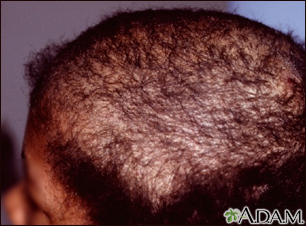
Trichotillomania - top of the head
Schedule an Appointment
Definition
Trichotillomania is hair loss from repeated urges to pull or twist the hair until it breaks off. People are unable to stop this behavior, even as their hair becomes thinner.
Causes
Trichotillomania is a type of impulsive control disorder. Its causes are not clearly understood.
It may affect as much as 4% of the population. Women are 4 times more likely to be affected than men.
Symptoms
Symptoms most often begin before age 17. The hair may come out in round patches or across the scalp. The effect is an uneven appearance. The person may pluck other hairy areas, such as the eyebrows, eyelashes, or body hair.
These symptoms are most often seen in children:
- An uneven appearance to the hair
- Bare patches or all around (diffuse) loss of hair
- Bowel blockage (obstruction) if people eat the hair they pull out
- Constant tugging, pulling, or twisting of hair
- Denying the hair pulling
- Hair regrowth that feels like stubble in the bare spots
- Increasing sense of tension before the hair pulling
- Other self-injury behaviors
- Sense of relief, pleasure, or gratification after the hair pulling
Most people with this disorder also have problems with:
- Feeling sad or depressed
- Anxiety
- Poor self-image
Exams and Tests
Your health care provider will examine your skin, hair, and scalp. A piece of tissue may be removed (biopsy) to find other causes, such as a scalp infection, and to explain the hair loss.
Treatment
Experts don't agree on the use of medicine for treatment. However, naltrexone and selective serotonin reuptake inhibitors (SSRIs) have been shown to be effective in reducing some symptoms. Behavioral therapy and habit reversal may also be effective.
Outlook (Prognosis)
Trichotillomania that begins in younger children (less than 6 years old) may go away without treatment. For most people, the hair pulling ends within 12 months.
For others, trichotillomania is a lifelong disorder. However, treatment often improves the hair pulling and the feelings of depression, anxiety, or poor self-image.
Possible Complications
People can have complications when they eat the pulled-out hair (trichophagia). This can cause a blockage in the intestines or lead to poor nutrition.
Prevention
Early detection is the best form of prevention because it leads to early treatment. Decreasing stress can help, because stress may increase compulsive behavior.
References
American Psychiatric Association website. Obsessive-compulsive and related disorders. Diagnostic and Statistical Manual of Mental Disorders. 5th ed. Text Revision (DSM-5-TR), Washington, DC: American Psychiatric Association Publishing; 2022.
Bains A, Sanders KM. Disruptive, impulse-control, and conduct disorders. In: Stern TA, Wilens TE, Fava M, eds. Massachusetts General Hospital Comprehensive Clinical Psychiatry. 3rd ed. Philadelphia, PA: Elsevier; 2025:chap 23.
Martin KL. Disorders of hair. In: Kliegman RM, St. Geme JW, Blum NJ, et al, eds. Nelson Textbook of Pediatrics. 22nd ed. Philadelphia, PA: Elsevier; 2025:chap 703.
Review Date: 5/4/2024
Reviewed By: Fred K. Berger, MD, addiction and forensic psychiatrist, Scripps Memorial Hospital, La Jolla, CA. Also reviewed by David C. Dugdale, MD, Medical Director, Brenda Conaway, Editorial Director, and the A.D.A.M. Editorial team.
The information provided herein should not be used during any medical emergency or for the diagnosis or treatment of any medical condition. A licensed medical professional should be consulted for diagnosis and treatment of any and all medical conditions. Links to other sites are provided for information only -- they do not constitute endorsements of those other sites. No warranty of any kind, either expressed or implied, is made as to the accuracy, reliability, timeliness, or correctness of any translations made by a third-party service of the information provided herein into any other language.
© 1997-
A.D.A.M., a business unit of Ebix, Inc. Any duplication or distribution of the information contained herein is strictly prohibited.
All content on this site including text, images, graphics, audio, video, data, metadata, and compilations is protected by copyright and other intellectual property laws. You may view the content for personal, noncommercial use. Any other use requires prior written consent from Ebix. You may not copy, reproduce, distribute, transmit, display, publish, reverse-engineer, adapt, modify, store beyond ordinary browser caching, index, mine, scrape, or create derivative works from this content. You may not use automated tools to access or extract content, including to create embeddings, vectors, datasets, or indexes for retrieval systems. Use of any content for training, fine-tuning, calibrating, testing, evaluating, or improving AI systems of any kind is prohibited without express written consent. This includes large language models, machine learning models, neural networks, generative systems, retrieval-augmented systems, and any software that ingests content to produce outputs. Any unauthorized use of the content including AI-related use is a violation of our rights and may result in legal action, damages, and statutory penalties to the fullest extent permitted by law. Ebix reserves the right to enforce its rights through legal, technological, and contractual measures.
 All rights reserved