Doctor of osteopathic medicine
Osteopathic physician
A doctor of osteopathic medicine (DO) is a physician licensed to practice medicine, perform surgery, and prescribe medicine.
Images
Information
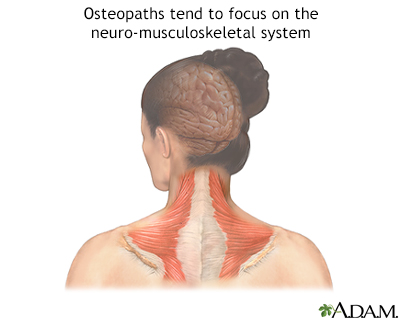
Like all allopathic physicians (or MDs), osteopathic physicians complete 4 years of medical school and can choose to practice in any specialty of medicine. However, osteopathic physicians receive an additional 300 to 500 hours in the study of hands-on manual medicine and the body's musculoskeletal system, called osteopathic manipulative therapy (OMT).
Osteopathic physicians hold to the principle that a person's history of illness and physical trauma are written into the body's structure. The osteopathic physician's highly developed sense of touch allows the physician to feel (palpate) the person's living anatomy (the flow of fluids, motion and texture of tissues, and structural makeup).
Like MDs, osteopathic physicians are licensed at the state level. Osteopathic physicians who wish to specialize may become board certified (in the same manner as MDs) by completing a 2- to 6-year residency within the specialty area, often side-by-side with MDs, and passing the same board certification exams as MDs.
DOs practice in all specialties of medicine, ranging from emergency medicine and cardiovascular surgery to psychiatry and geriatrics. Osteopathic physicians use the same medical and surgical treatments that are used by other medical doctors, but may also incorporate a holistic approach taught during their medical training and use OMT if indicated.
References
American Association of Colleges of Osteopathic Medicine website. What is osteopathic medicine? www.aacom.org/become-a-doctor/about-osteopathic-medicine. Accessed November 6, 2024.
Gevitz N. The "doctor of osteopathy": expanding the scope of practice. J Am Osteopath Assoc. 2014;114(3):200-212. PMID: 24567273 pubmed.ncbi.nlm.nih.gov/24567273/.
Stark J. A degree of difference: the origins of osteopathy and the first use of the "DO" designation. J Am Osteopath Assoc. 2014;114(8):615-617. PMID: 25082967 pubmed.ncbi.nlm.nih.gov/25082967/.
Thomson OP, Petty NJ, Moore AP. A qualitative grounded theory study of the conceptions of clinical practice in osteopathy - a continuum from technical rationality to professional artistry. Man Ther. 2014;19(1):37-43. PMID: 23911356 pubmed.ncbi.nlm.nih.gov/23911356/.
BACK TO TOPReview Date: 10/16/2024
Reviewed By: Allen J. Blaivas, DO, Division of Pulmonary, Critical Care, and Sleep Medicine, VA New Jersey Health Care System, Clinical Assistant Professor, Rutgers New Jersey Medical School, East Orange, NJ. Review provided by VeriMed Healthcare Network. Also reviewed by David C. Dugdale, MD, Medical Director, Brenda Conaway, Editorial Director, and the A.D.A.M. Editorial team.
Health Content Provider
06/01/2028
|
A.D.A.M., Inc. is certified by URAC, for Health Content Provider (www.urac.org). URAC's certification program is an independent audit to verify that A.D.A.M. follows rigorous standards of quality and accountability. A.D.A.M. is among the first to achieve this important distinction for online health information and services. Learn more about A.D.A.M.'s editorial policy, editorial process and privacy policy. |
The information provided herein should not be used during any medical emergency or for the diagnosis or treatment of any medical condition. A licensed medical professional should be consulted for diagnosis and treatment of any and all medical conditions. Links to other sites are provided for information only -- they do not constitute endorsements of those other sites. No warranty of any kind, either expressed or implied, is made as to the accuracy, reliability, timeliness, or correctness of any translations made by a third-party service of the information provided herein into any other language.
© 1997-
2026 A.D.A.M., a business unit of Ebix, Inc. Any duplication or distribution of the information contained herein is strictly prohibited.
All content on this site including text, images, graphics, audio, video, data, metadata, and compilations is protected by copyright and other intellectual property laws. You may view the content for personal, noncommercial use. Any other use requires prior written consent from Ebix. You may not copy, reproduce, distribute, transmit, display, publish, reverse-engineer, adapt, modify, store beyond ordinary browser caching, index, mine, scrape, or create derivative works from this content. You may not use automated tools to access or extract content, including to create embeddings, vectors, datasets, or indexes for retrieval systems. Use of any content for training, fine-tuning, calibrating, testing, evaluating, or improving AI systems of any kind is prohibited without express written consent. This includes large language models, machine learning models, neural networks, generative systems, retrieval-augmented systems, and any software that ingests content to produce outputs. Any unauthorized use of the content including AI-related use is a violation of our rights and may result in legal action, damages, and statutory penalties to the fullest extent permitted by law. Ebix reserves the right to enforce its rights through legal, technological, and contractual measures.
 All rights reserved.