
Amino acids

Amino acids
Schedule an Appointment
Information
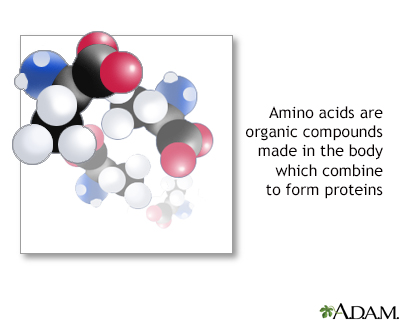
Amino acids are molecules that combine to form proteins. Amino acids and proteins are the building blocks of life.
When proteins are digested or broken down, amino acids are the result. The human body then uses amino acids to make proteins to help the body:
- Break down food
- Grow
- Repair body tissue
- Perform many other body functions
Amino acids can also be used as a source of energy by the body.
Amino acids are classified into three groups:
- Essential amino acids
- Nonessential amino acids
- Conditionally essential amino acids
ESSENTIAL AMINO ACIDS
- Essential amino acids cannot be made by the body. As a result, they must come from food.
- The 9 essential amino acids are: histidine, isoleucine, leucine, lysine, methionine, phenylalanine, threonine, tryptophan, and valine.
NONESSENTIAL AMINO ACIDS
Nonessential means that our bodies can produce the amino acid, even if we do not get it from the food we eat. Nonessential amino acids include: alanine, arginine, asparagine, aspartic acid, cysteine, glutamic acid, glutamine, glycine, proline, serine, and tyrosine.
CONDITIONALLY ESSENTIAL AMINO ACIDS
- Conditionally essential amino acids are usually not essential, except in times of illness and stress.
- Conditionally essential amino acids include: arginine, cysteine, glutamine, tyrosine, glycine, proline, and serine.
You do not need to eat essential and nonessential amino acids at every meal, but getting a balance of them over the whole day is important. A diet based on a single plant item will not be adequate, but we no longer worry about pairing proteins (such as beans with rice) at a single meal. Instead we look at the adequacy of the diet overall throughout the day.
References
Dietzen DJ, Willrich MAV. Amino acids, peptides, and proteins. In: Rifai N, Chiu RWK, Young I, Burnham Carey-Ann D, Wittwer CT, eds. Tietz Textbook of Laboratory Medicine. 7th ed. St Louis, MO: Elsevier; 2023:chap 31.
Hall JE, Hall ME. Protein metabolism. In: Hall JE, Hall ME, eds. Guyton and Hall Textbook of Medical Physiology. 14th ed. Philadelphia, PA: Elsevier; 2021:chap 70.
Institute of Medicine (US) Committee to Review Dietary Reference Intakes for Vitamin D and Calcium; Ross AC, Taylor CL, Yaktine AL, et al. Dietary reference intakes for calcium and vitamin D. National Academies Press. Washington, DC. 2011. PMID: 21796828 pubmed.ncbi.nlm.nih.gov/21796828/.
Mason JB. Nutritional principles and assessment of the gastroenterology patient. In: Feldman M, Friedman LS, Brandt LJ, eds. Sleisenger and Fordtran's Gastrointestinal and Liver Disease. 11th ed. Philadelphia, PA: Elsevier; 2021:chap 5.

Review Date: 1/21/2025
Reviewed By: Stefania Manetti, RDN, CDCES, RYT200, My Vita Sana LLC - Nourish and heal through food, San Jose, CA. Review provided by VeriMed Healthcare Network. Also reviewed by David C. Dugdale, MD, Medical Director, Brenda Conaway, Editorial Director, and the A.D.A.M. Editorial team.
The information provided herein should not be used during any medical emergency or for the diagnosis or treatment of any medical condition. A licensed medical professional should be consulted for diagnosis and treatment of any and all medical conditions. Links to other sites are provided for information only -- they do not constitute endorsements of those other sites. No warranty of any kind, either expressed or implied, is made as to the accuracy, reliability, timeliness, or correctness of any translations made by a third-party service of the information provided herein into any other language.
© 1997-
A.D.A.M., a business unit of Ebix, Inc. Any duplication or distribution of the information contained herein is strictly prohibited.
All content on this site including text, images, graphics, audio, video, data, metadata, and compilations is protected by copyright and other intellectual property laws. You may view the content for personal, noncommercial use. Any other use requires prior written consent from Ebix. You may not copy, reproduce, distribute, transmit, display, publish, reverse-engineer, adapt, modify, store beyond ordinary browser caching, index, mine, scrape, or create derivative works from this content. You may not use automated tools to access or extract content, including to create embeddings, vectors, datasets, or indexes for retrieval systems. Use of any content for training, fine-tuning, calibrating, testing, evaluating, or improving AI systems of any kind is prohibited without express written consent. This includes large language models, machine learning models, neural networks, generative systems, retrieval-augmented systems, and any software that ingests content to produce outputs. Any unauthorized use of the content including AI-related use is a violation of our rights and may result in legal action, damages, and statutory penalties to the fullest extent permitted by law. Ebix reserves the right to enforce its rights through legal, technological, and contractual measures.
 All rights reserved