
Lymph system

Definition
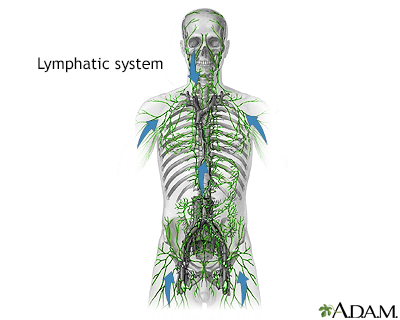
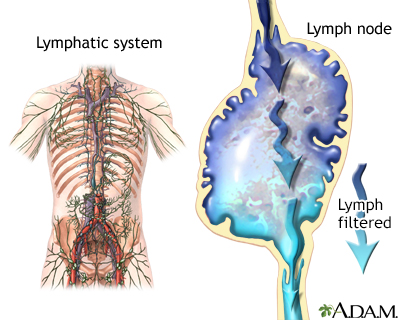
The lymph system is a network of organs, lymph nodes, lymph ducts, and lymph vessels that make and move lymph from tissues to the bloodstream. The lymph system is a major part of the body's immune system.
Information
Lymph is a clear-to-white fluid made of:
- White blood cells, especially lymphocytes, the cells that attack bacteria in the blood and body tissues
- Fluid from the intestines called chyle, which contains proteins and fats
Lymph nodes are most often soft, small, round- or bean-shaped structures. They usually cannot be seen or easily felt. They are located in clusters in various parts of the body, such as the:
- Neck
- Armpit
- Groin
- Inside the center of the chest and abdomen
Lymph nodes mainly store immune cells that help the body fight infection but are also places where these cells can be made. They also filter the lymph fluid and remove foreign material such as bacteria and cancer cells. When bacteria are recognized in the lymph fluid, the lymph nodes make more infection-fighting white blood cells. This causes the nodes to swell. The swollen nodes are sometimes felt in the neck, under the arms, and groin.
The lymph system includes the:
- Tonsils
- Adenoids
- Spleen
- Thymus
References
Ball JW, Dains JE, Flynn JA, Solomon BS, Stewart RW. Lymphatic system. In: Ball JW, Dains JE, Flynn JA, Solomon BS, Stewart RW, eds. Seidel's Guide to Physical Examination. 10th ed. Philadelphia, PA: Elsevier; 2023:chap 10.
Hall JE, Hall ME. The microcirculation and lymphatic system: capillary fluid exchange, interstitial fluid, and lymph flow. In: Hall JE, Hall ME, eds. Guyton and Hall Textbook of Medical Physiology. 14th ed. Philadelphia, PA: Elsevier; 2021:chap 16.

Review Date: 7/23/2024
Reviewed By: Linda J. Vorvick, MD, Clinical Professor, Department of Family Medicine, UW Medicine, School of Medicine, University of Washington, Seattle, WA. Also reviewed by David C. Dugdale, MD, Medical Director, Brenda Conaway, Editorial Director, and the A.D.A.M. Editorial team.
The information provided herein should not be used during any medical emergency or for the diagnosis or treatment of any medical condition. A licensed medical professional should be consulted for diagnosis and treatment of any and all medical conditions. Links to other sites are provided for information only -- they do not constitute endorsements of those other sites. No warranty of any kind, either expressed or implied, is made as to the accuracy, reliability, timeliness, or correctness of any translations made by a third-party service of the information provided herein into any other language.
© 1997-
A.D.A.M., a business unit of Ebix, Inc. Any duplication or distribution of the information contained herein is strictly prohibited.
All content on this site including text, images, graphics, audio, video, data, metadata, and compilations is protected by copyright and other intellectual property laws. You may view the content for personal, noncommercial use. Any other use requires prior written consent from Ebix. You may not copy, reproduce, distribute, transmit, display, publish, reverse-engineer, adapt, modify, store beyond ordinary browser caching, index, mine, scrape, or create derivative works from this content. You may not use automated tools to access or extract content, including to create embeddings, vectors, datasets, or indexes for retrieval systems. Use of any content for training, fine-tuning, calibrating, testing, evaluating, or improving AI systems of any kind is prohibited without express written consent. This includes large language models, machine learning models, neural networks, generative systems, retrieval-augmented systems, and any software that ingests content to produce outputs. Any unauthorized use of the content including AI-related use is a violation of our rights and may result in legal action, damages, and statutory penalties to the fullest extent permitted by law. Ebix reserves the right to enforce its rights through legal, technological, and contractual measures.
 All rights reserved