
Penis

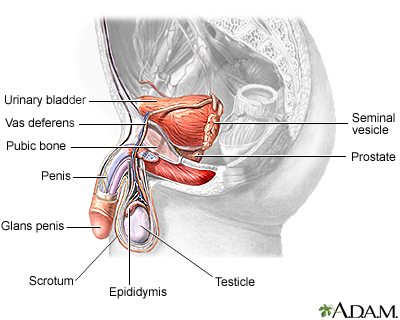
Male reproductive anatomy
Schedule an Appointment
Definition
The penis is the male organ used for urination and sexual intercourse. The penis is located above the scrotum. It is made of spongy tissue and blood vessels.
The shaft of the penis surrounds the urethra and is connected to the pubic bone.
The foreskin covers the head (glans) of the penis. The foreskin is removed if the boy is circumcised. This is often done shortly after birth, but can be done later in life for various medical and religious reasons.
Information
During puberty, the penis lengthens. The ability to ejaculate begins at around age 12 to 14. Ejaculation is the release of sperm-containing fluid from the penis during an orgasm.
Conditions of the penis include:
- Chordee -- downward curve of the penis
- Epispadias -- urethra opening is on the top of the penis, rather than the tip
- Hypospadias -- urethra opening is on the underside of the penis, rather than at the tip
- Palmatus or webbed penis -- the penis is enclosed by the scrotum
- Peyronie disease -- a curve during an erection
- Buried penis -- the penis is hidden by a pad of fat
- Micropenis -- the penis does not develop and is small
- Erectile dysfunction -- inability to achieve or maintain an erection
Other related topics include:
References
Di Carlo HN, Crigger CB. Anomalies of the penis and urethra. In: Kliegman RM, St. Geme JW, Blum NJ, et al, eds. Nelson Textbook of Pediatrics. 22nd ed. Philadelphia, PA: Elsevier; 2025:chap 581.
Netto GJ, Amin MB. The lower urinary tract and male genital system. In: Kumar V, Abbas AK, Aster JC, eds. Robbins and Cotran Pathologic Basis of Disease. 10th ed. Philadelphia, PA: Elsevier; 2021:chap 21.
Palmer LS, Palmer JS. Management of abnormalities of the external genitalia in boys. In: Partin AW, Dmochowski RR, Kavoussi LR, Peters CA, eds. Campbell-Walsh-Wein Urology. 12th ed. Philadelphia, PA: Elsevier; 2021:chap 44.
Ro JY, Divatia MK, Kim K-R, Amin MB, Ayala AG. Penis and scrotum. In: Cheng L, MacLennan GT, Bostwick DG, eds. Urologic Surgical Pathology. 4th ed. Philadelphia, PA: Elsevier; 2020:chap 15.

Review Date: 4/1/2025
Reviewed By: Kelly L. Stratton, MD, FACS, Associate Professor, Department of Urology, University of Oklahoma Health Sciences Center, Oklahoma City, OK. Also reviewed by David C. Dugdale, MD, Medical Director, Brenda Conaway, Editorial Director, and the A.D.A.M. Editorial team.
The information provided herein should not be used during any medical emergency or for the diagnosis or treatment of any medical condition. A licensed medical professional should be consulted for diagnosis and treatment of any and all medical conditions. Links to other sites are provided for information only -- they do not constitute endorsements of those other sites. No warranty of any kind, either expressed or implied, is made as to the accuracy, reliability, timeliness, or correctness of any translations made by a third-party service of the information provided herein into any other language.
© 1997-
A.D.A.M., a business unit of Ebix, Inc. Any duplication or distribution of the information contained herein is strictly prohibited.
All content on this site including text, images, graphics, audio, video, data, metadata, and compilations is protected by copyright and other intellectual property laws. You may view the content for personal, noncommercial use. Any other use requires prior written consent from Ebix. You may not copy, reproduce, distribute, transmit, display, publish, reverse-engineer, adapt, modify, store beyond ordinary browser caching, index, mine, scrape, or create derivative works from this content. You may not use automated tools to access or extract content, including to create embeddings, vectors, datasets, or indexes for retrieval systems. Use of any content for training, fine-tuning, calibrating, testing, evaluating, or improving AI systems of any kind is prohibited without express written consent. This includes large language models, machine learning models, neural networks, generative systems, retrieval-augmented systems, and any software that ingests content to produce outputs. Any unauthorized use of the content including AI-related use is a violation of our rights and may result in legal action, damages, and statutory penalties to the fullest extent permitted by law. Ebix reserves the right to enforce its rights through legal, technological, and contractual measures.
 All rights reserved