
Fistula

Definition
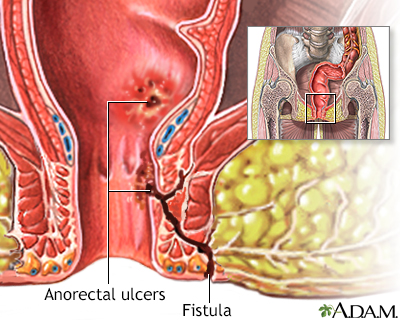
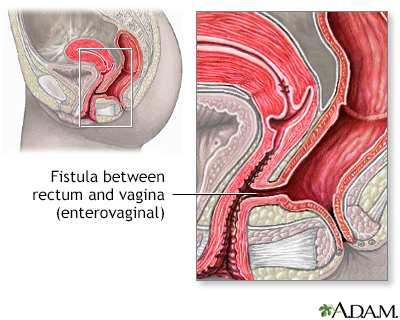
A fistula is an abnormal connection between two body parts, such as an organ or blood vessel and another structure. Fistulas are usually the result of an injury or surgery. Infection or inflammation can also cause a fistula to form.
Information
Fistulas may occur in many parts of the body. They can form between:
- An artery and vein (arteriovenous fistula)
- Bile ducts and the surface of the skin (from gallbladder surgery)
- The cervix and vagina
- The neck and throat
- The space inside the skull and nasal sinus
- The bowel and vagina
- The colon or intestine and surface of the body, causing feces to exit through an opening other than the anus (enterocutaneous fistula)
- The stomach and surface of the skin
- The uterus and peritoneal cavity (the space between the walls of the abdomen and internal organs)
- An artery and vein in the lungs (results in blood not picking up enough oxygen in the lungs)
- The navel and gastrointestinal tract
Crohn disease can lead to fistulas between one loop of intestine and another. Injury can cause fistulas to form between arteries and veins.
Types of fistulas include:
- Blind (open on one end only, but connects to two structures)
- Complete (has openings both outside and inside the body)
- Horseshoe (connects the anus to the surface of the skin after going around the rectum)
- Incomplete (a tube from an internal structure that is closed on the other end and does not connect to skin)
References
de Prisco G, Celinski S, Spak CW. Abdominal abscesses and gastrointestinal fistulas. In: Feldman M, Friedman LS, Brandt LJ, eds. Sleisenger & Fordtran's Gastrointestinal and Liver Disease. 11th ed. Philadelphia, PA: Elsevier; 2021:chap 29.
Lentz GM, Fialkow M. Anal incontinence: diagnosis and management. In: Gershenson DM, Lentz GM, Valea FA, Lobo RA, eds. Comprehensive Gynecology. 8th ed. Philadelphia, PA: Elsevier;2022:chap 22.
Taber's Cyclopedic Medical Dictionary. 24th ed. Philadelphia, PA: F.A. Davis Company; 2021. www.tabers.com/tabersonline/view/Tabers-Dictionary/759338/all/fistula. Accessed October 19, 2023.

Review Date: 10/13/2023
Reviewed By: Linda J. Vorvick, MD, Clinical Professor, Department of Family Medicine, UW Medicine, School of Medicine, University of Washington, Seattle, WA. Also reviewed by David C. Dugdale, MD, Medical Director, Brenda Conaway, Editorial Director, and the A.D.A.M. Editorial team. Editorial update 11/27/2024.
The information provided herein should not be used during any medical emergency or for the diagnosis or treatment of any medical condition. A licensed medical professional should be consulted for diagnosis and treatment of any and all medical conditions. Links to other sites are provided for information only -- they do not constitute endorsements of those other sites. No warranty of any kind, either expressed or implied, is made as to the accuracy, reliability, timeliness, or correctness of any translations made by a third-party service of the information provided herein into any other language.
© 1997-
A.D.A.M., a business unit of Ebix, Inc. Any duplication or distribution of the information contained herein is strictly prohibited.
All content on this site including text, images, graphics, audio, video, data, metadata, and compilations is protected by copyright and other intellectual property laws. You may view the content for personal, noncommercial use. Any other use requires prior written consent from Ebix. You may not copy, reproduce, distribute, transmit, display, publish, reverse-engineer, adapt, modify, store beyond ordinary browser caching, index, mine, scrape, or create derivative works from this content. You may not use automated tools to access or extract content, including to create embeddings, vectors, datasets, or indexes for retrieval systems. Use of any content for training, fine-tuning, calibrating, testing, evaluating, or improving AI systems of any kind is prohibited without express written consent. This includes large language models, machine learning models, neural networks, generative systems, retrieval-augmented systems, and any software that ingests content to produce outputs. Any unauthorized use of the content including AI-related use is a violation of our rights and may result in legal action, damages, and statutory penalties to the fullest extent permitted by law. Ebix reserves the right to enforce its rights through legal, technological, and contractual measures.
 All rights reserved