
Contracture deformity

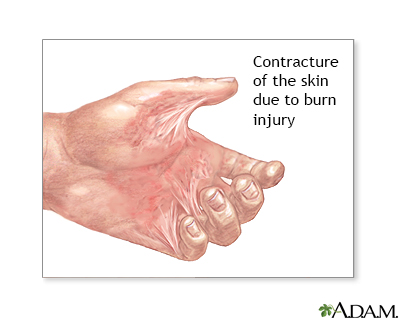
Contracture deformity
Schedule an Appointment
Definition
A contracture develops when normally stretchy (elastic) tissues are replaced by nonstretchy (inelastic) fiber-like tissue. This tissue makes it hard to stretch the area and prevents normal movement.
Contractures mostly occur in the skin, the tissues underneath, and the muscles, tendons, joint capsule, and ligaments surrounding a joint. They reduce the range of motion and function in a certain body part. Often, there is also pain.
Causes
Contracture can be caused by any of the following:
- Brain and nervous system disorders, such as cerebral palsy or stroke
- Inherited disorders (such as muscular dystrophy)
- Nerve damage
- Reduced use (for example, from lack of mobility or injuries)
- Severe muscle and bone injuries
- Scarring after traumatic injury or burns
Home Care
Follow your health care provider's instructions for treating a contracture at home. Treatments may include:
- Doing exercises and stretches
- Using braces and splints
When to Contact a Medical Professional
Contact your provider if:
- A contracture seems to be developing.
- You notice a decreased ability to move a joint.
What to Expect at Your Office Visit
Your provider will ask about your symptoms. Questions may include when the symptoms began, whether or not you have pain in the affected area, and what treatments you've had in the past.
Depending on the cause and type of contracture, you may need tests such as an x-ray.
Treatment may include physical therapy, medicines, and orthopedic braces. Surgery may be helpful for some types of contractures.
References
Campbell TM, Dudek N, Trudel G. Joint contractures. In: Frontera, WR, Silver JK, Rizzo TD Jr, eds. Essentials of Physical Medicine and Rehabilitation. 4th ed. Philadelphia, PA: Elsevier; 2019:chap 127.
Miller RH, Azar FM, Throckmorton TW. Shoulder and elbow injuries. In: Azar FM, Beaty JH, eds. Campbell's Operative Orthopaedics. 14th ed. Philadelphia, PA: Elsevier; 2021:chap 46.

Review Date: 8/27/2024
Reviewed By: C. Benjamin Ma, MD, Professor, Chief, Sports Medicine and Shoulder Service, UCSF Department of Orthopaedic Surgery, San Francisco, CA. Also reviewed by David C. Dugdale, MD, Medical Director, Brenda Conaway, Editorial Director, and the A.D.A.M. Editorial team.
The information provided herein should not be used during any medical emergency or for the diagnosis or treatment of any medical condition. A licensed medical professional should be consulted for diagnosis and treatment of any and all medical conditions. Links to other sites are provided for information only -- they do not constitute endorsements of those other sites. No warranty of any kind, either expressed or implied, is made as to the accuracy, reliability, timeliness, or correctness of any translations made by a third-party service of the information provided herein into any other language.
© 1997-
A.D.A.M., a business unit of Ebix, Inc. Any duplication or distribution of the information contained herein is strictly prohibited.
All content on this site including text, images, graphics, audio, video, data, metadata, and compilations is protected by copyright and other intellectual property laws. You may view the content for personal, noncommercial use. Any other use requires prior written consent from Ebix. You may not copy, reproduce, distribute, transmit, display, publish, reverse-engineer, adapt, modify, store beyond ordinary browser caching, index, mine, scrape, or create derivative works from this content. You may not use automated tools to access or extract content, including to create embeddings, vectors, datasets, or indexes for retrieval systems. Use of any content for training, fine-tuning, calibrating, testing, evaluating, or improving AI systems of any kind is prohibited without express written consent. This includes large language models, machine learning models, neural networks, generative systems, retrieval-augmented systems, and any software that ingests content to produce outputs. Any unauthorized use of the content including AI-related use is a violation of our rights and may result in legal action, damages, and statutory penalties to the fullest extent permitted by law. Ebix reserves the right to enforce its rights through legal, technological, and contractual measures.
 All rights reserved