
Drowsiness

Definition
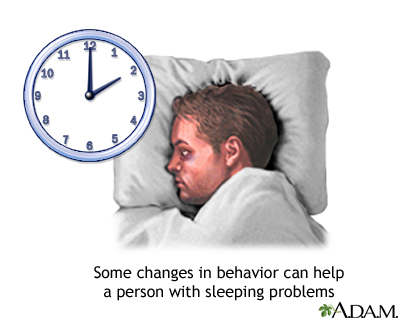
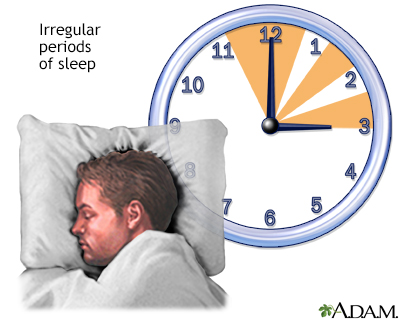
Drowsiness refers to feeling more sleepy than normal during the day. People who are drowsy may fall asleep when they do not want to or at times which can lead to safety concerns.
Considerations
Excessive daytime sleepiness (without a known cause) may be a sign of a sleep disorder.
Depression, anxiety, stress, and boredom can all contribute to excessive sleepiness. However, these conditions more often cause fatigue and apathy.
Causes
Drowsiness may be due to the following:
- Long-term (chronic) pain
- Diabetes
- Having to work long hours or different shifts (nights, weekends)
- Insomnia and other problems falling or staying asleep
- Changes in blood sodium levels (hyponatremia or hypernatremia)
- Medicines (tranquilizers, sleeping pills, antihistamines, certain painkillers, some psychiatric medicines)
- Not sleeping long enough
- Sleep disorders (such as sleep apnea and narcolepsy)
- Too much calcium in your blood (hypercalcemia)
- Underactive thyroid (hypothyroidism)
Home Care
You can relieve drowsiness by treating the cause of the problem. First, determine whether your drowsiness is due to depression, anxiety, boredom, or stress. If you are not sure, talk with your health care provider.
For drowsiness due to medicines, talk to your provider about switching or stopping your medicines. But, do nots stop taking or change your medicine without first talking to your provider.
Do not drive when drowsy.
What to Expect at Your Office Visit
Your provider will examine you to determine the cause of your drowsiness. You will be asked about your sleep patterns and health. Questions may include:
- How well do you sleep?
- How much do you sleep?
- Do you snore?
- Do you fall asleep during the day when you do not plan to nap (such as when watching TV or reading)? If so, do you awake feeling refreshed? How often does this happen?
- Are you depressed, anxious, stressed, or bored?
- What medicines do you take?
- What have you done to try to relieve the drowsiness? How well did it work?
- What other symptoms do you have?
Tests that may be done include:
- Blood tests (such as a CBC and blood differential, blood sugar level, electrolytes, calcium, and thyroid hormone levels)
- CT or MRI scan of the head
- Electroencephalogram (EEG)
- Sleep studies
- Urine tests (such as a urinalysis)
Treatment depends on the cause of your drowsiness.
References
Avidan AY. Sleep and its disorders. In: Jankovic J, Mazziotta JC, Pomeroy SL, Newman NJ, eds. Bradley and Daroff's Neurology in Clinical Practice. 8th ed. Philadelphia, PA: Elsevier; 2022:chap 101.
Sharafkhaneh A, Hirshkowitz M. Evaluating sleepiness and fatigue. In: Kryger M, Roth T, Goldstein CA, Dement WC, eds. Principles and Practice of Sleep Medicine. 7th ed. Philadelphia, PA: Elsevier; 2022:chap 207.
Vaughn BV, Basner RC. Sleep disorders. In: Goldman L, Cooney KA, eds. Goldman-Cecil Medicine. 27th ed. Philadelphia, PA: Elsevier; 2024:chap 374.
Review Date: 7/3/2025
Reviewed By: Linda J. Vorvick, MD, Clinical Professor Emeritus, Department of Family Medicine, UW Medicine, School of Medicine, University of Washington, Seattle, WA. Also reviewed by David C. Dugdale, MD, Medical Director, Brenda Conaway, Editorial Director, and the A.D.A.M. Editorial team.
The information provided herein should not be used during any medical emergency or for the diagnosis or treatment of any medical condition. A licensed medical professional should be consulted for diagnosis and treatment of any and all medical conditions. Links to other sites are provided for information only -- they do not constitute endorsements of those other sites. No warranty of any kind, either expressed or implied, is made as to the accuracy, reliability, timeliness, or correctness of any translations made by a third-party service of the information provided herein into any other language.
© 1997-
A.D.A.M., a business unit of Ebix, Inc. Any duplication or distribution of the information contained herein is strictly prohibited.
All content on this site including text, images, graphics, audio, video, data, metadata, and compilations is protected by copyright and other intellectual property laws. You may view the content for personal, noncommercial use. Any other use requires prior written consent from Ebix. You may not copy, reproduce, distribute, transmit, display, publish, reverse-engineer, adapt, modify, store beyond ordinary browser caching, index, mine, scrape, or create derivative works from this content. You may not use automated tools to access or extract content, including to create embeddings, vectors, datasets, or indexes for retrieval systems. Use of any content for training, fine-tuning, calibrating, testing, evaluating, or improving AI systems of any kind is prohibited without express written consent. This includes large language models, machine learning models, neural networks, generative systems, retrieval-augmented systems, and any software that ingests content to produce outputs. Any unauthorized use of the content including AI-related use is a violation of our rights and may result in legal action, damages, and statutory penalties to the fullest extent permitted by law. Ebix reserves the right to enforce its rights through legal, technological, and contractual measures.
 All rights reserved