Natal teeth
Fetal teeth; Congenital teeth; Predeciduous teeth; Precocious teeth
Natal teeth are teeth that are already present at birth. They are different from neonatal teeth, which grow in during the first 30 days after birth.
Images
Considerations
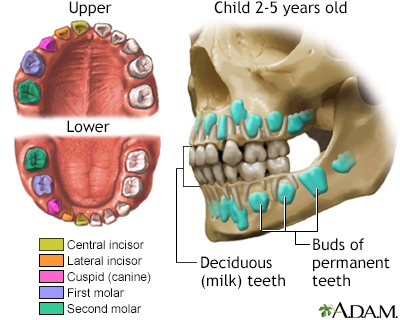
Natal teeth are uncommon. They most often develop on the lower gum, where the central incisor teeth will appear. They have little root structure. They are attached to the end of the gum by soft tissue and are often wobbly.
Natal teeth are usually not well-formed, but they may cause irritation and injury to the infant's tongue when nursing. Natal teeth may also be uncomfortable for a nursing mother.
Natal teeth are often removed shortly after birth while the newborn infant is still in the hospital. This is done very often if the tooth is loose and the child runs a risk of "breathing in" the tooth.
Causes
Most of the time, natal teeth are not related to a medical condition. However, sometimes they may be associated with:
- Ellis-van Creveld syndrome
- Hallermann-Streiff syndrome
- Cleft palate
- Pierre-Robin syndrome
- Soto syndrome
Home Care
Clean the natal teeth by gently wiping the gums and teeth with a clean, damp cloth. Examine the infant's gums and tongue often to make sure the teeth are not causing injury.
When to Contact a Medical Professional
Contact your health care provider if an infant with natal teeth develops a sore tongue or mouth, or other symptoms.
What to Expect at Your Office Visit
Natal teeth are most often discovered by the provider shortly after birth.
Dental x-rays may be done in some cases. If there are signs of another condition that may be linked with natal teeth, exams and testing for that condition may need to be done.
Related Information
NeonateReferences
Ball JW, Dains JE, Flynn JA, Solomon BS, Stewart RW. Ears, nose, and throat. In: Ball JW, Dains JE, Flynn JA, Solomon BS, Stewart RW, eds. Seidel's Guide to Physical Examination. 10th ed. St Louis, MO: Elsevier; 2023:chap 13.
Dhar VK. Development and developmental anomalies of the teeth. In: Kliegman RM, St. Geme JW, Blum NJ, et al, eds. Nelson Textbook of Pediatrics. 22nd ed. Philadelphia, PA: Elsevier; 2025:chap 353.
BACK TO TOPReview Date: 3/31/2024
Reviewed By: Michael Kapner, DDS, General Dentistry, Norwalk Medical Center, Norwalk CT. Review provided by VeriMed Healthcare Network. Also reviewed by David C. Dugdale, MD, Medical Director, Brenda Conaway, Editorial Director, and the A.D.A.M. Editorial team.

Health Content Provider
06/01/2028
|
A.D.A.M., Inc. is certified by URAC, for Health Content Provider (www.urac.org). URAC's certification program is an independent audit to verify that A.D.A.M. follows rigorous standards of quality and accountability. A.D.A.M. is among the first to achieve this important distinction for online health information and services. Learn more about A.D.A.M.'s editorial policy, editorial process and privacy policy. |
The information provided herein should not be used during any medical emergency or for the diagnosis or treatment of any medical condition. A licensed medical professional should be consulted for diagnosis and treatment of any and all medical conditions. Links to other sites are provided for information only -- they do not constitute endorsements of those other sites. No warranty of any kind, either expressed or implied, is made as to the accuracy, reliability, timeliness, or correctness of any translations made by a third-party service of the information provided herein into any other language.
© 1997-
2026 A.D.A.M., a business unit of Ebix, Inc. Any duplication or distribution of the information contained herein is strictly prohibited.
All content on this site including text, images, graphics, audio, video, data, metadata, and compilations is protected by copyright and other intellectual property laws. You may view the content for personal, noncommercial use. Any other use requires prior written consent from Ebix. You may not copy, reproduce, distribute, transmit, display, publish, reverse-engineer, adapt, modify, store beyond ordinary browser caching, index, mine, scrape, or create derivative works from this content. You may not use automated tools to access or extract content, including to create embeddings, vectors, datasets, or indexes for retrieval systems. Use of any content for training, fine-tuning, calibrating, testing, evaluating, or improving AI systems of any kind is prohibited without express written consent. This includes large language models, machine learning models, neural networks, generative systems, retrieval-augmented systems, and any software that ingests content to produce outputs. Any unauthorized use of the content including AI-related use is a violation of our rights and may result in legal action, damages, and statutory penalties to the fullest extent permitted by law. Ebix reserves the right to enforce its rights through legal, technological, and contractual measures.
 All rights reserved.