
Enlarged liver

Definition
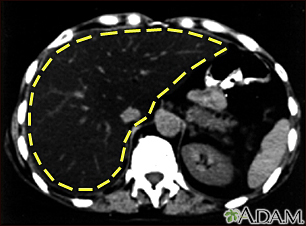
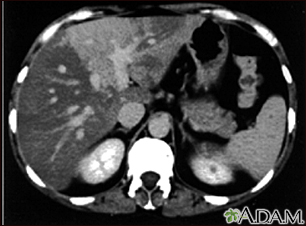
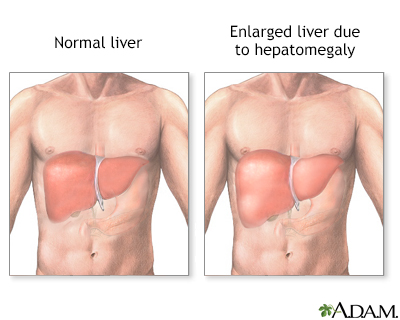
Enlarged liver refers to swelling of the liver beyond its normal size. Hepatomegaly is another word to describe this problem.
If both the liver and spleen are enlarged, it is called hepatosplenomegaly.
Considerations
The lower edge of the liver normally comes just to the lower edge of the ribs on the right side. The edge of the liver is normally thin and firm. It cannot be felt with the fingertips below the edge of the ribs, except when you take a deep breath. It may be enlarged if a health care provider can feel it in this area.
Causes
The liver is involved in many of the body's functions. Its function is affected by many conditions that can cause hepatomegaly, including:
- Alcohol use (especially alcohol abuse)
- Cancer metastases (spread of cancer to the liver)
- Congestive heart failure
- Glycogen storage disease
- Hepatitis A
- Hepatitis B
- Hepatitis C
- Hepatocellular carcinoma
- Hereditary fructose intolerance
- Infectious mononucleosis
- Leukemia
- Niemann-Pick disease
- Portal vein thrombosis
- Primary biliary cholangitis
- Reye syndrome
- Sarcoidosis
- Sclerosing cholangitis
- Steatosis (fat in the liver from metabolic problems such as diabetes, obesity, and high triglycerides, also called nonalcoholic steatohepatitis, or NASH)
When to Contact a Medical Professional
This condition is most often detected by a provider. You may not be aware of the liver or spleen swelling.
What to Expect at Your Office Visit
The provider will examine you and ask questions such as:
- Did you notice fullness or a lump in the abdomen?
- What other symptoms do you have?
- Is there any abdominal pain?
- Is there any yellowing of the skin (jaundice)?
- Is there any vomiting?
- Is there any unusual-colored or pale-colored stools?
- Has your urine appeared to be darker than usual (brownish)?
- Have you had a fever?
- What medicines are you taking including over-the-counter and herbal medicines?
- How much alcohol do you drink?
Tests to determine the cause of hepatomegaly vary, depending on the suspected cause, but may include:
- Abdominal x-ray
- Abdominal ultrasound (may be done to confirm the condition if the provider thinks your liver feels enlarged during a physical exam)
- CT scan of the abdomen
- Liver function tests, including blood clotting tests
- MRI scan of the abdomen
References
Martin P. Approach to the patient with liver disease. In: Goldman L, Cooney KA, eds. Goldman-Cecil Medicine. 27th ed. Philadelphia, PA: Elsevier; 2024:chap 132.
Plevris J, Parks R. The gastrointestinal system. In: Dover AR, Innes JA , Fairhurst K, eds. Macleod's Clinical Examination. 15th ed. Philadelphia, PA: Elsevier; 2024:chap 6.
Squires JE, Balistreri WF. Manifestations of liver disease. In: Kliegman RM, St. Geme JW, Blum NJ, et al, eds. Nelson Textbook of Pediatrics. 22nd ed. Philadelphia, PA: Elsevier; 2025:chap 403.

Review Date: 4/21/2025
Reviewed By: Todd Eisner, MD, Private practice specializing in Gastroenterology in Boca Raton and Delray Beach, Florida at Gastroenterology Consultants of Boca Raton. Affiliate Assistant Professor, Florida Atlantic University School of Medicine. Review provided by VeriMed Healthcare Network. Also reviewed by David C. Dugdale, MD, Medical Director, Brenda Conaway, Editorial Director, and the A.D.A.M. Editorial team.
The information provided herein should not be used during any medical emergency or for the diagnosis or treatment of any medical condition. A licensed medical professional should be consulted for diagnosis and treatment of any and all medical conditions. Links to other sites are provided for information only -- they do not constitute endorsements of those other sites. No warranty of any kind, either expressed or implied, is made as to the accuracy, reliability, timeliness, or correctness of any translations made by a third-party service of the information provided herein into any other language.
© 1997-
A.D.A.M., a business unit of Ebix, Inc. Any duplication or distribution of the information contained herein is strictly prohibited.
All content on this site including text, images, graphics, audio, video, data, metadata, and compilations is protected by copyright and other intellectual property laws. You may view the content for personal, noncommercial use. Any other use requires prior written consent from Ebix. You may not copy, reproduce, distribute, transmit, display, publish, reverse-engineer, adapt, modify, store beyond ordinary browser caching, index, mine, scrape, or create derivative works from this content. You may not use automated tools to access or extract content, including to create embeddings, vectors, datasets, or indexes for retrieval systems. Use of any content for training, fine-tuning, calibrating, testing, evaluating, or improving AI systems of any kind is prohibited without express written consent. This includes large language models, machine learning models, neural networks, generative systems, retrieval-augmented systems, and any software that ingests content to produce outputs. Any unauthorized use of the content including AI-related use is a violation of our rights and may result in legal action, damages, and statutory penalties to the fullest extent permitted by law. Ebix reserves the right to enforce its rights through legal, technological, and contractual measures.
 All rights reserved