
Pectus excavatum

Definition
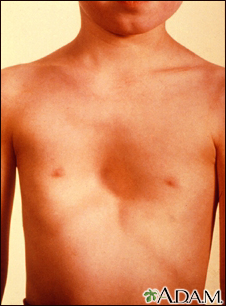
Pectus excavatum is a medical term that describes an abnormal formation of the rib cage that gives the chest a caved-in or sunken appearance.
Considerations
Pectus excavatum occurs while a baby is developing in the womb. It can also develop in a baby after birth. The condition can be mild or severe.
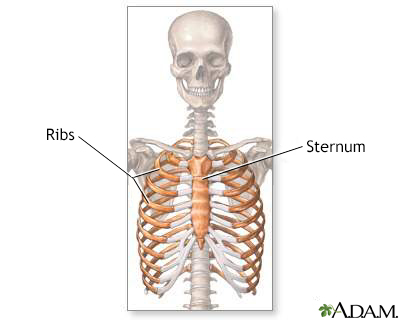
Pectus excavatum is due to too much growth of the connective tissue that joins the ribs to the breastbone (sternum). This causes the sternum to grow inward. As a result, there is a depression in the chest over the sternum, which may appear quite deep.
If the condition is severe, the heart and lungs can be affected. Also, the way the chest looks may cause emotional stress for the child.
Causes
The exact cause is unknown. Pectus excavatum may occur by itself. Or there may be a family history of the condition. Other medical problems linked with this condition include:
- Marfan syndrome (connective tissue disease)
- Noonan syndrome (disorder that causes many parts of the body to develop abnormally)
- Poland syndrome (disorder that causes muscles to not develop fully or at all)
- Rickets (softening and weakening of the bones)
- Scoliosis (abnormal curving of the spine)
When to Contact a Medical Professional
Contact your health care provider if you or your child has any of the following:
- Chest pain
- Trouble breathing
- Feelings of depression or anger about the condition
- Feeling tired, even when not being active
What to Expect at Your Office Visit
Your provider will perform a physical examination. An infant with pectus excavatum may have other symptoms and signs that, when taken together, define a specific condition known as a syndrome.
Your provider will also ask about medical history, such as:
- When was the problem first noticed?
- Is it getting better, worse, or staying the same?
- Do other family members have an unusual-shaped chest?
- What other symptoms are there?
Tests may be done to rule out suspected disorders. These tests may include:
Tests may also be done to find out how severely the lungs and heart are affected.
This condition can be surgically repaired. Surgery is generally advised if there are other health problems, such as trouble breathing. Surgery may also be done to improve the appearance of the chest. Talk to your provider about treatment options.
References
Beh HZ, Ferry AM, Dibbs RP, Buchanan EP, Monson LA. Pediatric chest and trunk deformities. In: Losee JE, Hopper RA, eds. Plastic Surgery: Volume 3: Craniofacial, Head and Neck Surgery and Pediatric Plastic Surgery. 5th ed. Philadelphia, PA: Elsevier; 2024:chap 32.
Boas SR. Skeletal diseases influencing pulmonary function. In: Kliegman RM, St. Geme JW, Blum NJ, Shah SS, Tasker RC, Wilson KM, eds. Nelson Textbook of Pediatrics. 21st ed. Philadelphia, PA: Elsevier; 2020:chap 445.
Weller JH, Nasr IW. Repair of pectus excavatum. In: Cameron JL, Cameron AM, eds. Current Surgical Therapy. 14th ed. Philadelphia, PA: Elsevier; 2023:951-992.

Review Date: 8/22/2023
Reviewed By: Mary C. Mancini, MD, PhD, Cardiothoracic Surgeon, Shreveport, LA. Review provided by VeriMed Healthcare Network. Also reviewed by David C. Dugdale, MD, Medical Director, Brenda Conaway, Editorial Director, and the A.D.A.M. Editorial team.
The information provided herein should not be used during any medical emergency or for the diagnosis or treatment of any medical condition. A licensed medical professional should be consulted for diagnosis and treatment of any and all medical conditions. Links to other sites are provided for information only -- they do not constitute endorsements of those other sites. No warranty of any kind, either expressed or implied, is made as to the accuracy, reliability, timeliness, or correctness of any translations made by a third-party service of the information provided herein into any other language.
© 1997-
A.D.A.M., a business unit of Ebix, Inc. Any duplication or distribution of the information contained herein is strictly prohibited.
All content on this site including text, images, graphics, audio, video, data, metadata, and compilations is protected by copyright and other intellectual property laws. You may view the content for personal, noncommercial use. Any other use requires prior written consent from Ebix. You may not copy, reproduce, distribute, transmit, display, publish, reverse-engineer, adapt, modify, store beyond ordinary browser caching, index, mine, scrape, or create derivative works from this content. You may not use automated tools to access or extract content, including to create embeddings, vectors, datasets, or indexes for retrieval systems. Use of any content for training, fine-tuning, calibrating, testing, evaluating, or improving AI systems of any kind is prohibited without express written consent. This includes large language models, machine learning models, neural networks, generative systems, retrieval-augmented systems, and any software that ingests content to produce outputs. Any unauthorized use of the content including AI-related use is a violation of our rights and may result in legal action, damages, and statutory penalties to the fullest extent permitted by law. Ebix reserves the right to enforce its rights through legal, technological, and contractual measures.
 All rights reserved