
Hemoglobinuria test

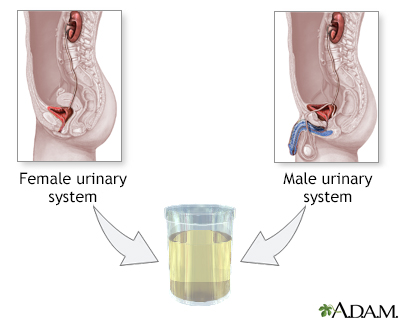
Urine sample
Schedule an Appointment
Definition
Hemoglobinuria test is a urine test that checks for hemoglobin in the urine.
How the Test is Performed
A clean-catch (midstream) urine sample is needed. The clean-catch method is used to prevent germs from the penis or vagina from getting into a urine sample. To collect your urine, you may get a special clean-catch kit from your health care provider that contains a cleansing solution and sterile wipes. Follow instructions exactly so that the results are accurate.
How to Prepare for the Test
No special preparation is necessary for this test. If the collection is being taken from an infant, a couple of extra collection bags may be necessary.
How the Test will Feel
The test involves only normal urination. There is no discomfort.
Why the Test is Performed
Hemoglobin is a molecule contained within red blood cells. Hemoglobin helps move oxygen through the body.
Red blood cells have an average life span of 120 days. After this time, they are broken down into parts that can make a new red blood cell. This breakdown takes place in the spleen, bone marrow, and liver. If the red blood cells break down in the blood vessels, their parts move freely in the bloodstream.
If the level of hemoglobin in the blood rises too high, then hemoglobin begins to appear in the urine. This is called hemoglobinuria.
This test may be used to help diagnose causes of hemoglobinuria.
Normal Results
Normally, hemoglobin does not appear in the urine.
What Abnormal Results Mean
Hemoglobinuria may be a result of any of the following:
- Burns
- Crushing injury
- Hemolytic uremic syndrome (HUS), a disorder that occurs when an infection in the digestive system produces toxic substances
- Kidney infection
- Kidney inflammation or injury including glomerulonephritis
- Kidney tumor
- Malaria
- Paroxysmal nocturnal hemoglobinuria, disease in which red blood cells break down earlier than normal
- Paroxysmal cold hemoglobinuria, disease in which the body's immune system produces antibodies that destroy red blood cells
- Sickle cell anemia
- Thalassemia, disease in which the body makes an abnormal form or inadequate amount of hemoglobin
- Thrombotic thrombocytopenic purpura (TTP)
- Transfusion reaction
- Tuberculosis
References
Gharavi AG, Landry DW. Approach to the patient with renal disease. In: Goldman L, Cooney KA, eds. Goldman-Cecil Medicine. 27th ed. Philadelphia, PA: Elsevier; 2024:chap 100.
Krishnan A, Levin A. Laboratory assessment of kidney disease: glomerular filtration rate, urinalysis, and proteinuria. In: Yu ASL, Chertow GM, Luyckx VA, Marsden PA, Skorecki K, Taal MW, eds. Brenner and Rector's The Kidney. 11th ed. Philadelphia, PA: Elsevier; 2020:chap 23.
Riley RS, McPherson RA. Basic examination of urine. In: McPherson RA, Pincus MR, eds. Henry's Clinical Diagnosis and Management by Laboratory Methods. 24th ed. Philadelphia, PA: Elsevier; 2022:chap 29.

Review Date: 7/13/2025
Reviewed By: Laura J. Martin, MD, MPH, ABIM Board Certified in Internal Medicine and Hospice and Palliative Medicine, Atlanta, GA. Also reviewed by David C. Dugdale, MD, Medical Director, Brenda Conaway, Editorial Director, and the A.D.A.M. Editorial team.
The information provided herein should not be used during any medical emergency or for the diagnosis or treatment of any medical condition. A licensed medical professional should be consulted for diagnosis and treatment of any and all medical conditions. Links to other sites are provided for information only -- they do not constitute endorsements of those other sites. No warranty of any kind, either expressed or implied, is made as to the accuracy, reliability, timeliness, or correctness of any translations made by a third-party service of the information provided herein into any other language.
© 1997-
A.D.A.M., a business unit of Ebix, Inc. Any duplication or distribution of the information contained herein is strictly prohibited.
All content on this site including text, images, graphics, audio, video, data, metadata, and compilations is protected by copyright and other intellectual property laws. You may view the content for personal, noncommercial use. Any other use requires prior written consent from Ebix. You may not copy, reproduce, distribute, transmit, display, publish, reverse-engineer, adapt, modify, store beyond ordinary browser caching, index, mine, scrape, or create derivative works from this content. You may not use automated tools to access or extract content, including to create embeddings, vectors, datasets, or indexes for retrieval systems. Use of any content for training, fine-tuning, calibrating, testing, evaluating, or improving AI systems of any kind is prohibited without express written consent. This includes large language models, machine learning models, neural networks, generative systems, retrieval-augmented systems, and any software that ingests content to produce outputs. Any unauthorized use of the content including AI-related use is a violation of our rights and may result in legal action, damages, and statutory penalties to the fullest extent permitted by law. Ebix reserves the right to enforce its rights through legal, technological, and contractual measures.
 All rights reserved