
Extremity x-ray

Definition
An extremity x-ray is an image of the hands, wrist, feet, ankle, leg, thigh, forearm humerus or upper arm, hip, shoulder or all of these areas. The term "extremity" often refers to a human limb.
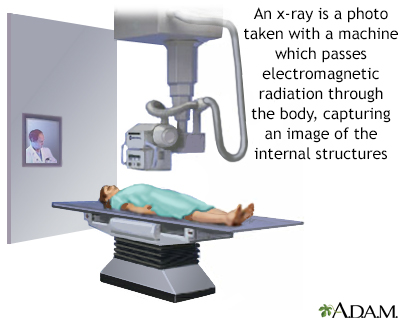
X-rays are a form of radiation that passes through the body to form an image on film or a digital image recorder. Structures that are dense (such as bone) will appear white. Air will be black, and other structures will be shades of gray.
How the Test is Performed
The test is done in a hospital radiology department or in the health care provider's office. The x-ray is done by an x-ray technologist.
You will need to hold still as the x-ray is taken. You may be asked to change position, so more x-rays can be taken.
How to Prepare for the Test
Tell your provider if you are pregnant. Remove all jewelry from the area being imaged.
In general, there is no discomfort. You may be slightly uncomfortable while the leg or arm is put in place for the x-ray.
Why the Test is Performed
Your provider may order this test if you have signs of:
- A fracture
- Tumor
- Arthritis (inflammation of the joints)
- A foreign body (such as a piece of metal)
- An infection of the bone (osteomyelitis)
- Delayed growth in a child
Normal Results
The x-ray shows normal structures for the age of the person.
What Abnormal Results Mean
Abnormal results may be due to:
- Bone conditions that get worse over time (degenerative)
- Bone tumor
- Broken bone (fracture)
- Dislocated bone
- Osteomyelitis (infection)
- Arthritis
Other conditions for which the test may be performed:
- Clubfoot
- To detect foreign objects in the body
Risks
There is low-level radiation exposure. X-rays are monitored and regulated to provide the smallest amount of radiation exposure needed to make the image. Most experts feel that the risk is low compared with the benefits for an appropriate x-ray exam.
Pregnant women and children are more sensitive to the risks of an x-ray.
References
Geiderman JM, Torbati S. General principles of orthopedic injuries. In: Walls RM, ed. Rosen's Emergency Medicine: Concepts and Clinical Practice. 10th ed. Philadelphia, PA: Elsevier; 2023:chap 41.
Kelly DM. Congenital anomalies of the lower extremity. In: Azar FM, Beaty JH, eds. Campbell's Operative Orthopaedics. 14th ed. Philadelphia, PA: Elsevier; 2021:chap 29.
Laoteppitaks C. Compartment syndrome evaluation. In: Roberts JR, Custalow CB, Thomsen TW, eds. Roberts and Hedges' Clinical Procedures in Emergency Medicine and Acute Care. 7th ed. Philadelphia, PA: Elsevier; 2019:chap 54.

Review Date: 7/15/2024
Reviewed By: Jason Levy, MD, FSIR, Northside Radiology Associates, Atlanta, GA. Also reviewed by David C. Dugdale, MD, Medical Director, Brenda Conaway, Editorial Director, and the A.D.A.M. Editorial team.
The information provided herein should not be used during any medical emergency or for the diagnosis or treatment of any medical condition. A licensed medical professional should be consulted for diagnosis and treatment of any and all medical conditions. Links to other sites are provided for information only -- they do not constitute endorsements of those other sites. No warranty of any kind, either expressed or implied, is made as to the accuracy, reliability, timeliness, or correctness of any translations made by a third-party service of the information provided herein into any other language.
© 1997-
A.D.A.M., a business unit of Ebix, Inc. Any duplication or distribution of the information contained herein is strictly prohibited.
All content on this site including text, images, graphics, audio, video, data, metadata, and compilations is protected by copyright and other intellectual property laws. You may view the content for personal, noncommercial use. Any other use requires prior written consent from Ebix. You may not copy, reproduce, distribute, transmit, display, publish, reverse-engineer, adapt, modify, store beyond ordinary browser caching, index, mine, scrape, or create derivative works from this content. You may not use automated tools to access or extract content, including to create embeddings, vectors, datasets, or indexes for retrieval systems. Use of any content for training, fine-tuning, calibrating, testing, evaluating, or improving AI systems of any kind is prohibited without express written consent. This includes large language models, machine learning models, neural networks, generative systems, retrieval-augmented systems, and any software that ingests content to produce outputs. Any unauthorized use of the content including AI-related use is a violation of our rights and may result in legal action, damages, and statutory penalties to the fullest extent permitted by law. Ebix reserves the right to enforce its rights through legal, technological, and contractual measures.
 All rights reserved