
Uric acid - blood

Definition
Uric acid is a chemical created when the body breaks down substances called purines. Purines are normally produced in the body and are also found in some foods and drinks. Foods with a high content of purines include liver, anchovies, mackerel, red meat, shellfish, dried beans and peas, and beer.
Most uric acid dissolves in blood and travels to the kidneys. From there, it passes out in urine. If your body produces too much uric acid or does not remove enough of it, you can get sick. A high level of uric acid in the blood is called hyperuricemia.
This test checks to see how much uric acid you have in your blood. Another test that can be used to check the level of uric acid is a test of your urine.
How the Test is Performed
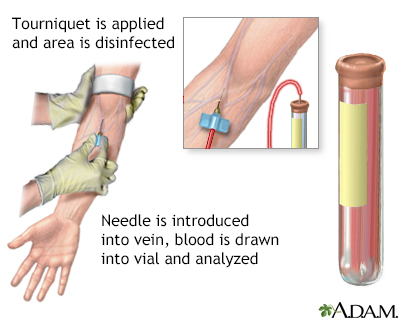
A blood sample is needed. Most of the time, blood is drawn from a vein located on the inside of the elbow or the back of the hand.
How to Prepare for the Test
You should not eat or drink anything for 4 hours before the test unless told otherwise.
Many medicines can interfere with blood test results.
- Your health care provider will tell you if you need to stop taking any medicines before you have this test.
- DO NOT stop or change your medicines without talking to your provider first.
Why the Test is Performed
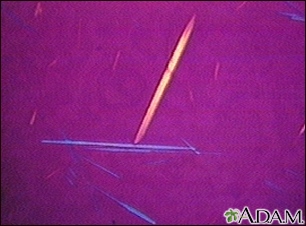
This test is done to see if you have a high level of uric acid in your blood. High levels of uric acid can sometimes cause gout or kidney disease.
You may have this test if you have had or are about to have certain types of chemotherapy. Rapid destruction of cancerous cells or weight loss, which may occur with such treatments, can rapidly increase the amount of uric acid in your blood.
Normal Results
Normal values are 3.0 to 7.1 milligrams per deciliter (mg/dL) for women and 4.0 to 8.6 mg/dL for men.
For patients being treated for gout, the goal uric acid is either less than 6 mg/dL or 5 mg/dL based on clinical factors.
Normal value ranges may vary slightly among different laboratories. Talk to your provider about the meaning of your specific test results.
The example above shows the common measurement range for results for these tests. Some laboratories use different measurements or may test different specimens.
What Abnormal Results Mean
Greater-than-normal levels of uric acid (hyperuricemia) may be due to:
- Acidosis
- Alcohol (ethanol) consumption
- Chemotherapy-related side effects
- Dehydration
- Diabetic ketoacidosis
- Excessive exercise
- Fructose consumption
- Hyperparathyroidism
- Hypothyroidism
- Lactic acidosis
- Lead poisoning
- Leukemia
- Medicines such as cyclosporine, diuretics, nicotinic acid, salicylates (low dose), tacrolimus
- Medullary cystic kidney disease
- Obesity
- Polycythemia vera
- Psoriasis
- Purine-rich diet
- Renal failure
- Toxemia of pregnancy
- Vitamin B12 deficiency
Lower-than-normal levels of uric acid may be due to:
- Fanconi syndrome
- Hereditary diseases of metabolism
- HIV infection
- Low purine diet
- Medicines such as atorvastatin, captopril, enalapril, fenofibrate, losartan, probenecid, and trimethoprim-sulfamethoxazole
- Syndrome of inappropriate antidiuretic hormone (SIADH) secretion
Other reasons this test may be performed include:
- Chronic kidney disease
- Gout
- Injury of the kidney and ureter
- Kidney stones (nephrolithiasis)
References
Dalbeth N. Clinical features and treatment of gout. In: Firestein GS, McInnes IB, Koretzky GA, Mikuls TR, Neogi T, O'Dell JR, eds. Firestein & Kelley's Textbook of Rheumatology. 12th ed. Philadelphia, PA: Elsevier; 2025:chap 97.
Edwards NL. Crystal deposition diseases. In: Goldman L, Cooney KA, eds. Goldman-Cecil Medicine. 27th ed. Philadelphia, PA: Elsevier; 2024:chap 252.
Weisbord SD, Palevsky PM. Prevention and management of acute kidney injury. In: Yu ASL, Chertow GM, Luyckx VA, Marsden PA, Skorecki K, Taal MW, eds. Brenner and Rector's The Kidney. 11th ed. Philadelphia, PA: Elsevier; 2020:chap 29.

Review Date: 4/1/2025
Reviewed By: Diane M. Horowitz, MD, Rheumatology and Internal Medicine, Northwell Health, Great Neck, NY. Review provided by VeriMed Healthcare Network. Also reviewed by David C. Dugdale, MD, Medical Director, Brenda Conaway, Editorial Director, and the A.D.A.M. Editorial team.
The information provided herein should not be used during any medical emergency or for the diagnosis or treatment of any medical condition. A licensed medical professional should be consulted for diagnosis and treatment of any and all medical conditions. Links to other sites are provided for information only -- they do not constitute endorsements of those other sites. No warranty of any kind, either expressed or implied, is made as to the accuracy, reliability, timeliness, or correctness of any translations made by a third-party service of the information provided herein into any other language.
© 1997-
A.D.A.M., a business unit of Ebix, Inc. Any duplication or distribution of the information contained herein is strictly prohibited.
All content on this site including text, images, graphics, audio, video, data, metadata, and compilations is protected by copyright and other intellectual property laws. You may view the content for personal, noncommercial use. Any other use requires prior written consent from Ebix. You may not copy, reproduce, distribute, transmit, display, publish, reverse-engineer, adapt, modify, store beyond ordinary browser caching, index, mine, scrape, or create derivative works from this content. You may not use automated tools to access or extract content, including to create embeddings, vectors, datasets, or indexes for retrieval systems. Use of any content for training, fine-tuning, calibrating, testing, evaluating, or improving AI systems of any kind is prohibited without express written consent. This includes large language models, machine learning models, neural networks, generative systems, retrieval-augmented systems, and any software that ingests content to produce outputs. Any unauthorized use of the content including AI-related use is a violation of our rights and may result in legal action, damages, and statutory penalties to the fullest extent permitted by law. Ebix reserves the right to enforce its rights through legal, technological, and contractual measures.
 All rights reserved