
Phosphorus blood test

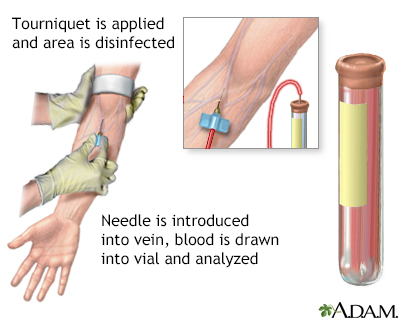
Blood test
Schedule an Appointment
Definition
The phosphorus blood test measures the amount of phosphate in the blood.
How the Test is Performed
A blood sample is needed.
How to Prepare for the Test
Your health care provider may tell you to temporarily stop taking medicines that may affect the test. These medicines include water pills (diuretics), antacids, and laxatives.
Do not stop taking any medicine without talking to your provider.
How the Test will Feel
When the needle is inserted to draw blood, some people feel moderate pain. Others feel only a prick or stinging. Afterward, there may be some throbbing or slight bruising. This soon goes away.
Why the Test is Performed
Phosphorus is a mineral the body needs to build strong bones and teeth. It is also important for nerve signaling and muscle contraction.
This test is ordered to see how much phosphorus is in your blood. Kidney, liver, and certain bone diseases can cause abnormal phosphorus levels.
Normal Results
Normal values range from:
- Adults: 2.8 to 4.5 mg/dL
- Children: 4.0 to 7.0 mg/dL
Normal value ranges may vary slightly among different laboratories. Some labs use different measurements or test different samples. Talk to your provider about the meaning of your specific test results.
What Abnormal Results Mean
A higher than normal level (hyperphosphatemia) may be due to many different health conditions. Common causes include:
- Diabetic ketoacidosis (life-threatening condition that occurs mainly in people with type 1 diabetes)
- Hypoparathyroidism (parathyroid glands do not make enough of their hormone)
- Kidney damage or failure
- Liver disease
- Too much vitamin D
- Too much phosphate in your diet
- Use of certain medicines such as laxatives that have phosphate in them
A lower than normal level (hypophosphatemia) may be due to:
- Alcoholism
- Hypercalcemia (too much calcium in the blood)
- Primary hyperparathyroidism (parathyroid glands make too much of their hormone)
- Too little dietary intake of phosphate
- Very poor nutrition
- Too little vitamin D, resulting in bone problems such as rickets (childhood) or osteomalacia (adult)
Risks
There is little risk involved with having your blood taken. Veins and arteries vary in size from one person to another and from one side of the body to the other. Taking blood from some people may be more difficult than from others.
Other risks associated with having blood drawn are slight, but may include:
- Fainting or feeling lightheaded
- Multiple punctures to locate veins
- Hematoma (blood buildup under the skin)
- Excessive bleeding
- Infection (a slight risk any time the skin is broken)
References
Chonchol M, Smogorzewski MJ, Stubbs JR, Yu ASL. Disorders of calcium, magnesium, and phosphate balance. In: Yu ASL, Chertow GM, Luyckx VA, Marsden PA, Skorecki K, Taal MW, eds. Brenner and Rector's The Kidney. 11th ed. Philadelphia, PA: Elsevier; 2020:chap 18.
Klemm KM, Klein MJ, Zhang Y. Biochemical markers of bone metabolism. In: McPherson RA, Pincus MR, eds. Henry's Clinical Diagnosis and Management by Laboratory Methods. 24th ed. Philadelphia, PA: Elsevier; 2022:chap 16.
Kliegman RM, Stanton BF, St. Geme JW, Blum NJ, Shah SS, Tasker RC, Wilson KM. Electrolyte and acid-base disorders. In: Kliegman RM, St. Geme JW, Blum NJ, Shah SS, Tasker RC, Wilson KM, eds. Nelson Textbook of Pediatrics. 21st ed. Philadelphia, PA: Elsevier; 2020:chap 68.

Review Date: 11/19/2023
Reviewed By: Jacob Berman, MD, MPH, Clinical Assistant Professor of Medicine, Division of General Internal Medicine, University of Washington School of Medicine, Seattle, WA. Also reviewed by David C. Dugdale, MD, Medical Director, Brenda Conaway, Editorial Director, and the A.D.A.M. Editorial team.
The information provided herein should not be used during any medical emergency or for the diagnosis or treatment of any medical condition. A licensed medical professional should be consulted for diagnosis and treatment of any and all medical conditions. Links to other sites are provided for information only -- they do not constitute endorsements of those other sites. No warranty of any kind, either expressed or implied, is made as to the accuracy, reliability, timeliness, or correctness of any translations made by a third-party service of the information provided herein into any other language.
© 1997-
A.D.A.M., a business unit of Ebix, Inc. Any duplication or distribution of the information contained herein is strictly prohibited.
All content on this site including text, images, graphics, audio, video, data, metadata, and compilations is protected by copyright and other intellectual property laws. You may view the content for personal, noncommercial use. Any other use requires prior written consent from Ebix. You may not copy, reproduce, distribute, transmit, display, publish, reverse-engineer, adapt, modify, store beyond ordinary browser caching, index, mine, scrape, or create derivative works from this content. You may not use automated tools to access or extract content, including to create embeddings, vectors, datasets, or indexes for retrieval systems. Use of any content for training, fine-tuning, calibrating, testing, evaluating, or improving AI systems of any kind is prohibited without express written consent. This includes large language models, machine learning models, neural networks, generative systems, retrieval-augmented systems, and any software that ingests content to produce outputs. Any unauthorized use of the content including AI-related use is a violation of our rights and may result in legal action, damages, and statutory penalties to the fullest extent permitted by law. Ebix reserves the right to enforce its rights through legal, technological, and contractual measures.
 All rights reserved