
Creatine phosphokinase test

Blood test
Schedule an Appointment
Definition
Creatine phosphokinase (CPK) is an enzyme in the body. It is found mainly in the heart, brain, and skeletal muscle. This article discusses the test to measure the amount of CPK in the blood.
How the Test is Performed
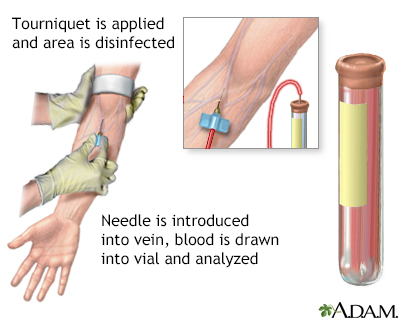
A blood sample is needed. This may be taken from a vein. The procedure is called a venipuncture.
This test may be repeated over 2 or 3 days if you are a patient in the hospital.
How to Prepare for the Test
No special preparation is needed most of the time.
Tell your health care provider about any medicines you are taking.
Drugs that can increase CPK measurements include the following:
- Alcohol
- Amphotericin B
- Certain anesthetics
- Cocaine
- Fibrate medicines
- Statins
- Steroids, such as dexamethasone
This list is not all-inclusive.
How the Test will Feel
You may feel slight pain when the needle is inserted to draw blood. Some people feel only a prick or stinging sensation. Afterward, there may be some throbbing.
Why the Test is Performed
When the total CPK level is very high, it most often means there has been injury or stress to muscle tissue, the heart, or the brain.
Muscle tissue injury is most likely. When a muscle is damaged, CPK leaks into the bloodstream. Finding which specific form of CPK is high helps determine which tissue has been damaged.
This test may be used to:
- Diagnose a heart attack
- Evaluate the cause of chest pain
- Determine if or how badly a muscle is damaged
- Detect dermatomyositis, polymyositis, and other muscle diseases
- Tell the difference between malignant hyperthermia and postoperative infection
The pattern and timing of a rise or fall in CPK levels can be significant in making a diagnosis. This is particularly true if a heart attack is suspected.
In most cases, other tests are used instead of or with this test to diagnose a heart attack.
Normal Results
Total CPK normal values:
- 10 to 120 micrograms per liter (mcg/L)
Normal value ranges may vary slightly among different laboratories. Some labs use different measurements or test different samples. Talk to your provider about the meaning of your specific test results.
What Abnormal Results Mean
High CPK levels may be seen in people who have:
- Brain injury or stroke
- Convulsions
- Delirium tremens
- Dermatomyositis or polymyositis
- Electric shock
- Heart attack
- Inflammation of the heart muscle (myocarditis)
- Lung tissue death (pulmonary infarction)
- Muscular dystrophies
- Myopathy
- Rhabdomyolysis
- Trauma
Other conditions that may give abnormally high test results include:
Risks
Risks associated with having blood drawn are slight but may include:
- Excessive bleeding
- Fainting or feeling lightheaded
- Hematoma (blood accumulating under the skin)
- Infection (a slight risk any time the skin is broken)
Considerations
Other tests should be done to find the exact location of muscle damage.
Factors that may affect test results include cardiac catheterization, intramuscular injections, trauma to muscles, recent surgery, and heavy exercise.
References
Borg K, Ensrud E. Myopathies. In: Frontera WR, Silver JK, Rizzo TD Jr, eds. Essentials of Physical Medicine and Rehabilitation. 4th ed. Philadelphia, PA: Elsevier; 2019:chap 136.
Mccullough PA. Interface between renal disease and cardiovascular illness. In: Libby P, Bonow RO, Mann DL, Tomaselli GF, Bhatt DL, Solomon SD, eds. Braunwald's Heart Disease: A Textbook of Cardiovascular Medicine. 12th ed. Philadelphia, PA: Elsevier; 2022:chap 101.
Pincus MR, Carty RP. Clinical enzymology. In: McPherson RA, Pincus MR, eds. Henry's Clinical Diagnosis and Management by Laboratory Methods. 24th ed. Philadelphia, PA: Elsevier; 2022:chap 21.
Selcen D. Muscle diseases. In: Goldman L, Cooney KA, eds. Goldman-Cecil Medicine. 27th ed. Philadelphia, PA: Elsevier; 2024:chap 389.

Review Date: 1/1/2025
Reviewed By: Michael A. Chen, MD, PhD, Associate Professor of Medicine, Division of Cardiology, Harborview Medical Center, University of Washington Medical School, Seattle, WA. Also reviewed by David C. Dugdale, MD, Medical Director, Brenda Conaway, Editorial Director, and the A.D.A.M. Editorial team.
The information provided herein should not be used during any medical emergency or for the diagnosis or treatment of any medical condition. A licensed medical professional should be consulted for diagnosis and treatment of any and all medical conditions. Links to other sites are provided for information only -- they do not constitute endorsements of those other sites. No warranty of any kind, either expressed or implied, is made as to the accuracy, reliability, timeliness, or correctness of any translations made by a third-party service of the information provided herein into any other language.
© 1997-
A.D.A.M., a business unit of Ebix, Inc. Any duplication or distribution of the information contained herein is strictly prohibited.
All content on this site including text, images, graphics, audio, video, data, metadata, and compilations is protected by copyright and other intellectual property laws. You may view the content for personal, noncommercial use. Any other use requires prior written consent from Ebix. You may not copy, reproduce, distribute, transmit, display, publish, reverse-engineer, adapt, modify, store beyond ordinary browser caching, index, mine, scrape, or create derivative works from this content. You may not use automated tools to access or extract content, including to create embeddings, vectors, datasets, or indexes for retrieval systems. Use of any content for training, fine-tuning, calibrating, testing, evaluating, or improving AI systems of any kind is prohibited without express written consent. This includes large language models, machine learning models, neural networks, generative systems, retrieval-augmented systems, and any software that ingests content to produce outputs. Any unauthorized use of the content including AI-related use is a violation of our rights and may result in legal action, damages, and statutory penalties to the fullest extent permitted by law. Ebix reserves the right to enforce its rights through legal, technological, and contractual measures.
 All rights reserved