
Lactic acid test

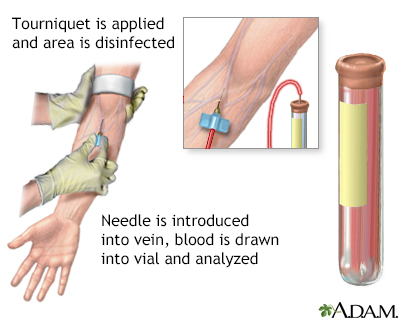
Blood test
Schedule an Appointment
Definition
Lactic acid is mainly produced in muscle cells and red blood cells. It forms when the body breaks down carbohydrates to use for energy when oxygen levels are low. Times when your body's oxygen level might drop include:
- During intense exercise
- When you have an infection or disease that reduces oxygen delivery to your body tissues
A test can be done to measure the amount of lactic acid in the blood.
How the Test is Performed
A blood sample is needed. Most of the time blood is drawn from a vein located on the inside of the elbow or the back of the hand.
How to Prepare for the Test
DO NOT exercise for several hours before the test. Exercise can cause a temporary increase in lactic acid levels.
How the Test will Feel
You may feel slight pain or a sting when the needle is inserted. You may also feel some throbbing at the site after the blood is drawn.
Why the Test is Performed
This test is most often done to diagnose lactic acidosis.
Normal Results
Normal results range from 4.5 to 19.8 milligrams per deciliter (mg/dL) (0.5 to 2.2 millimoles per liter [mmol/L]).
Normal value ranges may vary slightly among different laboratories. Talk to your health care provider about the meaning of your specific test results.
The examples above show the common measurements for results for these tests. Some laboratories use different measurements or may test different specimens.
What Abnormal Results Mean
Abnormal results mean that body tissues are not getting enough oxygen.
Conditions that can increase lactic acid levels include:
- Diabetic ketoacidosis
- Heart failure
- Liver disease
- Lung disease
- Medicines such as beta adrenergic agonists (albuterol, salmeterol), certain HIV medicines, metformin
- Not enough blood containing oxygen getting to a certain area of the body
- Severe infection that affects the entire body (sepsis)
- Very low levels of oxygen in the blood (hypoxia)
Considerations
Clenching the fist or having the elastic band in place for a long time while having blood drawn can increase the lactic acid level even if there is no underlying medical condition. This may be misleading to your provider.
References
Neligan PJ. How should acid-base disorders be diagnosed? In: Deutschman CS, Neligan PJ, eds. Evidence-Based Practice of Critical Care. 3rd ed. Philadelphia, PA: Elsevier; 2020:chap 59.
Seifter JL. Acid-base disorders. In: Goldman L, Cooney KA, eds. Goldman-Cecil Medicine. 27th ed. Philadelphia, PA: Elsevier; 2024:chap 104.

Review Date: 5/19/2025
Reviewed By: Jacob Berman, MD, MPH, Clinical Assistant Professor of Medicine, Division of General Internal Medicine, University of Washington School of Medicine, Seattle, WA. Also reviewed by David C. Dugdale, MD, Medical Director, Brenda Conaway, Editorial Director, and the A.D.A.M. Editorial team.
The information provided herein should not be used during any medical emergency or for the diagnosis or treatment of any medical condition. A licensed medical professional should be consulted for diagnosis and treatment of any and all medical conditions. Links to other sites are provided for information only -- they do not constitute endorsements of those other sites. No warranty of any kind, either expressed or implied, is made as to the accuracy, reliability, timeliness, or correctness of any translations made by a third-party service of the information provided herein into any other language.
© 1997-
A.D.A.M., a business unit of Ebix, Inc. Any duplication or distribution of the information contained herein is strictly prohibited.
All content on this site including text, images, graphics, audio, video, data, metadata, and compilations is protected by copyright and other intellectual property laws. You may view the content for personal, noncommercial use. Any other use requires prior written consent from Ebix. You may not copy, reproduce, distribute, transmit, display, publish, reverse-engineer, adapt, modify, store beyond ordinary browser caching, index, mine, scrape, or create derivative works from this content. You may not use automated tools to access or extract content, including to create embeddings, vectors, datasets, or indexes for retrieval systems. Use of any content for training, fine-tuning, calibrating, testing, evaluating, or improving AI systems of any kind is prohibited without express written consent. This includes large language models, machine learning models, neural networks, generative systems, retrieval-augmented systems, and any software that ingests content to produce outputs. Any unauthorized use of the content including AI-related use is a violation of our rights and may result in legal action, damages, and statutory penalties to the fullest extent permitted by law. Ebix reserves the right to enforce its rights through legal, technological, and contractual measures.
 All rights reserved